
How to Fix Schengen Visa Rejection & Reapply Successfully
Do you want to learn how to fix Schengen visa rejection? If your Schengen visa was refused, the first reaction is usually confusion. You may replay the application in your head, wondering what exactly went wrong. Many applicants from India, the Philippines, Nigeria, and other non-EU countries feel the same way, especially when the refusal letter looks short and impersonal.
A Schengen visa rejection is not a judgment about you as a traveler. It is simply the embassy saying that, based on the documents submitted, they were not fully convinced at that moment. As I explained on our last post :” Top 20 Reasons why Schengen Visas Get Rejected”,Visa officers work with limited time and strict rules. When something does not add up clearly, refusal is often the safest decision for them.
What matters now is not the rejection itself, but how you respond to it. Some people rush to reapply with the same documents and get refused again. Others take time to understand the problem, fix it properly, and succeed on the next attempt.
This guide is written for the second group. It will help you slow down, understand what the refusal actually means, and learn how to correct your application before reapplying. A well-prepared reapplication can change the outcome completely.
Read the Refusal Letter Properly (Most People Don’t)
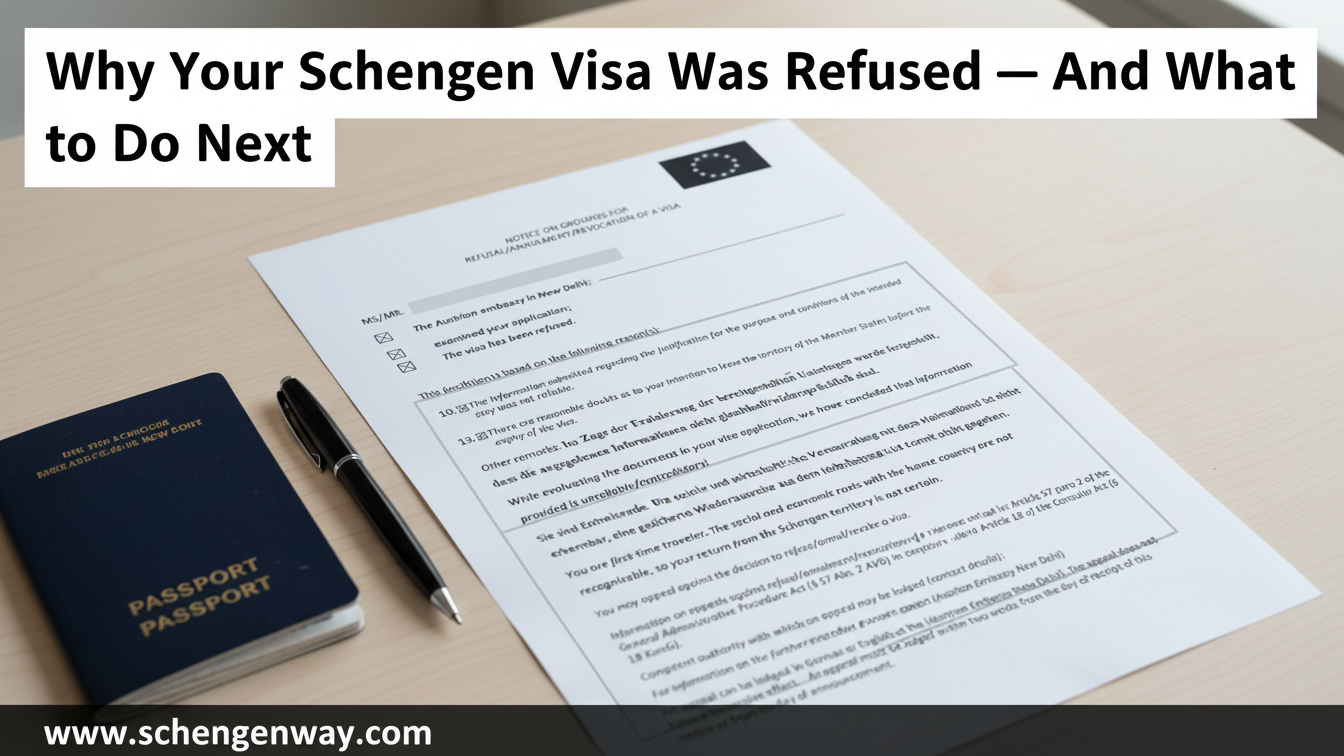
After a Schengen visa rejection, the refusal letter is often the most misunderstood document. Many applicants read it once, feel discouraged, and move on without really understanding what it says. This is a mistake. The refusal letter is not just a formality. It is your starting point for fixing the problem.
Schengen embassies use a standard refusal format. Instead of long explanations, they tick one or more boxes that match common refusal reasons. These reasons may look vague, but they are not random. Each line points to a specific concern in your application. When an embassy writes that your “intention to leave the territory of the Member States could not be ascertained,” they are saying they were not convinced you would return home.
It is also important to know that more than one reason can apply. Some applicants focus on just one line and ignore the others. This often leads to another rejection because the full picture was never addressed. Every checked reason must be taken seriously.
Do not try to guess what the embassy “really meant” or rely on advice from people who did not see your documents. Instead, read the refusal letter carefully and compare each point with what you submitted. This step alone helps many applicants realize where their application was weak.
Understanding the refusal letter clearly gives you direction. Without this clarity, any reapplication becomes a gamble rather than a planned correction.
Identify the Exact Reason(s) for Your Schengen Visa Rejection
Once you understand what the refusal letter says, the next step is to connect it to your own documents. This is where many applicants go wrong. They accept the reason in general terms but do not trace it back to a specific weakness in their application.
For example, if the refusal mentions “insufficient proof of funds”, ask yourself what the visa officer actually saw. Was your bank balance low for the length of the trip? Were there sudden deposits without explanation? Did your income documents match your bank statements? The issue is rarely just “not enough money.” It is usually about how believable the financial story looked.
If the reason is about “intention to leave the Schengen area”, look at your ties to your home country. Did you submit a strong employment letter? Did you explain your job, business, or studies clearly? For applicants from Nigeria, India, and the Philippines, this point is closely examined because embassies want clear proof that you have reasons to return.
Sometimes, the problem is not one big mistake but several small ones. A weak cover letter, unclear travel dates, and poor accommodation details together can create doubt. When this happens, fixing only one issue will not be enough.
Take time to list each refusal reason and write down what you submitted for it. This process helps you see the gaps clearly. Once you know exactly what raised concern, you can focus on correcting those areas instead of changing things at random.
Can You Reapply Immediately After a Schengen Visa Rejection?
One of the first questions people ask after a Schengen visa rejection is whether they can apply again right away. Technically, there is no official waiting period. You are allowed to reapply as soon as you want. However, being allowed to reapply and being ready to reapply are two very different things.
Reapplying immediately without fixing the reasons for refusal often leads to the same result. Visa officers can see your previous application and refusal. If your new application looks similar to the old one, they will likely reach the same decision. This is why many second refusals happen within a short time.
There are situations where a quick reapplication makes sense. For example, if your refusal was due to a missing document or a clear technical error, and you can correct it properly, reapplying sooner may be reasonable. But if the refusal was based on weak finances, unclear travel purpose, or doubts about return, time is usually your ally.
Waiting allows you to improve your documents in a real way. It gives you time to build a stronger bank statement history, clarify your employment situation, or adjust your travel plan. For many applicants from Asia and Africa, a brief pause before reapplying can lead to a significantly stronger case.
The key is honesty with yourself. Do not reapply just because you are eager to travel. Reapply because your application is genuinely better than the last one.
How to Fix the Reasons for Your Schengen Visa Rejection
Before you even think about submitting a new application, you must clearly understand why your visa was refused. Every Schengen refusal is accompanied by a refusal letter that has specific boxes ticked. These are not random. Each tick points to a concern the visa officer had about your application.
Start by reading the refusal letter slowly and carefully. Do not assume you already know the reason. Many applicants misunderstand vague points like “purpose of travel not justified” or “insufficient means of subsistence.” These phrases have specific meanings in visa processing. Your job is to translate them into practical fixes.
If your rejection was due to financial reasons, do not rush to deposit a large sum of money and reapply. Sudden deposits raise more questions. Instead, show steady income, clear salary records, and consistent bank activity over time. If someone is sponsoring you, make sure the sponsorship documents are complete and believable.
If the issue was travel purpose, your documents likely did not tell a clear story. Your flight plans, hotel bookings, cover letter, and itinerary must all support the same reason for travel. If one says tourism and another looks like job hunting or long stays, it creates doubt. Fix this by simplifying your travel plan and making it realistic.
For ties to the home country, this is where many applicants from non-EU countries struggle. You must clearly show what brings you back home. Employment letters, business ownership, school enrollment, family responsibilities, and property documents all help—but only if they are genuine and easy to understand. Do not overload your file with irrelevant papers.
If your rejection mentioned doubts about intention to leave the Schengen area, you need to show stability. This is not something you fix overnight. Stable work, ongoing studies, or long-term commitments carry more weight than emotional explanations.
The most important rule is this: never submit the same explanation twice. Every problem identified in the refusal must be addressed with a stronger document, clearer explanation, or better evidence. If nothing has changed, the outcome will not change either.
Fixing a Schengen visa rejection is not about tricks. It is about presenting your real situation clearly, honestly, and in a way that answers the visa officer’s concerns directly.
Writing a Strong Cover Letter for Reapplication
When you reapply after a Schengen visa rejection, your cover letter becomes one of the most important documents in your file. This is your chance to speak directly to the visa officer and explain what has changed since your last application. A weak or emotional letter can harm your case. A clear, factual one can make a real difference.
Start your cover letter by acknowledging the previous refusal. Do not pretend it did not happen. Briefly mention the date of the refusal and state that you have reviewed the reasons carefully. This shows awareness and responsibility, not desperation.
Next, address each refusal reason one by one. Keep it simple. If the issue was finances, explain how your financial situation has improved and point to the exact documents that support this. If it was unclear travel purpose, explain your revised itinerary and why it now makes sense. Do not write long stories. Stick to facts that the officer can verify.
Avoid defensive language. Do not argue with the embassy or blame anyone. Phrases like “I was unfairly rejected” or “the officer misunderstood me” create a negative impression. Instead, focus on what you have corrected and how your new application answers the earlier concerns.
Your tone should be calm and professional. This is not a personal appeal. It is an explanation. Visa officers read hundreds of letters. Clear structure and direct language matter more than emotion.
End the letter by confirming your intention to respect the visa rules and return to your home country before the visa expires. Do not promise things you cannot prove. Let your documents support your words.
A good reapplication cover letter does not try to convince. It explains. It guides the officer through your improved application and makes their decision easier.
Correcting Your Documents Before Reapplying
As I said, many Schengen visa rejections happen not because the applicant is unqualified, but because the documents submitted were unclear, inconsistent, or poorly prepared. Before you reapply, every document must be reviewed with fresh eyes. Assume the visa officer knows nothing about you beyond what is on paper.
Start with your application form. Small mistakes matter. Inconsistent dates, unclear travel plans, or missing information raise doubts. Make sure your new form matches your itinerary, cover letter, and supporting documents exactly. One mismatch can weaken the entire file.
Next, review your financial documents. Bank statements should be recent, clean, and easy to understand. Avoid unexplained large deposits. If your income comes from employment, business, or freelance work, provide documents that clearly show how you earn and receive money. For sponsored trips, ensure the sponsor’s documents are complete and realistic.
Your employment or study documents must be current. Old letters, unsigned documents, or vague job descriptions do more harm than good. Employment letters should state your role, salary, length of employment, and approved leave dates. Students should show proof of enrollment and academic commitment.
Check your travel documents carefully. Flight reservations, accommodation bookings, and travel insurance must all align. Your itinerary should be realistic, not rushed or overly ambitious. Too many cities in a short time can raise suspicion.
If you are self-employed or running a business, your documents must explain this clearly. Business registration, tax records, and proof of ongoing activity help show stability. Random invoices or unclear statements often confuse rather than support your case.
Finally, remove unnecessary documents. More papers do not mean a stronger application. Visa officers prefer clear, relevant files. Every document should serve a purpose and support your story.
Correcting your documents is not about adding more. It is about making everything consistent, believable, and easy to verify.
Choosing the Right Embassy or Consulate for Reapplication
After a Schengen visa rejection, many applicants wonder if changing the embassy will improve their chances. While applying through a different Schengen country is allowed in some cases, it must follow the official rules. Choosing the wrong embassy can lead to another refusal or even a rejected application at the submission stage.
You must apply to the embassy of the country that is your main destination. This means the country where you will spend the most time. If your stay is evenly split, then you apply through the country of first entry. This rule applies even when reapplying. Ignoring it is a common mistake.
Switching embassies only makes sense if your travel plan has genuinely changed. For example, if your previous application focused on France but your new itinerary clearly centers on Italy, then applying through Italy may be acceptable. However, changing embassies without a clear reason looks like embassy shopping, and visa officers notice this.
Applicants from India, the Philippines, and Nigeria should also consider processing history. Some embassies are stricter about documentation and consistency. This does not mean you should avoid them, but you must be more careful with your paperwork if you apply there.
If your refusal was based on weak documents rather than embassy-specific issues, changing embassies alone will not fix the problem. The Schengen system is shared, and your previous refusal is visible across consulates.
Before reapplying, review your itinerary honestly. Ask yourself where you will actually spend the most time. Build your application around that country and support it with solid documents.
The right embassy is not the one with the shortest queue. It is the one that correctly matches your travel plan.
What Not to Do After a Schengen Visa Rejection
After a visa refusal, it’s easy to feel frustrated and impatient. Many applicants make mistakes that hurt their next chance without realizing it. The most common errors are avoidable with careful planning.
Never submit fake documents or exaggerated information. This is the fastest way to get another refusal, and it may affect future applications permanently. Visa officers are trained to spot inconsistencies and forged papers.
Do not change your story. If your cover letter or itinerary conflicts with what you submitted previously, it raises red flags. Stick to facts, even if you need to explain changes clearly. Contradictions look suspicious.
Avoid rushing the reapplication. Submitting the same documents immediately after a rejection rarely works. Take the time to correct issues properly, especially financial or employment documents. Patience improves your chances.
Also, avoid relying solely on agents who promise faster approval. Agents can assist with preparation, but they cannot change the embassy’s requirements or guarantee approval. Your focus should be on strengthening your application, not shortcuts.
Finally, do not ignore the refusal letter. Many applicants treat it as irrelevant and repeat the same mistakes. Every point in the refusal letter must be addressed before reapplying.
When Appealing a Schengen Visa Rejection Makes Sense (And When It Doesn’t)
Some applicants consider appealing a refusal instead of reapplying. While appealing is an option, it is not always the best choice. Appeals can take months and rarely overturn the original decision unless there is a clear error or missing documentation.
Appeal if you have concrete evidence that the embassy made a procedural mistake, such as overlooked documents or misapplied rules. Do not appeal just because you are disappointed. Many applicants find that correcting the application and reapplying is faster and more effective.
Reapplying is usually better if the refusal reasons are about finances, unclear travel purpose, or weak ties to home country. These are subjective judgments, and appeals do not often change them. Focus on improving your application instead.
Realistic Timeline for Reapplying Successfully
Timing matters. Before submitting a new application, give yourself time to strengthen your documents and correct previous issues. For most applicants, a preparation period of 2–6 weeks is sufficient, depending on the complexity of your case.
Consider seasonal factors. High travel seasons like summer or winter holidays can increase processing times and reduce appointment availability. Planning ahead helps you avoid unnecessary delays.
Final Advice for Reapplying After Schengen Visa Rejection
A rejection is a setback, not the end. Many travelers are approved on the second attempt when they take the right steps.
Focus on clarity, honesty, and completeness. Address each refusal reason with proper documentation, a clear cover letter, and a realistic travel plan. Make it easy for the visa officer to understand your intentions and verify your documents.
Remember, the process is about presenting your true situation in the clearest way possible. When done correctly, reapplication is straightforward, and your chances improve significantly.