
How to Convert a Schengen Visa to a Work Permit (Real Facts)
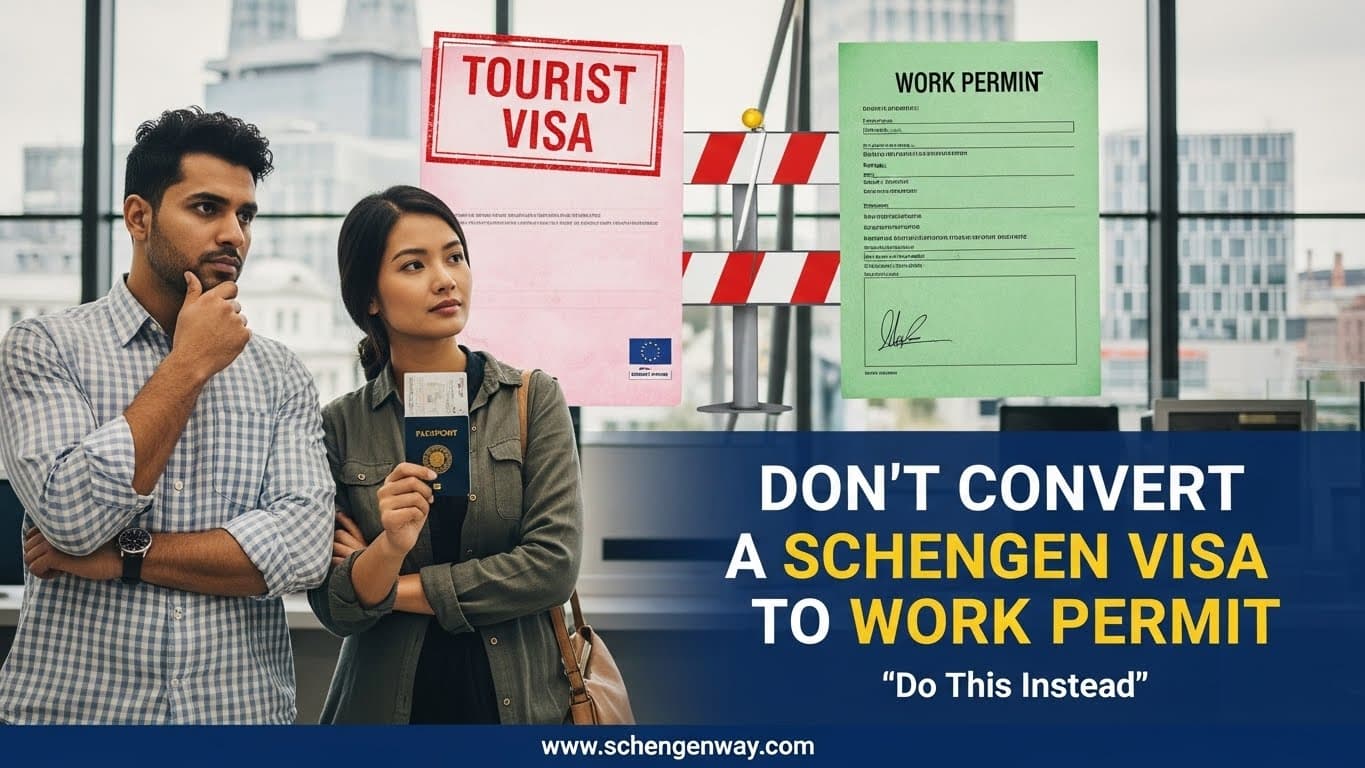
Many people who travel to Europe on a Schengen visa later ask the same question:“Can I convert my Schengen visa to a work permit?”
This question is very common among visitors from Africa, Asia, and other non-EU regions. Some people ask it after finding a job opportunity. Others ask after overstaying or realizing they want to remain in Europe legally.
Unfortunately, the internet is full of confusing advice, half-truths, and outright lies about this topic. Some websites claim it is easy. Others say it is impossible in all cases. The truth is more balanced — and more strict.
This article explains what is legally possible, what is not, and what you should realistically do instead if your goal is to work and live in Europe.
Trust me, this is not a hype. I am not going to give you false hope. Just real facts.
But before we, you can also check out the Best Schengen Countries for Work Opportunities (2026 Guide).
Can I Convert a Schengen Visa to a Work Permit?
The short answer is: In most cases, NO
A Schengen visa is a short-stay visa, usually issued for tourism, visiting family, business meetings, or short events. It allows you to stay in the Schengen Area for up to 90 days within a 180-day period.
A work permit, on the other hand, is a long-stay residence authorization issued for employment purposes.
Because of this difference, Schengen visas are not designed to be converted into work permits.
For most non-EU nationals, European immigration law requires that:
- You apply for a work visa from outside the country
- The application is submitted in your home country or country of legal residence
- Approval is given before you enter Europe for work.
Why conversion is usually not allowed
European countries restrict visa switching for three main reasons:
To prevent misuse of tourist visas
Tourist visas are easier to obtain than work visas. Allowing easy conversion would encourage abuse.
To protect the local labor market
You cannot convert a Schengen visa to a work visa because governments want to control who works, in which sectors, and under what conditions.
To enforce proper background checks
As you know, work visas require deeper checks, including qualifications, employer approval, and labor market tests.
Because of this, most embassies and immigration offices will reject any request to convert a Schengen visa into a work permit from inside the country.
Are There Any Exceptions at All?
Yes — but they are limited, country-specific, and rare.
1. Some countries allow status change only in special cases
A few countries (such as Germany, France, Spain, Portugal, and Italy) allow very limited in-country status changes only if all conditions are met, such as:
- You entered legally
- You did not violate visa rules
- You received a highly skilled job offer
- The law of that country explicitly allows in-country change
Even then:
- Approval is not guaranteed
- Many applications are rejected
- Processing can take months
- You may still be asked to leave and apply from abroad
This is not a standard pathway and should never be relied on.
2. Students and researchers are treated differently
People who entered Europe on student visas, research visas, or national long-stay visas may have legal pathways to change status.
But this does not apply to Schengen tourist visas.
What Happens If I Try to Work on a Schengen Visa?
Working on a Schengen visa is illegal. If caught, the consequences may include:
- Immediate visa cancellation
- Fines
- Deportation
- Entry bans (1–5 years or more)
- Permanent record in the Schengen Information System (SIS)
Even if an employer offers you a job, they cannot legally employ you without the correct permit.
What Should I Do Instead?
If your real goal is to work in Europe, there are legal and realistic alternatives. These paths may take time, but they protect your future.
1. Return Home and Apply for a Work Visa Properly
I know this isn’t the answer many people want to hear. But it is the strongest and safest option.
Here’s how it usually works:
- You find a job offer
- The employer applies for approval
- You submit your work visa application from your home country
- You enter Europe legally to work
This process protects you. It protects the employer. And it keeps your immigration record clean.
2. Use a Job-Seeker Visa (Where Available)
Some countries offer visas that allow you to enter legally to look for work.
Germany, Austria, and Portugal are examples.
These are not tourist visas. They are designed for employment.
If you qualify, this path is much safer than trying to “convert” a Schengen visa.
3. Apply for a Student Pathway That Leads to Work
For many non-EU nationals, studying is a more realistic long-term route.
Benefits:
- Legal residence
- Part-time work rights
- Post-study work permits in many countries
- Easier transition to full employment
Countries like Germany, France, and Spain allow students to convert student residence permits into work permits after graduation.
4. Look Into Seasonal or Temporary Work Visas
Some European countries issue seasonal work permits, especially for:
- Agriculture
- Hospitality
- Tourism
- Care work
These visas are usually applied for from outside Europe and are time-limited, but they are legal and safer than overstaying.
5. Avoid “Visa Fixers” and False Promises
This is a point I always take time to explain carefully, because many people get into serious trouble here.
You will meet people—sometimes online, sometimes through friends—who confidently say things like “we can convert your tourist visa,” or “just stay, we will fix your papers,” or even “overstay first and apply later.” They often sound convincing because they speak with certainty, and they usually claim to have helped others before.
But in reality, these promises rarely end well.
In most cases, what happens is simple. You lose money. The person disappears or keeps asking for more fees. Meanwhile, your visa expires, your stay becomes illegal, and your name enters immigration systems that follow you for years. Some people end up with entry bans. Others find that future visa applications are rejected, even for countries outside Europe.
If converting a Schengen visa into a work permit were truly easy, embassies would not be rejecting thousands of applications every year. Immigration rules would be written differently. The fact that these rejections keep happening is proof that there is no hidden shortcut.
When it comes to visas, anyone promising an easy fix is usually not offering a solution—they are offering a problem.
The Honest Reality Most People Don’t Tell You
There are a few truths about Schengen visas that many people avoid saying out loud, especially when emotions and expectations are high.
The first is that a Schengen visa was never meant to be a backdoor into employment or long-term residence. Like I mentioned earlier, it is issued for short visits, and immigration officers treat it exactly that way. Expecting it to turn into a work permit later often leads to disappointment.
Another important point is that conversion is not something you are entitled to. Even if you find a job, even if an employer likes you, the final decision still rests with immigration authorities. They are not required to approve a status change simply because circumstances have changed.
It is also important to understand that immigration laws in Europe are becoming stricter, not more relaxed. Systems are more connected, checks are stronger, and overstays or violations are easier to detect than they were in the past.
Because of this, a single wrong decision—working illegally, overstaying, or trusting the wrong advice—can affect your ability to travel not just this year, but for many years to come.
Europe does offer real opportunities for work and settlement. But those opportunities are only available to people who follow the legal pathways designed for them. Knowing this early helps you make choices that protect your future rather than damage it.
Conclusion
That’s it for the question: “How to Convert a Schengen Visa to a Work Permit”. But, if you are holding a Schengen visa and thinking about working in Europe, the most important thing is this:
Do not risk your future by breaking visa rules.
In most cases, you cannot convert a Schengen visa into a work permit. The few exceptions are narrow, unpredictable, and country-specific.
What works better is planning ahead:
- Choose the right visa type
- Apply from the correct country
- Follow the legal process
It may take longer, but it protects your chances — not just for Europe, but for international travel in general.
If you want more country-specific guides, legal pathways, and updated visa rules for non-EU citizens, focus on official immigration sources and structured guides — not shortcuts.
Check out the Schengen Visa Requirements for All Applicants (Master Checklist)
Real facts always beat false hope.