Liechtenstein Schengen Visa 2026 — Requirements, Fees, and How to Apply (Complete Guide)
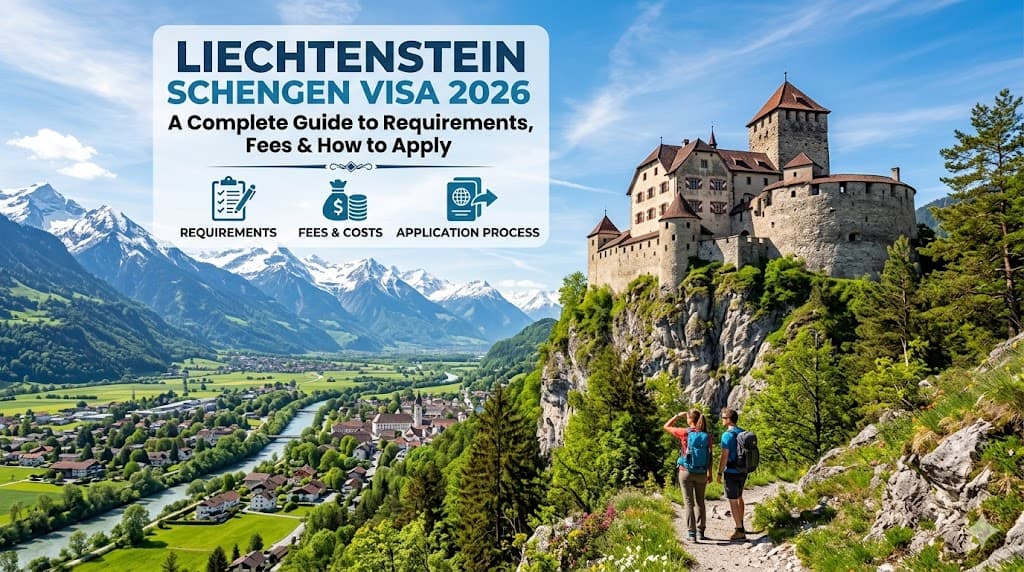
Most people cannot find Liechtenstein on a map without help. It sits tucked between Switzerland and Austria — 160 square kilometers of Alpine mountains, medieval castles, and rolling countryside that somehow managed to become one of the wealthiest nations on earth per capita. The entire country is roughly the size of Washington D.C. You could drive its longest road in under an hour. And yet it is a fully sovereign nation, a member of the Schengen Area, and one of the most quietly spectacular places in all of Europe.
If you have never heard of it, you are not alone. If you have heard of it and assumed it was too obscure, too small, or too complicated to visit — this guide is going to change that assumption.
The Liechtenstein Schengen visa situation is one of the most interesting in all of European travel because of one specific fact that most guides bury in the middle of a long article. Liechtenstein does not issue its own visas. Because Liechtenstein does not issue visas, it is not possible to get a Schengen visa for Liechtenstein directly. If you are eligible for a Schengen visa and wish to visit Liechtenstein, you should apply through Switzerland, which handles Liechtenstein’s consular affairs and has the same visa code.
That single fact changes everything about how you approach this application. And it is the first of several things that make Liechtenstein genuinely different from every other Schengen destination.
This guide covers everything — who needs a Liechtenstein Schengen visa, the Swiss embassy connection explained in plain terms, what documents you need, what fees you will pay, how long processing takes, and specific guidance for applicants from Nigeria, India, the UAE, and other major source countries.
Is Liechtenstein in the Schengen Area?
Yes — and it’s also one of the last country to join. Liechtenstein signed the Schengen Agreement in 2008 and officially joined the Schengen Area in 2011, making it the third most recent Schengen member state, after Bulgaria and Romania.
This matters for several reasons. First, it means that anyone who needs a Schengen visa to travel in Europe needs one to visit Liechtenstein — the same standard rules apply. Second, it means that anyone who already holds a valid Schengen visa issued by any other Schengen country — France, Germany, Italy, Spain, the Netherlands — can enter Liechtenstein on that existing visa without any additional application. Because Liechtenstein is a Schengen member, anyone with a valid Schengen visa is eligible to enter the country.
Third — and this is the part that surprises most people — travelers do not pass through formal border controls when entering Liechtenstein from Switzerland or Austria, as Liechtenstein maintains an open border with these countries. However, immigration checks can be conducted anywhere within the territory, and travelers must be in possession of valid travel documents and meet all entry requirements at all times.
There are no passport control booths when you cross from Switzerland into Liechtenstein by road or bus. You simply enter. But that does not mean the entry requirements do not apply — you must have the correct documentation at all times because checks can happen anywhere inside the country.
Liechtenstein is one of four Schengen states that is not also a member of the EU — the others being Iceland, Norway, and Switzerland. It is also not in the eurozone — the Swiss Franc is the official currency of Liechtenstein. If you are traveling from other Schengen countries that use the euro, you will need Swiss francs for transactions inside Liechtenstein.
One more practical note worth knowing before we get into the visa specifics: Liechtenstein does not have a national airport, meaning that you cannot fly directly into Liechtenstein. You must use an airport in Switzerland or Austria. Zurich Airport in Switzerland is the most common entry point, from which Liechtenstein is approximately 75 minutes by car or train and bus. This means your visa application needs to account for Switzerland as your actual point of entry into the Schengen zone, which is consistent with the fact that Switzerland handles your application in the first place.
Do I Need a Schengen Visa to Visit Liechtenstein?
This depends entirely on your passport nationality — and it follows the exact same rules as every other Schengen country.
Citizens do not need a visa to enter countries of the Schengen Agreement, including Liechtenstein, as tourists or business travelers if their stay is no longer than 90 days within six months. Visa-free nationalities include the United States, United Kingdom, Canada, Australia, New Zealand, Japan, South Korea, UAE, Brazil, and approximately 60 others. These travelers need only a valid passport for short stays — though from late 2026, they will also need ETIAS pre-authorization, which we will cover in its own section.
Nationals of countries that require a Schengen visa — which includes India, Nigeria, Pakistan, Bangladesh, China, and most of Africa, South Asia, and Southeast Asia — need a formal Schengen visa before travel. This applies regardless of where you currently live. An Indian national living in Dubai still needs a Schengen visa to visit Liechtenstein. A Nigerian based in the UK still needs a Schengen visa. Your passport nationality determines your requirement, not your country of residence.
One important clarification for travelers who already have a valid Schengen visa from another country: you do not need to apply for anything additional to visit Liechtenstein. Anyone with a valid Schengen visa is eligible to enter Liechtenstein. If you are visiting Germany on a German Schengen visa and want to take a day trip to Liechtenstein, your existing visa covers the visit without any additional paperwork.
For travelers who are planning Liechtenstein as their primary or only Schengen destination and need a visa — the application process is what makes Liechtenstein uniquely different from every other country in this guide.
Why Does Liechtenstein Not Issue Its Own Visas — and What Does That Mean for You?
This is the question that confuses most applicants searching for a Liechtenstein Schengen visa, and it deserves a clear, honest explanation.
Liechtenstein is a country of approximately 38,000 people. It is the fourth smallest country in Europe by population. Maintaining a global network of embassies and consulates in dozens of countries around the world — the way Germany, France, or Spain does — would be logistically and financially impractical for a sovereign nation of that size.
The solution is a long-standing diplomatic arrangement with Switzerland. Liechtenstein’s visa policy is identical to Switzerland’s, as Switzerland handles Liechtenstein’s visa issuance and border control. Therefore, a Schengen visa issued by Switzerland is valid for entry into Liechtenstein.
What this means practically is that when you apply for a Liechtenstein Schengen visa, you are not going to a Liechtenstein embassy. You are going to a Swiss embassy or consulate, or to a VFS Global center operating on Switzerland’s behalf in your country. For example, in India, the Swiss embassy deals with applications for Liechtenstein visas, or you can apply through VFS Global.
The visa sticker you receive in your passport will be a Swiss Schengen visa — not a Liechtenstein-specific document. That Swiss Schengen visa covers your entire Schengen trip including Liechtenstein, the same as any other Schengen visa would.
For Nigerian applicants, this means applying through the Swiss embassy or its authorized VFS Global representative in Nigeria. For Indian applicants, it means VFS Global India processing on behalf of Switzerland. For UAE residents, the Swiss consulate or VFS Global Dubai handles the submission.
This arrangement simplifies things in one important way — Switzerland is well-represented globally, with consulates and VFS processing partnerships in far more countries than Liechtenstein could maintain on its own. Finding a Swiss visa application center is significantly easier than finding a dedicated Liechtenstein mission would be.
What Documents Do You Need for a Liechtenstein Schengen Visa?
Since your Liechtenstein Schengen visa application goes through the Swiss embassy or its authorized VFS Global partner, the document requirements follow Switzerland’s Schengen visa checklist — which aligns with the standard Schengen framework with a few Switzerland-specific details worth knowing.
Getting this right before your appointment is everything. A missing document does not earn you an extension or a second chance at the same slot. It earns you a delay, an additional document request, or in some cases an outright refusal. Prepare everything before you book your appointment — not after.
Core documents every applicant needs
Before traveling, visitors should ensure their passport is valid for at least three months beyond their intended date of departure from the Schengen Area and has been issued within the last ten years. Beyond passport validity, every application needs:
- Valid passport with at least two blank pages for visa stickers and stamps, issued within the last 10 years, valid for at least three months beyond your planned departure from the Schengen zone
- Completed and signed Schengen visa application form — completed in capital letters, printed, and signed by hand before your appointment. Do not leave any section blank
- Two recent passport-size photographs — 35mm x 45mm, white or light background, taken within the last six months, full face visible, no glasses
- Travel and medical insurance covering you up to costs of €30,000, a cover letter stating your itinerary and the purpose of your visit, a flight itinerary and proof of accommodation, proof of your civil status like a marriage certificate, and proof you have means of subsistence during your stay
- Return or onward flight reservation showing your entry into and exit from the Schengen zone — note that since you cannot fly directly into Liechtenstein, your flight reservation will show arrival at Zurich, Basel, or another Swiss airport
- Confirmed accommodation for every night of your stay — hotel bookings, Airbnb confirmations, or a formal invitation letter from a host
For employed applicants
If employed, you need an employment contract, a current bank statement, a no objection letter from your employer giving you leave to travel, and an income tax return.
Beyond these, include:
- Recent payslips covering the last three to six months
- Bank statements for the last three to six months showing consistent salary credits that match your employment letter
- Leave approval letter confirming your employer has granted time off for the travel period
For self-employed applicants
If self-employed, you will need a copy of your business license, company bank statements, and income tax returns.
Nigerian self-employed applicants should include their CAC registration certificate alongside business bank statements. Indian self-employed applicants should include GST registration documents and ITR filings. The principle is the same everywhere — document your business existence, your income source, and your financial stability through verifiable official records.
For students
Student visas require proof of enrolment at a Liechtenstein institution, a no objection letter from your place of study in your homeland, and an invitation letter.
For tourists visiting Liechtenstein rather than studying there, the student documentation is simpler — enrollment confirmation from your home institution, a letter confirming you have leave to travel, and proof of financial support from a parent or guardian if you are not self-funding.
One document requirement worth flagging specifically
An invitation letter is required regardless of whether you are applying for a work visa or a short-stay Schengen visa. This is a Switzerland and Liechtenstein-specific requirement that differs slightly from some other Schengen applications where an invitation letter is only needed for family or hosted visits. If you are applying for a tourist visa and not staying with anyone, your cover letter effectively serves as your self-written explanation of your visit purpose — make sure it is detailed, specific, and honest.
Cover letter — what it must contain
Your cover letter is the one document in your entire application written entirely in your own words. It should explain clearly why you are visiting Liechtenstein, what you plan to do during your stay, your travel itinerary, how your trip will be funded, and why you will return home when your visa expires. For Liechtenstein specifically, also explain your planned route — through Zurich or Basel — since there is no direct flight into the country. This shows the visa officer you understand the practicalities of traveling to a landlocked country without its own airport.
How Much Does a Liechtenstein Schengen Visa Cost in 2026?
Schengen visas cost €90 for adults, €45 for children ages 6 to 12, and free for children under the age of 6.
This is the standard Schengen fee that applies uniformly across all Schengen member states following the EU-wide revision in 2024. The fee is the same whether you apply for a France visa, a Germany visa, or a Liechtenstein visa processed through the Swiss embassy. Some older sources still reference the previous fee of €80 for adults and €40 for children — those figures are outdated. The confirmed 2026 fee is €90 for adults.
Beyond the embassy fee, applicants submitting through VFS Global pay an additional service charge. This varies by country but typically sits between €15 and €30. For Indian applicants submitting through VFS Global India, the combined total including service charge is approximately ₹13,000 to ₹22,000 depending on your city and service tier. For Nigerian applicants submitting through VFS Global Nigeria, the total in naira varies with the exchange rate — check the current VFS Global Nigeria portal for the live figure before your appointment.
Two things to understand about these fees before you submit:
First, appointments can book weeks to months in advance. The fee is paid before or at your appointment — but the slot booking happens before you have assembled all your documents in most cases. Start looking for appointment slots as early as possible, particularly in cities with heavy Swiss visa demand like Lagos, New Delhi, Mumbai, and Dubai.
Second, the visa fee is non-refundable in all circumstances. Whether your application is approved, refused, or withdrawn after submission, the €90 stays with the embassy. This is standard Schengen policy and not unique to Switzerland or Liechtenstein — but it reinforces why preparing a strong, complete application before submission is not optional.
How Long Does a Liechtenstein Schengen Visa Take to Process?
Processing times for Liechtenstein visas vary but are typically around 15 business days.
Processing can take 15 calendar days or longer.
In reality, the processing timeline depends on the specific VFS Global center handling your submission, the completeness of your documents, and the time of year you apply. Straightforward applications from experienced travelers with clean travel histories and complete documentation are often decided faster than the 15-day standard. First-time Schengen applicants, incomplete files, or applications submitted during peak summer travel season can extend toward 30 to 45 days.
However, appointments can book weeks to months in advance — meaning the 15-day processing clock does not start until you actually attend your appointment. If your nearest Swiss visa appointment slot is three weeks out and processing then takes 15 working days, your total wait from today to passport return could be six weeks or more.
The practical recommendation is to start the process significantly earlier than most people think they need to. For a summer trip to Liechtenstein — June through August — start gathering documents and booking your appointment three to four months in advance. For shoulder season travel, six to eight weeks ahead is the comfortable minimum. For first-time Schengen applicants, add another two to three weeks to every estimate because first applications receive more detailed scrutiny.
Step-by-Step: How Do You Apply for a Liechtenstein Schengen Visa?
The steps to follow when applying for a Liechtenstein Schengen visa are: work out which visa type you need based on the purpose of your travel, collect the required documents, make a visa appointment with the embassy, consulate, or accredited visa application center in your home country, attend the visa interview at the appropriate embassy, consulate, or visa application center, and wait to see if your visa is approved.
Let me expand each step with the practical detail that makes the difference between a smooth application and a frustrating one.
Step 1 — Confirm you need a visa and identify the right application route
Check your passport nationality against the Schengen visa-free list. If you need a visa, confirm that Liechtenstein is your primary Schengen destination — meaning the country where you will spend the most days or your first point of entry if splitting time equally between countries. Then identify the Swiss embassy or VFS Global center in your country that handles Swiss Schengen visa applications — this is where your Liechtenstein application goes.
If another Schengen country will be your primary destination on the same trip — say you are spending 10 days in Germany and only two days in Liechtenstein — apply to the German embassy rather than through Switzerland. The Liechtenstein leg of your trip is covered by whichever Schengen visa you hold.
Step 2 — Gather all documents before booking your appointment
Do not book your appointment and then start gathering documents. Assemble everything first — every document on the checklist, checked and double-checked for consistency. Your bank statement dates must align with your employment letter dates. Your flight reservation dates must match what you write in your cover letter. Your insurance coverage must meet the minimum threshold. Every piece of information across every document must tell the same coherent story. Only when your document package is complete should you book your appointment slot.
Step 3 — Book your appointment through the official channel
In most countries, Swiss Schengen visa appointments are booked through VFS Global. Go to the official VFS Global website for your country, select Switzerland as the destination country, and book the earliest available slot at your nearest center. Do not use third-party booking services that charge extra fees for what is a free process on the official portal.
For full guide, check out How to Book Schengen Visa Appointments Faster in 2026
Step 4 — Attend your appointment in person
You must apply for a Schengen visa in person at a visa center or Swiss consulate or embassy. There are no exceptions to in-person attendance for biometric collection. Bring original documents alongside photocopies of each. At your appointment your fingerprints and photograph will be recorded as part of the mandatory biometric data collection for all Schengen visa applications.
Step 5 — Track your application and collect your passport
After submission, track your application status through the VFS Global tracking portal. When a decision is made you will receive notification by SMS or email. On collection, check every detail on your visa sticker immediately — validity dates, number of entries permitted, and maximum duration of stay. Report any errors before leaving the center.
What Are the Financial Requirements for a Liechtenstein Schengen Visa?
Proof of sufficient financial means is not specifically stipulated by the Liechtenstein government and is regulated on a case-by-case basis.
This is an important distinction from countries like Spain, Italy, or France which publish specific daily rate requirements. Liechtenstein — via Switzerland — assesses financial sufficiency on a case-by-case basis rather than against a fixed daily figure. What this means practically is that you should aim to show funds that are clearly sufficient to cover your entire trip including accommodation, food, local transport, activities, and an emergency buffer — without relying on a specific magic number.
As a general benchmark, Switzerland’s financial guidance for Schengen purposes typically aligns with approximately CHF 100 per day — roughly €105 at current exchange rates. For a seven-day Liechtenstein trip, that translates to approximately CHF 700 or €735 in accessible trip funds. For a 14-day stay, approximately CHF 1,400.
For Nigerian applicants, CHF 100 per day at current exchange rates converts to approximately ₦180,000 to ₦200,000 per day — making Liechtenstein one of the higher financial bars among Schengen destinations in naira terms. This is not because Liechtenstein sets an exceptionally high standard but because the Swiss franc is strong relative to the naira. The honest advice is to show as healthy and consistent a bank balance as your genuine financial situation allows, supported by three to six months of properly stamped statements.
For Indian applicants, CHF 100 per day converts to approximately ₹9,200 per day — more accessible than the naira equivalent but still worth planning for well in advance.
The case-by-case assessment also means that your overall financial profile matters more than hitting a specific daily figure. A consistent salary, a growing savings history, a clean statement with no suspicious large deposits, and a financial picture that clearly matches your stated employment — these qualities tell a better story than an account that hit a specific balance threshold right before submission.
We have covered the complete strategy for preparing your bank statement for Schengen visa applications in our detailed guide on Schengen Visa Bank Statement Requirements — worth reading before you prepare your financial documents for the Liechtenstein application.
Liechtenstein Schengen Visa for Nigerians — What You Need to Know
Nigerian passport holders need a Liechtenstein Schengen visa for any visit regardless of purpose. The application goes through the Swiss embassy or VFS Global Nigeria — not a Liechtenstein-specific mission, because as established earlier, Liechtenstein does not operate its own embassies.
Where Nigerians apply
Submit your application at VFS Global Nigeria — either the Lagos center at The Purple Lekki, 2 Purple Way, Freedom Way, Lekki Phase 1, Lagos, or the Sterling Bank Plaza, 3rd Floor, Plot 1083 Mohammadu Buhari Way, Central Business District, Abuja. Both centers handle Swiss Schengen visa applications. As covered in our detailed guide on VFS Global Lagos vs VFS Global Abuja. Abuja tends to have faster appointment availability — worth checking both before committing to a center.
Key documents for Nigerian applicants
- Valid Nigerian passport with at least two blank pages
- Six months of bank statements — officially stamped and signed by your Nigerian bank
- Employment letter with salary details and approved leave confirmation
- CAC registration certificate if self-employed
- Business bank statements for the last six months if self-employed
- Cover letter explaining your Liechtenstein travel purpose and itinerary
- Travel insurance with minimum €30,000 coverage
- Confirmed accommodation and flight reservation through Switzerland
- Proof of ties to Nigeria — employment, business, family responsibilities, property
The Swiss franc consideration for Nigerians:
Because Liechtenstein uses Swiss francs and you will likely enter through Zurich, your financial planning needs to account for Switzerland’s high cost of living even for a short transit. Even if you spend only one night in Zurich before crossing into Liechtenstein, hotel costs in Switzerland are among the highest in Europe. Factor this into both your itinerary budget and what you demonstrate in your bank statements.
Liechtenstein Schengen Visa for Indians — What You Need to Know
In India, the Swiss embassy deals with applications for Liechtenstein visas, or you can apply through VFS Global.
For Indian applicants, the Liechtenstein Schengen visa is one of the more straightforward applications in the zone — Switzerland’s VFS Global India network is extensive with centers across 14 cities, processing is efficient, and the Swiss embassy’s approach to Indian applications is generally consistent and predictable for well-prepared files.
Where Indians apply
VFS Global India handles Swiss Schengen visa applications — and therefore Liechtenstein visa applications — across Mumbai, Pune, Puducherry, Chennai, Jalandhar, Jaipur, Hyderabad, Goa, New Delhi, Kochi, Chandigarh, Ahmedabad, Kolkata, and Bengaluru. The New Delhi center relocated in January 2026 to VFS Global House, 27 Kasturba Gandhi Marg, Connaught Place.
Key documents specifically important for Indian applicants
- ITR filings for the last two to three years
- Form 16 if salaried
- GST registration if applicable for self-employed applicants
- Bank statements for the last three to six months with consistent salary credits
- No-objection letter from employer
- For students — enrollment confirmation, NOC from institution, and sponsor’s financial documents
Cost for Indian applicants
The total cost including the €90 embassy fee and VFS service charge sits at approximately ₹13,000 to ₹22,000 depending on your city and service tier. Check the current VFS Global India portal for the exact service charge applicable at your center.
Liechtenstein Schengen Visa for UAE Residents — What You Need to Know
The UAE situation requires the standard clarification — UAE nationals and UAE residents holding foreign passports face completely different requirements.
UAE nationals
UAE passport holders can enter Liechtenstein visa-free for short stays. They do not need a Schengen visa. From late 2026, they will need ETIAS pre-authorization — we covered this in the our previous post. Check it out What ETIAS is and how to get it.
UAE residents holding foreign passports
If you are an Indian, Nigerian, Pakistani, or other non-visa-exempt national residing in the UAE, your UAE residence does not exempt you from the Schengen visa requirement. You apply for your Liechtenstein Schengen visa through the Swiss consulate or VFS Global in Dubai or Abu Dhabi.
Key document specific to UAE-based applicants
Your UAE residence visa must be valid for at least three months beyond your planned return date. Include UAE-based bank statements alongside or instead of home country statements where your UAE income is your primary financial evidence. Your UAE employment letter in English or with a certified translation is accepted.
Processing from the UAE typically follows the standard 15 working day timeline for complete, straightforward applications.
Final Thought
Here is the thing about Liechtenstein that most travel guides miss entirely. The country’s smallness is not a limitation — it is the entire point.
In a continent where the most popular destinations are increasingly overwhelmed by visitors, where you queue for an hour to see a painting and fight for space on a viewpoint that was once genuinely quiet, Liechtenstein offers something that has become genuinely rare in European travel. Space. Calm. The feeling of being somewhere that has not been packaged and optimized for mass consumption.
The visa process has one unusual twist — applying through Switzerland rather than a Liechtenstein mission — but once you understand why, it is actually simpler than many Schengen applications. Switzerland is well-represented globally. The processing is efficient. The fee is the same €90 as every other Schengen country. And a successful application gives you access to all 29 Schengen countries on the same visa.
For Nigerian and Indian applicants specifically, a Liechtenstein trip applied for through the Swiss embassy builds exactly the kind of clean Schengen travel record that makes every future European application — France, Italy, Germany, Spain — significantly easier to secure.
Vaduz is waiting. It has been quietly waiting while everyone else was fighting for selfie spots in Santorini and Rome. Go before that changes.
If you have questions about your specific application situation — your documents, your financial profile, or how Liechtenstein fits into a broader European itinerary — drop them in the comment section and I will give you a straight answer.
Related Articles on SchengenWay
- Schengen Visa for Iceland 2026 — Who Needs One and How to Apply
- Latvia Schengen Visa 2026 — Requirements, Fees and How to Apply
- VFS Global Lagos vs VFS Global Abuja — Which Center Processes Applications Faster?
- Schengen Visa Bank Statement Requirements — How Much Money Is Enough?
- 10 Most Visited Schengen Countries in 2026 — Where Travelers Are Going and Why