

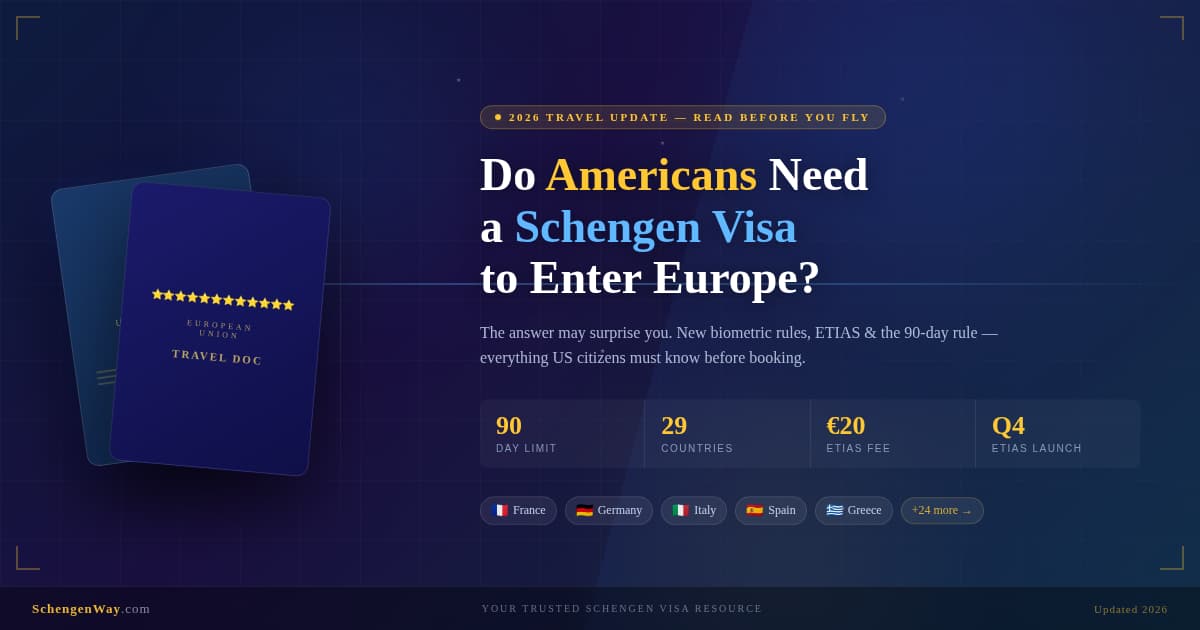
If you’re an American planning a trip to Europe this year and you’ve been hearing things about new visas, biometric systems, and travel authorizations — and you’re not entirely sure what applies to you — this guide is going to clear everything up.
The short answer is no. As of right now, Americans do not need a Schengen visa to travel to Europe for short stays. US citizens have enjoyed visa-free access to the Schengen Area for decades, and that has not changed in 2026.
But here is where things get interesting. While the visa-free arrangement remains intact, Europe has introduced two significant new systems this year that every American traveler needs to understand before they board their flight. One of them — the Entry/Exit System — is already fully operational as of April 10, 2026. The other — ETIAS, a pre-travel authorization — is expected to launch in the final quarter of 2026 and will change how Americans register before traveling to Europe going forward.
Neither of these is a Schengen visa. But both of them will affect your trip in ways that are worth understanding clearly before you travel, not after you land at Charles de Gaulle or Fiumicino and find yourself confused at the border.
This guide covers everything — what the Schengen Area actually is, what visa-free access means in practical terms, how long you can stay, what the new EES biometric system means for you at the border, what ETIAS is and when it becomes mandatory, and the specific situations where Americans actually do need a visa. If you are planning a European trip in 2026 or 2027, read this before you go.
What Is the Schengen Area and Why Does It Matter for American Travelers?
Before getting into visa rules and new systems, it helps to understand exactly what the Schengen Area is — because a lot of American travelers use “Europe” and “Schengen” interchangeably, and they are not the same thing.
The Schengen Area is a group of 29 European countries that have abolished their internal border controls and operate as a single travel zone. When you enter the Schengen Area, you pass through border control once — at your point of entry — and from that point you can move freely between all Schengen member countries without stopping at checkpoints or showing your passport again at internal borders.
The 29 countries currently in the Schengen Area are Austria, Belgium, Croatia, Czech Republic, Denmark, Estonia, Finland, France, Germany, Greece, Hungary, Iceland, Italy, Latvia, Liechtenstein, Lithuania, Luxembourg, Malta, Netherlands, Norway, Poland, Portugal, Romania, Slovakia, Slovenia, Spain, Sweden, and Switzerland. These are the countries your visa-free access applies to as an American traveler.
Two things Americans commonly get wrong here. First, the United Kingdom is not part of the Schengen Area. Since Brexit, the UK operates under completely separate entry rules. If your European itinerary includes London, Edinburgh, or anywhere in England, Scotland, Wales, or Northern Ireland, the UK entry requirements are entirely separate from anything Schengen-related. Second, Ireland is also not part of the Schengen Area, despite being an EU member. Days spent in the UK or Ireland do not count toward your Schengen allowance — a fact that experienced European travelers sometimes use strategically when planning extended trips.
So, understanding this distinction matters because the new systems being introduced in 2026 — EES and ETIAS — apply specifically to the Schengen Area, not to all of Europe. If you are traveling exclusively to the UK, neither system affects you, though the UK has its own Electronic Travel Authorization requirement that we will cover later in this guide.
Do Americans Need a Schengen Visa in 2026?
No. American citizens do not need a Schengen visa for short stays in Europe in 2026. The United States is among approximately 60 countries whose citizens enjoy visa-free access to the Schengen Area for tourism, business, and transit purposes.
As of March 2026, US passport holders can enter the Schengen Area without any visa or pre-authorization. You show your passport at the border, get processed, and you’re in.
This visa-free arrangement means you do not need to apply for anything at a consulate, pay a visa fee, submit documents, or wait for an approval before traveling to most European countries. You simply book your trip, show up with a valid US passport, and enter. That is how it has worked for decades, and that remains the case in 2026.
What is changing is what happens at the border when you arrive, and what you will need to do before you travel once ETIAS launches later this year. These are not visas — they are different systems entirely — but they represent real changes that American travelers need to be aware of and prepared for.
How Long Can Americans Stay in the Schengen Area?
This is one of the most important questions for any American planning a European trip, and it is also one of the most misunderstood rules in international travel.
US citizens can spend a maximum of 90 days within any rolling 180-day period across all Schengen countries combined. This is known as the 90/180-day rule, and it applies to the Schengen Area as a whole — not to each individual country separately.
That last point is where American travelers frequently make expensive mistakes. The 90 days is not 90 days per country. It is 90 days total across all 29 Schengen countries combined within any given 180-day window. So if you spend 30 days in France, then 30 days in Italy, then 30 days in Spain, you have used your full 90-day allowance. You cannot then cross into Germany for another 30 days and claim a fresh allowance because you switched countries.
The 180-day window is also rolling, not fixed to a calendar period. It does not reset on January 1st or on your birthday or on any fixed date. It moves continuously, meaning the relevant question at any given moment is: in the 180 days immediately before today, how many of those days did I spend inside the Schengen Area? If the answer is 90 or more, you cannot currently enter. If it is less than 90, you can enter and stay for the difference.
This calculation can get complicated quickly, especially for Americans who make multiple European trips in the same year or who split time between Schengen and non-Schengen countries. The official Schengen 90/180-Day Calculator helps travelers calculate their specific dates and understand exactly how many days they have remaining.
If European travel is a regular part of your life, bookmarking and using that calculator before every trip is genuinely useful — particularly now that the new Entry/Exit System is tracking these dates digitally rather than relying on passport stamps.
What happens if you exceed 90 days? Overstay consequences include fines ranging from €500 to €10,000 or more depending on the country, possible deportation, and bans on future Schengen travel. With the new EES system now fully operational and digitally tracking every entry and exit, overstays are significantly easier for authorities to detect than they were under the old passport-stamping system.
The Entry/Exit System — What Every American Traveler Needs to Know Right Now
This is the change that is affecting American travelers today, in April 2026, right now. The EU’s Entry/Exit System — known as EES — became fully operational on April 10, 2026, and it changes what happens at the European border every time you arrive or depart.
The EES is an automated IT system for registering non-EU nationals travelling for a short stay, each time they cross the external borders of 29 European countries. It replaces the old system of manual passport stamping with secure biometric checks.
In plain terms: the passport stamp that used to mark your entry and exit from Europe is gone. Instead, the system captures and verifies biometric information — fingerprints and facial images — ensuring the accurate identification of travellers.
Here is what this means practically for an American arriving at a European airport or land border today. On your first entry after the system launched, you will be directed to either a self-service kiosk or a staffed booth where your fingerprints and photograph will be collected and stored digitally. Standard passport holders need to use manned booths for initial registration and provide a photo and fingerprints. This data will be stored for three years, making future checks significantly faster.
On subsequent visits within that three-year period, the process is faster because your biometric profile already exists in the system — the officer or kiosk simply verifies your fingerprints and photo against the stored record rather than creating a new one from scratch.
Your fingerprints, facial image, passport details, and entry and exit dates will be collected upon entry to an EES country and stored digitally. The system also uses this data to automatically track whether travelers are respecting the 90/180-day rule — replacing the honor system that existed under manual passport stamping.
A few things worth noting specifically. Travellers who refuse to provide biometric data will automatically be refused entry. This is not optional. The EES is also free — there is no fee to go through this process. And US citizens who hold dual citizenship with any EU member state or with any non-EU Schengen Area member — Iceland, Liechtenstein, Norway, or Switzerland — do not need to use the EES.
One practical reality to prepare for: while the system is designed to make border control more efficient, travelers may encounter longer airport lines this year as the EES experiences initial hiccups. Border technology rollouts across dozens of countries simultaneously rarely go perfectly smoothly in the first weeks and months. If you are traveling to Europe in spring or summer 2026, build extra time into your connection schedules and arrival plans.
ETIAS — What Americans Need to Know Before Late 2026
While the EES is the system affecting your border experience right now, there is a second change coming later this year that Americans planning future European trips need to be aware of.
After numerous false starts, ETIAS will launch in late 2026. European Union officials have been somewhat vague on an exact date, but the latest timeline points to the last quarter of the year.
Based on what understand about ETIAS, it is the Europe’s version of the ESTA — the same system Americans have required foreign visitors to complete before entering the United States since 2009. It is a short online form completed before your trip, not a visa, not a consulate appointment, and not a lengthy document submission process.
The fee was increased from the originally proposed €7 to €20 — approximately $23. It will be valid for three years and cover all 29 participating Schengen countries in a single application. Travelers under 18 and over 70 are exempt from the fee but still need to complete the application.
One important clarification worth making here: ETIAS is not a Schengen visa like I said, and it does not change the fact that Americans travel to Europe visa-free. ETIAS does not replace a Schengen visa. It is intended for travelers who previously did not need any formal authorization for short-term visits. Americans fall into this category. Your 90-day allowance, your entry rights, and your travel freedom across Europe remain exactly the same — ETIAS simply adds a pre-screening step before you board your flight.
As of April 2026, the ETIAS application portal is not yet open. So, any website currently claiming to accept ETIAS applications is either running a scam or charging unnecessary fees. When the official portal launches, we will update this article with the direct link.
For the complete breakdown of ETIAS — how to apply step by step, what questions the form asks, what happens at the border, and how it interacts with the EES — read our full guide: ETIAS 2026 — Complete Guide for International Travelers.
The UK Electronic Travel Authorization — A Separate Requirement Americans Need Right Now
Here is something many Americans planning a combined Europe-and-UK itinerary in 2026 do not realize until it is too late: the United Kingdom is completely separate from the Schengen Area and has introduced its own pre-travel authorization system that is already mandatory — not coming in Q4 like ETIAS, but already required today.
As of February 25, 2026, anyone traveling to the UK from a visa-exempt country must have an approved Electronic Travel Authorization before they board a plane, train, or ferry. No ETA, no boarding. This applies to Americans, Canadians, Australians, and citizens of all 27 EU countries.
The UK ETA currently costs £20 and permits multiple journeys to the UK for stays of up to six months at a time over two years, or until the holder’s passport expires — whichever comes first.
The application process is straightforward. Americans apply through the official “UK ETA” smartphone app available on iOS and Android. The process requires downloading the app, scanning your American passport using your phone’s NFC chip, taking a selfie photo, filling in personal and travel details, and paying the £20 fee. Most approvals come through within minutes, though the UK government recommends applying at least three working days before travel to allow for the small number of applications that require additional checks.
You need to understand two things here. First, the UK ETA is entirely separate from ETIAS — they are different systems for different destinations, and having one does not give you the other. If your trip includes both Schengen countries and the UK, you will eventually need both authorizations. For now, you need the UK ETA immediately for any UK travel, while ETIAS is not yet operational.
Second, an ETA does not guarantee entry to the UK. I know there are other websites that charge more to apply, but you need to avoid websites that imitate government services. The only official application route is through the UK ETA app or the official UK government website at gov.uk/eta.
When DO Americans Actually Need a Schengen Visa?
We have established clearly that Americans do not need a Schengen visa for short stays. But there are specific situations where the visa-free arrangement does not apply and Americans genuinely need to go through a formal visa process — particularly for extended time in Europe for work, study, or retirement.
Staying longer than 90 days
The moment your intended stay in the Schengen Area exceeds 90 days within any 180-day period, you move beyond what your American passport covers. A D-Visa, also known as a National Visa or Long-Stay Visa, is issued by countries in the Schengen Area to foreign nationals who wish to stay for longer than 90 days.
Unlike the standard tourist entry which covers the entire Schengen Area, a Type D long-stay visa is country-specific — issued by the individual country where you intend to primarily reside, and tied to the specific purpose of your extended stay, whether that is work, study, retirement, or family reunification.
Working in Europe
If you are planning to take up employment in a Schengen country — including contracts with European employers — your tourist visa-free access does not cover you. It is illegal to plan to work with a tourist visa. You need a Type D work visa. This applies whether you are accepting a formal job offer, freelancing for European clients under contract, or working for a European company in any capacity.
The question of remote work for a non-European employer while physically in Europe is a gray area that different countries handle differently, and digital nomad visa programs are expanding rapidly across Europe as a result. But formal employment for a European employer always requires proper work authorization.
Studying for more than 90 days
For longer visits or purposes like work, study, or family reunification, Americans need to apply for a Schengen visa specific to the country they are visiting. If you have been accepted to a degree program, a language course, or any formal educational institution running longer than three months, you need a student visa from that specific country — not ETIAS and not a tourist entry.
Applying for long-stay visas
For any of these situations the process is significantly more involved than standard tourist entry. You apply through the consulate of the specific Schengen country where you intend to primarily reside, submit supporting documentation relevant to your visa type — employment contract, university acceptance letter, proof of financial means — and attend an in-person appointment. Processing times vary by country and purpose but can range from several weeks to several months. Starting early is not optional.
US Passport Requirements for Europe in 2026
One more detail that catches American travelers off guard regularly — especially those who renewed their passport years ago and have not thought about expiry since.
Your passport needs to be valid for at least six months after your arrival date in the European Schengen area. Some individual Schengen countries technically only require validity for the duration of your stay, but since border officers exercise discretion and airlines may refuse boarding if your passport falls short of the six-month threshold, treating this as your hard minimum is the safest approach.
ETIAS will also require that your passport was issued no more than ten years before the date you enter the EU and is valid for at least three months beyond your planned departure from Europe. When ETIAS launches these passport validity requirements become formally embedded in the authorization itself.
Check your passport expiry date before booking any European trip. If it expires within the next year, renew it before your travel dates — not after you have already paid for flights and accommodation.
Your Practical Checklist Before Traveling to Europe in 2026
Let me put this in the simplest possible terms. If you are an American getting ready for a European trip this year, here is exactly what you need to do — in order — before you leave.
Check your passport first, before anything else
Seriously, do this today if you have a trip coming up. Pull out your passport, look at the expiry date, and confirm it will be valid for at least six months beyond your arrival date in Europe. This is the single most common reason Americans get turned away at airport check-in — not missing documents, not visa issues, just a passport that is closer to expiry than they realized. Airlines check this before you board. If your passport fails the six-month test, renew it before you book anything else.
Confirm your 90-day allowance if you have traveled to Europe recently
If this is your first European trip in a while, you are fine. But if you have been to Europe within the last six months, you need to calculate how many Schengen days you have already used. Use the official Schengen calculator on the our website, plug in your previous travel dates, and confirm how many days you have remaining. Do this before you pay for flights, not after.
Apply for the UK ETA if your trip includes the United Kingdom
If London, Edinburgh, or anywhere in the UK is on your itinerary, you need to do this now. It takes about fifteen minutes on the UK ETA app, costs £20, and most people get approved within hours. Do not leave this until the day before your flight.
Book your flights and accommodation as normal
Beyond the passport check and the UK ETA if applicable, nothing else has changed for Americans traveling to Europe in 2026 before ETIAS launches. You do not need to apply for anything in advance to enter Schengen countries right now. You just show up with your valid US passport.
Be prepared for the EES biometric registration at the border
When you land at your first European entry point, you will go through the new Entry/Exit System process — fingerprints and a photograph collected either at a self-service kiosk or a staffed booth. It is free, it is not optional, and it will add some time to your border crossing experience, particularly this year while the system is still settling in across all Schengen entry points. Build a buffer into any tight connection times.
Monitor ETIAS announcements if you are traveling in late 2026 or planning a 2027 trip
The EU will announce the ETIAS launch date several months before it goes live. When that happens, applying is simple — our full ETIAS guide walks you through it step by step. For now, no action is needed.
Mistakes Americans Make With Schengen Rules — And How to Avoid Every One of Them
I have spoken with a surprising number of American travelers over the years who genuinely did not know they had overstayed their Schengen allowance until they were standing at a border crossing being told they could not enter. These are not careless people — they are people who did not fully understand how the 90/180 rule works in practice. Here are the mistakes that come up most often.
Treating 90 days as 90 days per country rather than 90 days total
This is the big one. An American who spends 45 days in France, flies home for a week, and then returns for 45 days in Italy has used all 90 days of their Schengen allowance — not 45, not 90 per country, but 90 total. The week spent at home does not reset anything because the 180-day window is rolling, not calendar-based. Many Americans hit this limit without realizing it because they think of France and Italy as separate countries with separate allowances. Inside the Schengen Area, they are not.
Forgetting that the 180-day window rolls continuously
A lot of travelers assume their Schengen allowance resets every six months on a fixed schedule — like on January 1st or six months after their last visit. It does not work that way. The 180-day window moves every single day, which means the calculation of how many days you have remaining changes every day. The only reliable way to know where you stand is to use the calculator on our platform, not to guess.
Assuming the UK counts as a break from Schengen
Days spent in the United Kingdom, Ireland, or any non-Schengen European country do not count toward your 90-day Schengen allowance — but they also do not reset it. Spending two weeks in London in the middle of your European trip is a genuine break from Schengen entry in the sense that those fourteen days are not counted against you, but they do not give you extra Schengen days either. Your 90-day allowance is exactly what it was before you crossed into the UK, and the 180-day window continued rolling while you were there.
Letting their passport get too close to expiry before traveling
We covered this in the checklist above, but it is worth repeating here because it catches people off guard so consistently. The six-month passport validity expectation is not a formal legal requirement in every Schengen country, but it is the standard that airlines and border officers apply in practice. A passport that expires three months after your arrival date will cause problems — potentially at check-in before you even leave the US.
Trying to extend their stay by leaving and re-entering Schengen
This used to be a strategy that some long-term travelers in Europe tried — the so-called “border run,” where you exit the Schengen Area into a non-Schengen country for a few days and then re-enter hoping for a fresh 90-day allowance. It has never been technically legal, and with the EES now digitally tracking every entry and exit across all Schengen borders simultaneously, it is effectively impossible to pull off without being detected. The EES knows exactly how many days you have been in the Schengen Area. There is no loophole in a digital biometric tracking system.
Thinking that working remotely on a tourist entry is a legal gray area
It used to be loosely tolerated in many European countries because there was no practical way to enforce it. That is changing. Several Schengen countries have introduced formal digital nomad visa programs specifically because they want to tax and regulate remote workers who are using tourist entries to live in Europe long term. If you are planning to work remotely from Europe for more than a short stint, look into the specific digital nomad visa options for the country you want to base yourself in rather than relying on a tourist entry that was not designed for that purpose.
Popular European Destinations — What Americans Should Know About Each
Every Schengen country operates under the same visa-free arrangement for Americans and the same 90/180-day rule. But there are some destination-specific details worth knowing before you travel.
France
France is the most visited country in the world and the most popular European destination for American travelers. There is no additional entry requirement for Americans beyond what we have already covered — valid US passport, EES biometric registration at the border, and ETIAS when it launches. Paris’s Charles de Gaulle airport is one of the busiest Schengen entry points, and the EES rollout there has seen some additional processing time at border control this spring. If you are connecting onward from CDG, build more connection time into your itinerary than you normally would this year.
Italy
Rome, Florence, Venice, the Amalfi Coast — Italy consistently ranks among the top three European destinations for Americans. Entry is straightforward under the standard Schengen rules. One thing worth knowing specifically for Italy: if you are staying in private accommodation — an Airbnb, a rented apartment, or with a friend — your host is legally required to register your stay with local authorities within 24 hours of your arrival. Most responsible hosts do this automatically, but it is worth confirming, particularly in cities like Florence and Venice where enforcement has increased.
Spain
Spain is hugely popular with American travelers for obvious reasons — the food, the weather, the architecture, Barcelona and Madrid and Seville all in one country. Standard Schengen entry rules apply. One Spain-specific note: the Canary Islands are part of Spain and therefore part of the Schengen Area, but they are geographically off the coast of Africa. Days spent there count toward your 90-day Schengen allowance the same as days spent in Madrid.
Germany
Germany processes a high volume of non-EU arrivals and Frankfurt Airport in particular is one of the largest Schengen entry hubs in Europe. Standard entry rules apply. If you are planning to work in Germany — even for a short contract — Germany has a well-developed work visa framework that requires proper authorization well before you arrive. Germany is not a country where working on a tourist entry goes unnoticed.
Greece
Greece is an especially popular destination for Americans in summer, and it is worth noting that Greece is part of the Schengen Area — days there count toward your 90-day allowance the same as days in France or Germany. Some American travelers mistakenly believe that Greece, because of its island geography, sits outside normal Schengen tracking. It does not. The EES operates at Greek entry points the same as everywhere else in the Schengen zone.
Switzerland
Switzerland is a Schengen member but not an EU member, which confuses some travelers. For entry purposes it operates under the same Schengen rules — your US passport gives you visa-free access, days in Switzerland count toward your 90-day Schengen allowance, and ETIAS will apply to Switzerland when it launches. The Swiss franc is the currency, not the euro, so budget accordingly.
Frequently Asked Questions
These are the questions American travelers search for most often. I am going to answer each one directly.
Do Americans need a visa to visit France in 2026?
No. France is a Schengen country and Americans have visa-free access for stays up to 90 days within any 180-day period. You need a valid US passport and will go through EES biometric registration at the French border. ETIAS will be required from late 2026.
Do Americans need a visa to visit Italy in 2026?
No. Same answer as France. Italy is part of the Schengen Area and your US passport covers short stays up to 90 days. EES applies at the border. Like I said, ETIAS coming in Q4 2026.
Can Americans live in Europe on a tourist entry?
No — not legally, and not practically anymore with the EES tracking entries and exits digitally. If you want to stay longer than 90 days, you need a Type D long-stay visa from the specific country where you intend to live. Options vary by country and purpose — work visa, student visa, retirement visa, digital nomad visa — but a tourist entry is not a substitute for any of them.
What happens if an American overstays their Schengen visa?
First, you do not have a Schengen visa — you have visa-free access. But if you overstay your 90-day allowance, the consequences are real. Depending on the country, you face fines, possible detention, deportation, and bans on future Schengen travel. With the EES now fully operational and tracking every entry and exit digitally, overstays are far easier for authorities to detect than they were under the old passport-stamping system.
Does traveling to the UK reset my Schengen 90 days?
No. Days in the UK do not count against your Schengen allowance, but they do not reset it either. Your 90-day counter continues from where it was before you entered the UK.
Can Americans work remotely in Europe on a tourist entry?
This is genuinely complicated and the honest answer is: it depends on the country and how long you plan to do it. For short trips where you check emails or take calls while on vacation, most countries are not going to have a problem. For extended remote work arrangements spanning weeks or months, you are in territory where a digital nomad visa gives you legal clarity and protection that a tourist entry simply does not.
Do American children need ETIAS?
Yes. When ETIAS launches, every traveler regardless of age needs their own authorization. Children under 18 are exempt from the €20 fee but still need the ETIAS application completed — typically by a parent or guardian on their behalf.
Is ETIAS the same as a Schengen visa?
No. A Schengen visa is required for nationals of countries that do not have visa-free access to Europe — think India, China, Nigeria, and many others. ETIAS is for travelers who already have visa-free access, like Americans. They are completely different systems targeting completely different groups of travelers.
Before You Book Your European Trip
The good news coming out of all of this is simple: if you are an American planning a European trip in 2026, the fundamentals have not changed. Your US passport still gets you into 29 European countries without a visa. Your 90-day allowance is the same as it has always been. Europe is as open to American travelers as it has ever been.
What has changed is the machinery running in the background. The border process is now digital and biometric rather than a stamp in your passport. A UK trip now requires the ETA you apply for on your phone. And later this year, ETIAS will add a quick online step before you fly to Europe — just like the ESTA that visitors to the United States complete before flying here.
None of these changes are reasons to delay or cancel a European trip. They are reasons to be informed, check your passport well in advance, apply for the UK ETA if your itinerary includes Britain, and bookmark the ETIAS guide on this site so you know exactly what to do when the system goes live.
Europe is worth the preparation. It always has been.
If you have a specific question about your situation — your travel dates, your passport, your Schengen day count, or anything else covered here — drop it in the comments below and I will do my best to point you in the right direction.

