

Finland has spent the last eight years being named the happiest country in the world. For most people reading that headline, it lands as a pleasant statistic and nothing more. But for a growing number of people across Asia, Africa, the Americas, and the Middle East, that ranking is the beginning of a serious question — one that leads them to Finnish immigration websites, expat forums, and eventually, guides like this one.
The question is simple. Can I actually move there?
The honest answer is yes — but the path has changed significantly in the last eighteen months, and 2026 is not the same landscape it was even two years ago. Finland has overhauled its immigration rules at every level — residence permits, permanent residency, and citizenship — in what the Finnish government calls a comprehensive tightening of its nationality framework. The most recent change, announced just days ago on April 16, 2026, is a proposal to introduce a mandatory citizenship test from the beginning of 2027, adding a formal civic knowledge exam as the final hurdle on the road to a Finnish passport.
This guide covers the entire journey from wherever you are in the world right now — whether you are a skilled professional considering Finland for the first time, a student who just received a university acceptance letter, a Nigerian professional looking at Europe’s Nordic tier, an American tech worker reassessing their options, or someone who has been living in Finland for years and is now navigating the residency and citizenship process.
We are going to cover every stage: what kind of visa gets you in the door, how the work permit system works, what permanent residency now requires after January 2026’s rule changes, and exactly what the new citizenship test means for people who did not grow up speaking Finnish or Swedish.
Related article>> Finland Schengen Visa Requirements
Why Finland Is Attracting International Talent in 2026
Before getting into the mechanics of visas and permits, I need you to understand what is actually drawing people to Finland right now — because the answer shapes everything else about the immigration conversation.
According to report, Finland will require over 100,000 foreign workers by 2026 to maintain economic growth and sustain vital industries. That is not a projection pulled from thin air. It is the direct consequence of two intersecting realities that Finland has been managing for over a decade.
First, Finland has one of the most rapidly ageing populations in Europe. The Baby Boomer generation is at or near retirement age, and the country simply does not have enough working-age people to fill the gaps they are leaving behind.
Secondly, Finland has invested heavily in technology and innovation, creating demand for skilled workers that the domestic workforce cannot satisfy on its own.
Finland’s technology ecosystem is one of Europe’s most dynamic. From gaming studios in Helsinki to industrial software firms in Tampere, employers are under pressure to recruit developers and architects. The country will need 130,000 new IT hires by 2030, with demand already outpacing supply.
This labor shortage is genuinely good news for international applicants from Nigeria, India, the Philippines, Brazil, and every other country whose professionals are considering Finland. It means Finland is not reluctantly tolerating immigration — it is actively pursuing it through specific recruitment programs, fast-track processing channels, and bilateral agreements with partner countries.
Finland’s value proposition centres on what increasingly matters to global talent: work-life integration, universal healthcare, subsidised childcare, tuition-free universities, and consistently ranking as one of the world’s happiest countries. The Finnish workplace culture emphasises respect for employees’ personal time, with parents able to step away during the day for family obligations without stigma. Month-long summer holidays are standard practice, and the protected 40-hour working week ensures genuine work-life balance.
For professionals coming from high-pressure work environments — whether that is Lagos, Mumbai, Manila, São Paulo, or New York — this picture of Finnish work culture is simultaneously attractive and slightly difficult to believe. It is real. The trade-off, which we will discuss honestly throughout this guide, is that the path to a Finnish passport has become significantly harder over the last two years and is about to become harder still in 2027.
Finland combines a world-class technology sector with exceptional quality of life and work-life balance. The average salary of €46,000 provides comfortable living with Nordic social benefits, and English proficiency at 70% makes Finland highly accessible for international professionals.
That 70% English proficiency figure is particularly important for non-Finnish speakers considering this move. Unlike some European countries where you genuinely struggle without the local language from day one, Finland’s major cities — Helsinki, Espoo, Tampere, Turku — function with a high degree of English accessibility, particularly in tech companies, research institutions, and international organizations. You can build a career in Finland without fluent Finnish, at least in the early years. What changes, as we will cover in detail, is what happens when you want to stay permanently.
Related article>> Best Schengen Countries for Work Opportunities (2026 Guide)
Finland and the Schengen Area — What International Visitors Need to Know First
Finland is a full member of the Schengen Area — something that matters significantly for how you enter the country and what rights you have during a short stay.
If you are a citizen of the United States, Canada, Australia, the United Kingdom, Brazil, or any of the approximately 60 countries with visa-free access to the Schengen Zone, you can enter Finland without a visa for short stays of up to 90 days within any 180-day period. This 90-day window covers tourism, short business visits, attending conferences, and exploratory trips to meet potential employers. It does not cover employment, and it cannot be used as a backdoor into the work permit system — a point we will return to.
For citizens of countries that require a Schengen visa — which includes Nigeria, India, China, Russia, Pakistan, and many others — the process starts with obtaining a short-stay Schengen visa before travel. Finland processes Schengen visa applications through its embassies and consulates, as well as through VFS Global centers in several countries. The standard Schengen visa rules apply — up to 90 days in the zone, financial proof, travel insurance covering at least €30,000, and a clear travel purpose.
For Nigerian applicants specifically, the Schengen visa process for a Finland visit follows the same documentary requirements we have covered extensively in other SchengenWay guides. The Finnish embassy tends to be thorough but fair in its reviews, and a well-prepared application with consistent documentation performs well. If your intention is to visit Finland to explore employment opportunities or attend interviews, the visit visa is your legitimate entry point — provided you do not begin actual work during that visit.
One important distinction for those thinking longer-term: a Schengen visitor visa gets you into Finland. It does not start your residence clock, it does not give you work rights, and it does not count toward the residence period required for permanent residency or citizenship. The moment you want to stay beyond 90 days or begin employment, you are in residence permit territory — which is an entirely different process.
You can check out>> Schengen Visa Requirements for All Applicants (Master Checklist)
Finland’s Residency Permit System — The Foundation of Your Immigration Journey
A Finland residence permit is an authorization allowing non-EU/EEA/Swiss nationals to live in Finland for over 90 days for work, studies, family, or other grounds. The Finnish Immigration Service, known as Migri, runs the core system including the Enter Finland online portal, while Finnish embassies, consulates, and VFS centers handle identity checks and biometrics for many first permits.
When you understand the residence permit system, it is the foundation of any serious Finland immigration plan, because every subsequent step — permanent residency, citizenship — is built on top of it. You cannot apply for permanent residence without an established history of continuous residence permits, and you cannot apply for citizenship without permanent residence. The entire journey is sequential, and it starts here.
EU and EEA citizens do not need a residence permit to live or work in Finland — they simply register their right of residence with Migri if staying beyond 90 days. Nordic citizens — from Sweden, Norway, Denmark, and Iceland — have even simpler arrangements and do not even need to register. But, everyone else like citizens of Nigeria, India, the Philippines, the United States, Brazil, China, and every other non-EU country — needs a residence permit for any stay beyond 90 days.
The main residence permit categories for international applicants are the following. A residence permit for an employed person covers the majority of work-based immigration and is what most international professionals moving to Finland will apply for.
A specialist residence permit covers highly qualified professionals who meet specific salary and qualification thresholds and comes with faster processing.
The EU Blue Card is an EU-wide instrument for highly qualified work with specific salary and education rules that provides additional mobility benefits across the EU.
A student residence permit covers those enrolled in Finnish degree programs.
A startup permit covers entrepreneurs establishing a startup company in Finland.
And a family reunification permit allows spouses, registered partners, and minor children of permit holders to join them.
Most first permits are applied for abroad via Enter Finland and finalized after the applicant proves identity and gives biometrics at a Finnish mission or VFS center. Processing times range from 4 to 12 weeks, with fast-track options available for highly skilled roles.
The application process begins with creating an account on the Enter Finland portal at enterfinland.fi, selecting the correct permit type, and completing your application online. For work-based permits, your employer then needs to add the terms of employment and supporting documentation through the Enter Finland for Employers system. This joint application approach means that the speed of your application is partly dependent on how quickly your employer responds — something worth discussing with your Finnish employer before you submit.
The Finland Work Permit — What Every International Applicant Needs to Know
The work permit is where most international immigration journeys to Finland actually begin — and it is where the most common and most costly mistakes happen. Understanding how this system works before you start the process saves you significant time, money, and frustration.
The first and most important rule of the Finnish work permit system is one that cannot be bent under any circumstances: you cannot arrive on a tourist visa and then begin working or convert your status later. Finnish authorities expect you to have a confirmed job offer, apply for the correct residence permit, wait for a decision, and then move to Finland once your permit is approved.
This rule catches people off guard, particularly applicants from countries where informal work arrangements are more common or where immigration systems have more flexibility around status changes. Finland does not work that way. The Finnish Immigration Service and employers are both legally accountable for compliance, and employers are not allowed to hire non-EU workers without the correct permit. If by any means, An employer hires someone to work illegally on a visitor visa, the employer faces serious legal consequences — which means most reputable Finnish employers will not take that risk regardless of how talented the candidate is.
For Nigerian professionals, Indian IT workers, Filipino healthcare workers, Brazilian engineers, and American researchers all looking at Finland — the sequence is the same for everyone. Get the job offer first. Then apply for the permit. Then move.
What the Finnish Work Permit Actually Requires
Like I said earlier, the journey to a Finland work permit always begins with a job offer. Without a solid offer and a signed or draft employment contract, your application will almost certainly be refused.
Beyond the job offer, the core requirements for the standard residence permit for an employed person are straightforward. Here they are:
- You need a valid passport with sufficient validity beyond your intended stay.
- You need your employment contract or official job offer letter clearly showing your role, your employer, and your agreed salary.
- You need your educational certificates and professional qualifications — particularly important for regulated professions like medicine, nursing, engineering, and education where Finnish authorities may need to verify that your qualifications meet Finnish standards.
- And you need civil status documents if your family will be joining you.
The salary threshold is a specific figure that changes regularly and matters enormously for your application. Your total gross salary must be at least €1,600 per month in 2026. You may earn your income from several employment relationships, and the employment may be part-time. However, a zero-hours contract or an on-demand contract does not meet the requirements because your employer has not agreed on regular minimum working hours.
That €1,600 monthly gross threshold is the floor for the standard employed person’s permit. In practice, most professional roles in Finland pay significantly above this — the average salary across the economy sits at approximately €46,000 annually, which works out to roughly €3,800 per month gross. But for roles in sectors like hospitality, agriculture, or entry-level services, the €1,600 threshold is worth checking explicitly before accepting an offer, because a role that falls below it will not support a residence permit application.
One nuance worth understanding: salary supplements such as evening work or night work supplements are excluded from the total salary calculation. Some of your salary may consist of fringe benefits such as a company car or employer-provided accommodation, but a maximum of 50% of your salary may consist of fringe benefits. This matters for applicants whose compensation packages include significant in-kind benefits — the cash component of your salary needs to meet the threshold on its own.
Processing Times and the Fast-Track Option
Standard processing times for the employed person’s residence permit range from four to twelve weeks depending on application volume and the complexity of the case. This is not a trivial waiting period — it means that once you have a job offer in hand, you are potentially looking at three months before you can legally start work in Finland. Planning your timeline around this reality is essential, particularly if your employer has a specific start date in mind.
Finland has introduced simplified residence permit policies, digital application systems, and fast-track visa processing for skilled professionals and startup founders. The fast-track service is a specific processing priority available for highly skilled professionals and their family members, where Migri targets a significantly shorter decision timeline compared to standard applications. To qualify for fast track, the application must be submitted through the Enter Finland online portal — paper applications are not eligible — and employers must add the terms of employment to the employee’s application within two working days of receiving notification that the application has been submitted.
For employers bringing in senior technical talent, researchers, or specialist professionals where time is genuinely critical, the fast-track route is worth prioritizing. For most standard employment cases, the regular queue is the realistic path and four to twelve weeks should be built into your planning timeline from the moment an offer is accepted.
The Specialist Permit and EU Blue Card — Who These Are For
Beyond the standard employed person’s permit, two higher-tier options are available for highly qualified international professionals and they come with meaningful advantages over the standard route.
The specialist residence permit is designed for highly skilled professionals with strong qualifications and salaries that exceed the standard employment threshold. The best-paying in-demand roles in Finland include specialist physicians earning €5,000 to €8,000 per month, senior software engineers averaging €4,400 per month with top specialists earning significantly more, and cybersecurity architects and AI specialists commanding comparable figures. Professionals in these salary ranges typically qualify for the specialist pathway, which offers faster processing and slightly more flexibility in how the permit operates.
The EU Blue Card is an EU-wide instrument for highly qualified employment that provides a specific set of advantages beyond the national permit. The EU Blue Card is an EU-wide option for highly qualified work with specific salary and education rules. It is valid for up to three years, renewable with continuous employment, and can lead to permanent residence after three years — faster than the standard route.
The EU Blue Card has two requirements that both need to be met simultaneously. First, you must hold a higher education qualification — a university degree or equivalent — that is relevant to the role you are taking. Second, your salary must meet a specific threshold that is set at a multiple of the average gross annual salary in Finland. For 2026, this threshold sits significantly above the standard €1,600 monthly minimum.
For Nigerian IT professionals, Indian software engineers, Filipino doctors, and other highly qualified applicants from non-EU countries who meet both the education and salary requirements, the EU Blue Card is worth considering seriously over the standard permit — not just because of the faster permanent residence pathway, but because EU Blue Card holders have enhanced mobility rights across EU member states, which gives your career more flexibility over time.
The Sectors Where Finland Is Actively Recruiting Internationally Right Now
Understanding where Finland’s genuine labour shortages sit helps you assess your own prospects honestly before committing to the immigration process. These are not aspirational targets — they are documented shortages that the Finnish government has formally acknowledged and is actively addressing through international recruitment.
The Ministry of Economic Affairs and Employment tracks 56 shortage occupations spanning ICT, health services, construction, and industry. The Finnish government issued a landmark June 2025 decree naming nine professions so critically understaffed that foreign workers can switch employers freely without a new permit application. That freedom to switch employers without triggering a new permit process is a significant practical benefit in a sector where talent is in genuinely short supply.
Technology roles dominate the shortage list. Finland will need 130,000 new IT hires by 2030, with demand already outpacing supply. The tech sector is growing by approximately 15%, adding over 25,000 new positions in roles such as AI specialists, cloud engineers, and cybersecurity experts.
Healthcare is the second major shortage area. An ageing population is pushing demand for healthcare professionals higher each year. Hospitals, clinics, and private care providers are competing for doctors, nurses, and rehabilitation specialists, and Finland has expanded international recruitment campaigns to meet demand, particularly for nursing staff.
Engineering, construction, education, and logistics round out the picture. For international professionals in any of these fields, Finland’s active recruitment stance means that the job offer — the critical first step in the permit process — is more achievable than it would be in a country without documented shortages.
For Nigerian professionals in particular, the tech and healthcare sectors represent the most realistic entry points. Nigeria produces a significant number of software developers, data analysts, nurses, and doctors whose qualifications are internationally competitive. The challenge, which we will address later in the guide, is that qualification recognition in Finland requires specific steps — particularly for regulated professions like medicine and nursing — and this adds time and administrative complexity to the process.
What Changed for Permanent Residency in January 2026 — The Full Picture
This is where the Finland immigration story gets significantly more complicated, and where many people who started planning their move under the old rules have had to fundamentally recalculate their timeline.
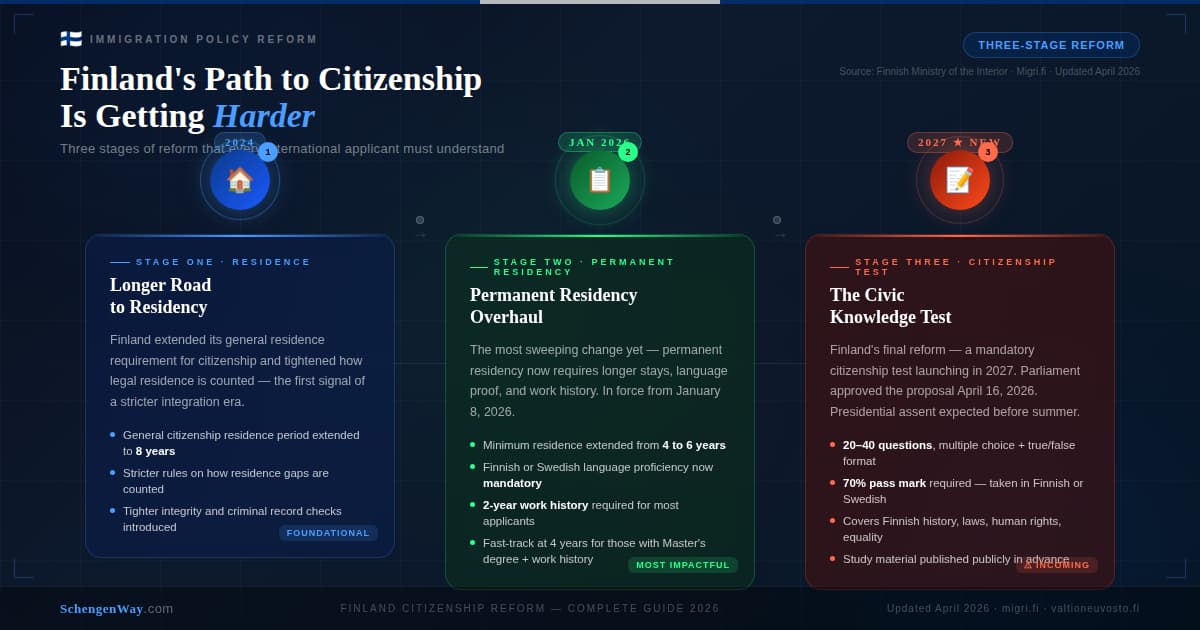
Under the new permanent residency rules effective from January 8, 2026, foreign nationals must spend at least six years continuously in Finland to be eligible for a permanent residence permit, instead of the previous four years. That is a 50% increase in the required residence period — from four years to six — and it represents the most significant single change to Finland’s immigration framework in recent memory.
But the residence period is only one part of what changed. The January 2026 amendments introduced what Finnish authorities call integration requirements — a set of conditions around language proficiency, employment history, and financial stability that applicants must meet alongside the residence period. Applicants for a permanent residence permit will need to have sufficient knowledge of Finnish or Swedish and a two-year work history, although some exceptions will apply.
The language requirement is where this gets genuinely challenging for international applicants, and particularly for those from countries where neither Finnish nor Swedish is spoken. Citizenship requires proven oral and written proficiency in Finnish or Swedish. A residence permit does not always require knowledge of Finnish or Swedish, although language skills become important when applying for permanent residence under the updated 2026 rules.
This means that the language investment — which many international workers in Finland’s English-friendly tech sector have been deferring — can no longer be deferred indefinitely. If permanent residency is your goal, Finnish or Swedish language learning needs to start early in your residence period, not in year five when the application deadline is approaching.
The Multiple Pathways to Permanent Residency Under the New Rules
The January 2026 amendments did not create a single rigid pathway — they created a system of multiple routes with different combinations of residence period, language level, and work history requirements. Understanding which pathway applies to your profile matters enormously for planning your timeline.
The standard pathway requires six years of continuous residence in Finland under a continuous residence permit. When you apply for a permanent residence permit on or after January 8, 2026, you must choose an application path, and each path has different requirements regarding the period of residence, Finnish or Swedish language skills, and work history.
The accelerated four-year pathway is available — but only for applicants who meet specific additional conditions. It is possible to obtain a permanent residence permit after four years of uninterrupted residence if the applicant also meets one of the following conditions: a master’s degree or postgraduate degree recognised in Finland and at least two years of work history, or particularly good knowledge of Finnish or Swedish and at least three years of work history.
For highly educated professionals — Nigerian doctors who completed their postgraduate training, Indian engineers with master’s degrees, Filipino nurses with advanced qualifications — the four-year accelerated pathway is worth pursuing actively. It requires getting your foreign qualification officially recognised in Finland, which involves a separate process with the Finnish National Agency for Education, but the investment of time and administrative effort pays off in a two-year shorter wait for permanent residency.
Granting an EU residence permit to a long-term resident who is a third-country citizen requires good knowledge of Finnish or Swedish. An unconditional sentence of imprisonment affects the calculation of the residence period for both permanent residence permits and EU long-term residence permits.
The work history requirement deserves particular attention for applicants who plan periods of study or career transition within their Finnish residence period. Time spent in Finland without employment does not count toward your two-year or three-year work history requirement — it simply counts toward the overall residence period. Gaps in employment extend the time you need before qualifying, which is why maintaining continuous employment throughout your Finnish residence is strategically important for anyone on the permanent residency track.
What These Changes Mean for Applicants From Different Parts of the World
The January 2026 rule changes affect different applicant profiles in different ways, and it is worth being specific about what this means for the major source countries of Finland’s international workforce.
For Indian professionals — currently one of the largest groups of non-EU workers in Finland, particularly in the technology sector — the six-year pathway is a significant extension. Many Indian IT workers who arrived in Finland under the previous rules were planning permanent residency applications after four years. Those who submitted before January 8, 2026 are assessed under the old four-year rules regardless of when the decision is made. Those who submitted after that date face the new framework. The updated policies encourage active workforce contribution, long-term integration, and social engagement of foreigners applying for a permanent residence permit. For Indian applicants with master’s degrees in technology fields, the four-year accelerated route via the education and work history pathway is the most realistic faster option.
For Nigerian professionals considering Finland, the message is both encouraging and sobering. Encouraging because Finland’s documented shortages in technology and healthcare align directly with Nigeria’s strongest professional export sectors — software development, data science, nursing, and medicine. Then, it is sobering because the combination of the six-year standard residence period, the Finnish or Swedish language requirement, and the incoming 2027 citizenship test creates a genuinely long and linguistically demanding integration journey. The honest advice for Nigerians considering Finland is to start Finnish language learning before you arrive — not after — and to target roles in shortage sectors where the fast-track permit processing applies.
For Filipino healthcare workers — a significant and growing presence in Finland’s nursing and care sectors — the work history requirement works in their favour because steady healthcare employment is essentially built into the role. The language challenge is real but Finland has invested in integration training programs specifically for healthcare workers that combine language learning with professional development. The six-year timeline is long, but the structure of the healthcare employment pathway makes it navigable.
For American professionals — particularly tech workers who have been increasingly considering Finland following Finland’s targeted recruitment drive in the US market — the context is different again. Salaries for engineers and researchers in Finland are generally 20 to 30 percent lower than comparable roles in the United States, particularly when measured against salaries in major US tech hubs. For many Americans who have already made the move, the decision is framed less as a financial upgrade and more as a shift in priorities. For Americans genuinely committed to the Finnish lifestyle rather than treating it as a temporary relocation, the six-year pathway to permanent residency is achievable — particularly for those who qualify for the EU Blue Card’s faster residency track.
For Brazilian and Latin American professionals — a smaller but growing cohort in Finland’s tech ecosystem — the combination of strong technical qualifications and the EU Blue Card pathway represents the most realistic route to a long-term Finnish future.
Finland’s Permanent Residency Application Process — Step by Step
Understanding the requirements is one thing. Knowing how the actual application process works is another. Here is the practical sequence for permanent residency applicants in 2026.
Like I mentioned earlier, the applications for permanent residence are submitted through the Enter Finland portal at enterfinland.fi. When you fill in the application, you must select your primary grounds for a continuous residence permit on the basis of which you are applying for a permanent residence permit. You can select up to two additional grounds if you meet the requirements connected with them. This selection matters because it determines which pathway — standard six-year or accelerated four-year — your application is assessed against.
The documentation requirements include:
- proof of your continuous residence period through your previous permit history
- evidence of your language proficiency at the required level
- documentation of your work history in Finland covering the required period
- proof of stable financial means
- and a clean criminal record.
For applicants using the education-based accelerated pathway, official recognition of your foreign qualification is also required.
One practical point that the official guidance mentions specifically: you may not be able to travel outside Finland if your current residence permit expires during the processing of your application for a permanent residence permit. This is an important logistical consideration — if your existing permit is close to expiry when you submit the permanent residency application, you need to be aware that international travel may be restricted during the processing period.
Processing times for permanent residence applications vary. Migri’s website publishes current processing time estimates, and given the January 2026 rule changes and the wave of applications from people who submitted before the deadline, processing times in 2026 may be longer than historical averages.
The New Finland Citizenship Test 2027 — Everything You Need to Know
This is the section most people reading this guide came for. The Finland citizenship test is the most significant immigration news coming out of Northern Europe right now, and the details matter enormously for anyone who has already built a life in Finland or is planning to.
The Finnish government submitted the proposal to Parliament on April 16, 2026. The test would be introduced after the legislative amendments enter into force at the beginning of 2027. The citizenship test is the final stage of a broader reform of the Citizenship Act, which tightens the conditions for acquiring Finnish citizenship.
To be clear about the current status: this is a proposal that has been submitted to Parliament, not a law that has already passed. Parliament’s Administration Committee will start deliberations in May, and the government hopes to obtain presidential assent before the summer recess. Given that the centre-right coalition that proposed it holds a parliamentary majority, most immigration analysts expect it to pass broadly as written. But until it receives presidential assent, it remains a proposal — which means if you are eligible to apply for Finnish citizenship right now and have been delaying, the window to apply under the current system without a citizenship test is still technically open.
What the Test Actually Looks Like
The exam will run on computers and must be taken in Finnish or Swedish. Applicants will face between 20 and 40 multiple-choice questions and need to answer roughly 70% correctly to pass. Questions will cover Finnish history and culture, fundamental and human rights, equality and gender equality, and core legislation on how the country works. A Yle report adds that the test will also include true-or-false items.
The computer-based format is worth noting because it standardises the testing experience across all applicants regardless of where in Finland they are located. Whether you are in Helsinki, Tampere, Oulu, or a smaller municipality, you will be sitting the same digital exam under the same conditions.
To ensure transparency and impartiality, the test questions will be based on predefined and publicly available learning material on civic orientation. The Finnish Immigration Service will commission a university to prepare the test.
That last point is genuinely important and often overlooked in coverage of this story. The study material will be publicly available in advance. This is not a surprise exam where applicants walk in blind. It is more comparable to the driving theory test — there is a defined body of knowledge, study resources are made available, and the test assesses whether you have engaged with that material. Universities will be contracted to draw up and regularly update the bank of questions.
The 70% pass mark means you need to answer correctly roughly 14 to 28 questions out of the 20 to 40 presented, depending on the length of the test version you receive. For someone who has genuinely lived and worked in Finland for the required years and engaged with Finnish society, this should not represent an insurmountable barrier — provided they have made a reasonable effort to learn the content beforehand.
What the Test Covers — Topic by Topic
The official government proposal is specific about what will and will not be tested. The test would include questions on the values of Finnish society, key legislation, fundamental and human rights, equality, gender equality, and Finland’s history and culture.
Breaking this down into practical terms, here is what applicants from Nigeria, India, the Philippines, the United States, and every other country should expect to study:
Finnish society’s values and principles means understanding the foundational principles that underpin how Finland operates — trust in institutions, transparency in government, the rule of law, individual rights balanced with collective responsibility. This is the philosophical layer of the test.
Key legislation means familiarity with Finland’s constitution, the basics of how Finnish law is structured, the rights and obligations of residents and citizens, and how the legal system functions in practice. You are not expected to be a lawyer — but you should understand how Finnish democracy works at a foundational level.
Fundamental and human rights means the specific rights guaranteed under the Finnish constitution and the European Convention on Human Rights as they apply in Finland. Freedom of expression, equality before the law, protection from discrimination, and similar principles.
Equality and gender equality is a topic that reflects Finland’s particular emphasis on these values as core social principles. Finland was the first country in the world to grant women full political rights in 1906, and gender equality is treated as a foundational national value rather than a policy position. Questions in this area will likely test understanding of equality legislation and its practical implications.
Finland’s history and culture is the broadest category and potentially the most demanding for recent arrivals. It covers key historical events, cultural landmarks, national symbols, and the development of Finland as an independent state since 1917. For applicants from countries with no historical connection to Finland, this is the area that requires the most deliberate study.
Who Is Exempt From the Test
Not everyone applying for Finnish citizenship from 2027 will need to sit this exam. The exemptions are specific and worth understanding clearly.
Exemptions are foreseen for applicants who have completed Finnish-language schooling or certain university degrees. More specifically, applicants could also demonstrate sufficient civic knowledge by passing the Finnish matriculation examination in Finnish or Swedish. Those who have completed a higher education degree in Finnish or Swedish would not be required to take the test.
In practical terms, this means three groups avoid the test entirely.
- First, people who went through the Finnish school system and took the national matriculation exam — essentially Finnish-educated residents.
- Second, people who completed a university or higher education degree conducted in Finnish or Swedish — which covers Finnish university graduates but also some international graduates of Finnish institutions who studied in either official language.
- Third, people who can demonstrate equivalent civic knowledge through another officially recognised route.
For the vast majority of international applicants — Nigerians, Indians, Filipinos, Americans, Brazilians, and others who arrived in Finland as adults, learned enough Finnish or Swedish to meet the basic B1 language threshold, and built their careers in English-language working environments — none of these exemptions apply. They will need to sit the test.
This is not necessarily bad news. It is simply a new requirement to prepare for, and the publicly available study material means preparation is structured rather than arbitrary.
How the Citizenship Test Fits Into the Broader Reform Picture
To understand the full weight of what Finland has done to its citizenship pathway over the last two years, it helps to see the three stages of reform as a single connected picture rather than isolated changes.
Stage one was the tightening of residence period requirements. The general residence period for citizenship was extended to eight years — one of the longer requirements in the EU — alongside stricter rules about how legal residence is counted and what gaps or interruptions mean for your timeline.
Stage two was the January 2026 permanent residency overhaul. The residence period for permanent residency was extended from four to six years, language requirements became mandatory for permanent residency, and the two-year work history requirement was added as a formal integration criterion.
Stage three is the incoming 2027 citizenship test. Interior Minister Mari Rantanen framed the move as a tool to ensure newcomers understand how Finnish society works and its key principles.
Behind the test lies the Orpo administration’s broader goal of tightening access to citizenship after several consecutive years of record-high naturalisations. The government argues that clearer, objectively verifiable criteria will improve transparency and integration outcomes; critics counter that the test could deter otherwise well-integrated workers and students who struggle with the languages.
The Interior Ministry estimates the combined reforms could cut permanent immigration by 8 to 12 percent a year once fully in force. That is a meaningful reduction, and it reflects the government’s deliberate policy intent rather than an accidental side effect.
What this means for you depends entirely on where you are in your journey. If you are just starting to consider Finland, you are planning within the new framework from the beginning — which is actually the clearest position to be in, because there is no ambiguity about what the rules are. If you are already in Finland on a work permit, the question is how the reforms change your timeline and what you need to do differently. If you are approaching eligibility for permanent residency or citizenship, the changes are most immediately consequential and require the most urgent attention.
The Full Finland Citizenship Requirements in 2026 — The Complete Picture
Beyond the incoming test, Finnish citizenship has a set of requirements that have been building in complexity since 2024. Here is the complete picture of what citizenship requires as of April 2026, before the 2027 test adds the civic knowledge layer.
The general residence period for citizenship is currently eight years. This is the time you must have spent legally residing in Finland under a valid continuous residence permit before you can apply. The eight years must be legal residence — periods spent in Finland on a visitor visa, a short-stay Schengen entry, or without a valid permit do not count.
Language proficiency at B1 level in Finnish or Swedish has been mandatory since 2011. The B1 level means you can understand the main points of clear standard input on familiar matters, can deal with most situations likely to arise while living in Finland, and can produce simple connected text on familiar topics. For most international applicants who have been living and working in Finland for years, B1 is achievable with sustained effort — but it requires deliberate language study, not passive absorption.
Financial self-sufficiency is a requirement that has been tightened alongside the residency changes. You must demonstrate that you have not been dependent on social assistance for a defined period before your application.
A clean integrity record means no serious criminal convictions and no outstanding legal issues. An unconditional sentence of imprisonment affects the calculation of the residence period. Depending on the severity, a criminal record can either delay your eligibility or disqualify you entirely.
From 2027, the citizenship test adds the civic knowledge requirement on top of all of the above. Until now, language proficiency has been the primary integration benchmark for citizenship. The proposed test marks a shift towards assessing broader civic awareness and alignment with societal values. If passed, this will be the first time Finland introduces a formal civic knowledge test specifically for naturalisation.
How the 2027 Citizenship Test Affects Different International Communities
Nigerian and African Applicants
For Nigerian professionals and other African applicants who have built careers in Finland’s technology and healthcare sectors, the citizenship test represents a meaningful additional challenge on top of an already demanding integration path. The language of the test — Finnish or Swedish — is the same language you needed to demonstrate at B1 level for the existing citizenship application. The difference is that the test requires active production in that language rather than passive comprehension.
The honest assessment is that for Nigerians and other African applicants who arrived in Finland as adults, the combination of the eight-year residence requirement, the Finnish or Swedish language learning investment, the work history requirements, and now the civic knowledge test creates a genuinely long and demanding path to a Finnish passport. It is achievable — but it requires treating integration as an active, continuous project from day one of your Finnish residence, not something to worry about in year seven.
The specific advantage that Nigerian applicants have in this process is community resilience and academic discipline. Nigerians who have navigated competitive university systems, professional certification processes, and the Schengen visa application gauntlet already know how to prepare for high-stakes assessments. The citizenship test, with publicly available study materials and a defined question bank, is a structured challenge — and structured challenges are manageable with the right preparation strategy.
Indian Applicants
India sends a significant share of Finland’s international workforce, particularly in the technology sector. The updated policies encourage active workforce contribution, long-term integration, and social engagement. For Indian IT professionals who arrived under the previous four-year permanent residency rules and are now facing the six-year threshold, the recalibration of their timeline is real. For those arriving now, the path is clear if longer than it was two years ago.
The citizenship test adds a layer that requires moving beyond the English-language Finnish tech bubble that many Indian professionals comfortably inhabit. Learning Finnish or Swedish to B1 and then studying civic knowledge in that language is a significant investment — but one that Finnish authorities are clearly signalling they expect from long-term residents seeking full membership in Finnish society.
Filipino Healthcare Workers
The Filipino community in Finland is concentrated in healthcare — nursing, elder care, and rehabilitation — where Finland’s labour shortage is among the most acute. The structured nature of healthcare employment, with its regular hours and continuous employment history, actually works in favour of Filipino applicants navigating the work history requirements for permanent residency and citizenship.
The language challenge is real for this group. Healthcare roles in Finland, unlike tech roles, often require Finnish at a higher functional level because patient communication depends on it. Many Filipino healthcare workers are therefore already investing in Finnish language learning as a professional necessity — which means the B1 requirement for citizenship and the Finnish-language citizenship test are natural extensions of a language investment they are already making.
American and Western European Applicants
For Americans, British, and other Western European professionals in Finland, the citizenship test landscape is different in one important way. These applicants often have less urgency around citizenship than applicants from countries with weaker passports, because their home country passports already provide significant global mobility. The Finnish passport adds value, but it is less transformative for an American than it is for a Nigerian or an Indian.
For those Americans who are genuinely committed to Finland long-term, the citizenship test is manageable — particularly because the study material will be publicly available and the civic knowledge content, while specific to Finland, is the kind of material that engaged residents encounter naturally through daily life, news consumption, and workplace interactions.
What to Do Right Now
Wherever you are in your Finland immigration journey, here is the specific action you should be taking right now based on your current stage.
If you have not yet applied for a Finnish work permit:
Start with the job search. Use Finland’s official Work in Finland portal at workinfinland.com, the Finnish Employment Service at te-palvelut.fi, and LinkedIn to identify roles in shortage sectors where your qualifications are relevant. Finland is actively recruiting in technology, healthcare, engineering, and research — match your skills to these areas and target employers who have experience hiring internationally. Once you have an offer, the permit process begins through Enter Finland at enterfinland.fi. Start Finnish language learning immediately alongside the job search — do not wait until you arrive.
If you are currently in Finland on a work permit:
Your priority is threefold:
- First, ensure your permit renewals are continuous with no gaps — breaks in continuous residence affect your permanent residency timeline.
- Second, start structured Finnish or Swedish language learning if you have not already, targeting B1 level well before you need it.Free integration training and language courses are available to all foreign residents in Finland through the kotoutumiskoulutus program.
- Third, keep documentation of your employment history — payslips, employment contracts, tax records — because you will need to demonstrate a two-year work history for permanent residency.
If you are approaching permanent residency eligibility:
Check your exact eligibility date against the January 8, 2026 cutoff carefully. If you submitted your permanent residency application before that date, the old four-year rules apply to your application regardless of when the decision comes. If you are submitting now or in the future, you are in the new six-year framework unless you qualify for the accelerated four-year pathway through the education and work history route. You can check the official Migri website at migri.fi for the specific path that applies to your profile and gather your language proficiency documentation, work history records, and financial documentation in advance.
If you are approaching citizenship eligibility:
This is the most urgent group given the incoming 2027 changes. If you currently meet all the citizenship requirements — eight years of legal residence, B1 language proficiency, financial self-sufficiency, clean record — applying now means applying under the current system without the citizenship test requirement. Once the 2027 amendments receive presidential assent, the test becomes mandatory for new applications. Talk to a Finnish immigration lawyer if you are in this window and uncertain about your eligibility — the cost of professional advice is trivial compared to the cost of an incorrectly timed application.
If you are just starting to research Finland from abroad:
You are starting with the clearest picture available. Build your plan around the current rules — six years to permanent residency under the standard pathway, eight years to citizenship, B1 language requirement, and the 2027 citizenship test. Start Finnish language learning now, even before you have a job offer. The earlier you start, the less pressure you will face at every subsequent stage of the process.
Frequently Asked Questions
These questions come from real searches by international applicants on Google, Reddit expat forums, Facebook immigration groups, and Quora — reflecting what people from Nigeria, India, the Philippines, the US, and around the world are genuinely asking about Finland immigration right now.
Can I take the Finland citizenship test in English?
No. The exam must be taken in Finnish or Swedish. This is one of the most searched questions about the test and the answer is unambiguous. There is no English-language version planned, and the language requirement reflects the Finnish government’s position that meaningful civic integration requires functional proficiency in one of Finland’s official languages. If Finnish or Swedish language learning is not already part of your integration plan, it needs to become one.
How hard is the Finland citizenship test?
Based on the official proposal, the test consists of 20 to 40 multiple-choice and true-or-false questions with a 70% pass mark, covering Finnish society, history, legislation, and values. The test questions will be based on predefined and publicly available learning material on civic orientation. For someone who has genuinely lived and worked in Finland for the required years and engages with Finnish news and society, the content should be broadly familiar. The challenge for most international applicants is that the test must be taken in Finnish or Swedish — so the language barrier is the harder obstacle, not the civic knowledge itself.
What happens if you fail the Finland citizenship test?
The official proposal does not yet specify the exact retake rules, including how many attempts are allowed or what the waiting period between attempts is. These details will be clarified when the final legislation is published after parliamentary approval. What is clear is that a failed test means the citizenship application cannot proceed until the test is passed — there is no pathway around the requirement for those who do not qualify for exemptions.
How long does it take to get Finnish citizenship?
Under the current rules, the standard path requires eight years of legal residence in Finland, B1 level Finnish or Swedish proficiency, a clean record, and financial self-sufficiency. From 2027, the citizenship test adds a further requirement. Realistically, from the date of your first Finnish work permit to citizenship, you are looking at a minimum of eight to ten years including the time needed to qualify for permanent residency first. The accelerated pathways for highly educated applicants with strong language skills can shorten the permanent residency stage to four years, but the eight-year citizenship requirement applies broadly.
Can I move to Finland without a job offer?
For non-EU citizens, a job offer is the standard starting point for Finnish immigration. You cannot arrive on a tourist visa and then begin working or convert your status later. Finland does not currently offer a dedicated digital nomad visa, though some remote work is possible under the specialist permit or business visa for those who qualify. If you are from a visa-free country like the US or UK, you can enter Finland as a tourist for up to 90 days and use that time to attend interviews and explore opportunities — but you cannot begin work during that period.
Is Finland easy to immigrate to from Nigeria?
Finland is accessible from Nigeria for skilled professionals in shortage sectors — technology, healthcare, engineering, and research. The work permit process is manageable with a genuine job offer, and Finland’s documented labour shortages mean that qualified Nigerian professionals in these fields are actively being sought. The harder challenge is the long-term integration path — Finnish or Swedish language learning, the six-year permanent residency requirement, and the incoming citizenship test all require sustained commitment over many years. For Nigerians considering Finland, the honest advice is to start the language learning process early, target shortage sectors, and approach this as a long-term life decision rather than a short-term migration strategy.
Does Finland allow dual citizenship?
Yes. Finland allows dual citizenship, which is an important consideration for applicants from countries like Nigeria, India, and the Philippines where home country laws may restrict dual nationality. Finnish law itself does not require you to renounce your previous citizenship when acquiring Finnish citizenship. However, your home country’s laws may have their own position on dual nationality, and it is worth checking the rules of your specific country before proceeding.
What is the Finland Fast Track visa and who qualifies?
Finland’s Fast Track service is a priority processing pathway for highly skilled professionals and their families, available through the Enter Finland portal. The Finnish government has introduced simplified residence permit policies, digital application systems, and fast-track visa processing for skilled professionals and startup founders. To qualify, your role must fall within Finland’s defined shortage occupations or specialist categories, and your employer must submit the employment terms within two working days of the application submission. For roles in AI, software engineering, research, healthcare specialist positions, and startup founding, this is the fastest legal route into Finland.
Will the Finland citizenship test affect people already living in Finland?
Yes — for anyone who has not yet applied for citizenship when the 2027 amendments enter into force, the test will apply to future applications. People currently in Finland on work permits or permanent residency who were planning to apply for citizenship in 2027 or later will need to meet the test requirement. The proposed legislative amendments are intended to enter into force at the beginning of 2027, when the citizenship test could also be introduced. Applications submitted before the amendments take effect will be assessed under the current rules.
What is the difference between a Finnish permanent residence permit and Finnish citizenship?
A permanent residence permit gives you the right to live and work in Finland indefinitely without needing to renew your permit, and it provides access to most of the social benefits available to Finnish residents. It does not give you the right to vote in national elections, hold a Finnish passport, or move freely throughout the EU on Finnish status. Finnish citizenship does all of those things. The permanent residence permit is typically the step before citizenship — you need it before you can apply — and under the current rules, it requires six years of continuous residence while citizenship requires eight.
Conclusion
Finland is not the easiest country in the world to build a permanent life in as an international applicant. The language is genuinely difficult — it belongs to a completely different language family from the Indo-European languages that most of the world’s major populations speak. The climate is cold and dark for a significant part of the year. The residence requirements for permanent status and citizenship have become longer and more demanding over the last two years, and the 2027 citizenship test adds another layer to an already demanding integration journey.
All of that said, Finland offers something that is increasingly rare in the modern world — a society that genuinely functions. Public services that work. A healthcare system that covers you. An education system that is free and excellent. A working culture that treats your personal time as genuinely yours. A political system that is largely free from the dysfunction that characterises many other democracies. And a labour market that is actively looking for skilled international professionals in exactly the sectors where global talent is concentrated.
For professionals from Nigeria, India, the Philippines, Brazil, the United States, and everywhere else who are willing to make the language investment, commit to the integration journey, and build their careers in one of Europe’s most stable and liveable societies — Finland is a legitimate and rewarding destination.
The rules have changed. The path is longer than it was two years ago. But the destination is the same.
We will update this guide as the 2027 citizenship test legislation moves through parliament and the final rules are confirmed. If you have specific questions about your situation — your work permit, your residency timeline, your language qualification, or how the new rules apply to your profile — drop them in the comment section, and we will do our best to point you in the right direction.

