

When people finally receive their passport back after applying for a Schengen visa, the first thing they usually do is flip to the visa page and stare at that colourful sticker. It looks official, it has codes, dates, numbers, and sometimes three different languages written on it.
And then the confusion starts.
Fans come to my inbox and ask the same question almost every week:
“What exactly does all this mean?”
More specifically, they want to understand the Schengen visa sticker number, where to find it, and how to read the rest of the information printed on the visa sticker.
This matters more than most people think. Your Schengen visa sticker contains the actual rules of your visa — the countries you can visit, how long you can stay, when your visa starts, when it expires, and how many times you can enter the Schengen Area.
If you misread it, you could accidentally overstay your visa, enter the wrong country, or misunderstand your travel validity.
So in this guide, let me walk you through it the same way I explain it to fans in my inbox. We’ll go through what the Schengen visa sticker number means, where to find it, and how to properly read every important part of the visa sticker.
What Is a Schengen Visa Sticker Number?
The Schengen visa sticker number is a unique identification number printed on the visa sticker placed inside your passport after your visa is approved.
Think of it as the tracking number for your visa.
Every visa issued by a Schengen embassy or consulate has its own unique sticker number. Immigration authorities use this number to identify and verify your visa inside their system.
You’ll typically find the Schengen visa sticker number in the top right corner of the visa sticker. It is usually printed in red ink and stands out from the rest of the text.
This number is important because it is tied to the visa record stored in the Schengen visa information system. If immigration officers need to check your visa details, they can use this number to retrieve your visa file.
For travelers, the Schengen visa sticker number is often required when:
- Filling out immigration forms
- Checking visa records
- Submitting travel documentation
- Contacting an embassy about your visa
In simple terms, it is the official identification number of your Schengen visa.
However, many travelers confuse this number with another number on the visa sticker — the visa number. They are not always the same thing, which leads us to the next point.
What Is the Difference Between Visa Sticker Number and Visa Number?
This is where many travelers get confused.
People often assume the Schengen visa sticker number and the visa number are the same thing. In most cases, they refer to the same identifier, but technically they serve slightly different purposes.
The visa sticker number is the number printed directly on the visa label attached to your passport.
The visa number, on the other hand, is the reference number used in immigration systems to identify the visa issued to you.
For most Schengen visas, the number printed on the sticker functions as both the sticker number and the visa number, which is why the terms are sometimes used interchangeably.
But the key thing to remember is this:
The visa sticker number refers to the physical number on the visa label.
The visa number refers to the official record of that visa in the immigration database.
Whenever a form asks for your Schengen visa number, you usually provide the number printed on the visa sticker in your passport.
That’s the number immigration officers recognize.
How to Find the Schengen Visa Sticker Number
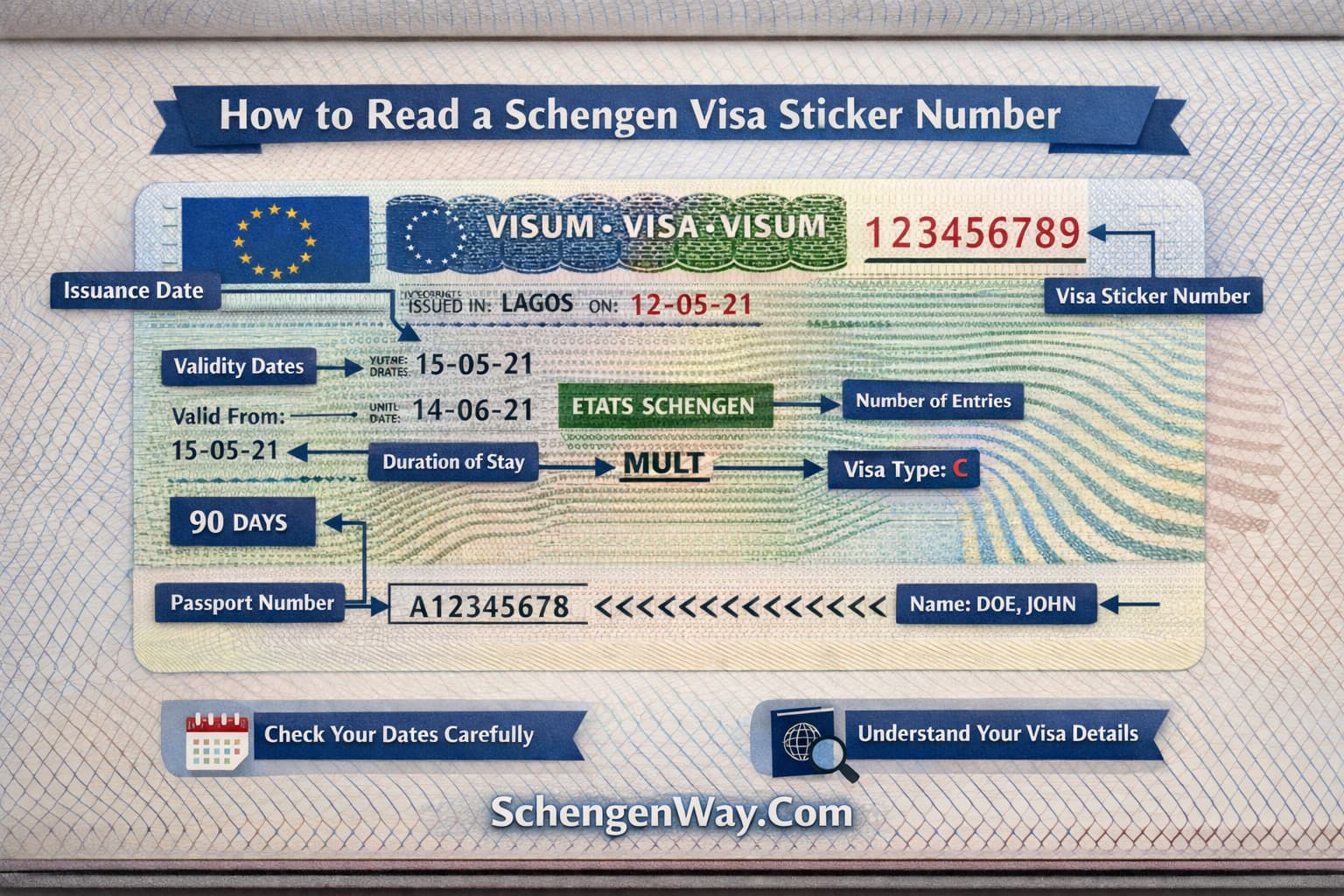
Once you know what you are looking for, finding the Schengen visa sticker number is actually very easy.
Open your passport to the page where the visa sticker is attached. The sticker usually takes up almost the entire page and contains several rows of information.
Look at the top right corner of the sticker.
You will see a red number printed clearly above the rest of the visa information. That number is your Schengen visa sticker number.
It is designed to be easily visible because immigration officials often need to identify it quickly.
While the rest of the visa contains structured sections like:
- validity dates
- visa type
- number of entries
- duration of stay
the sticker number is placed separately at the top to make identification faster.
So if you are ever asked for your Schengen visa sticker number, just open your passport and check the upper-right corner of the visa label.
How Do You Check the Validity of the Schengen Sticker Visa?
Another part of the visa sticker that travelers must understand is the validity period.
The visa sticker clearly states when your visa starts and when it ends.
On the sticker, you will see three labels printed in different languages, but they all mean the same thing.
The visa will show:
FROM – the first date you are allowed to enter the Schengen Area.
UNTIL – the last date your visa remains valid.
These two dates define the validity window of your Schengen visa.
This does not necessarily mean you can stay in the Schengen Area for the entire period. That is determined by another section called the duration of stay, which we will discuss shortly.
But the key rule is simple.
You cannot enter the Schengen Area before the “FROM” date, and you must leave before the “UNTIL” date unless you obtain another legal stay permit.
Many travelers misunderstand this and assume that a visa valid for six months automatically means they can stay for six months. That is not how Schengen visas work.
The visa validity simply tells you the travel window during which you are allowed to enter the Schengen zone.
Infact, to avoid mistakes, you can use the Schengen Visa Validity Checker on our platform to quickly confirm whether your travel dates fall within the validity period shown on your visa sticker.
How Can You Check the Visa Type?
Your Schengen visa sticker will also show the type of visa you have been granted.
You will find this information under a section labeled “TYPE OF VISA.”
Instead of long descriptions, Schengen visas use letters to indicate the visa category. For instance, Label «A» stands for the A type visa, Label «C» stands for the C type visa, and Label «D» stands for the D type visa.
Now, let’s briefly explain this common types of visas:
Type A Visa
This is an airport transit visa. It allows travelers to pass through the international transit area of a Schengen airport but does not allow entry into the country itself.
Passengers with this visa must remain inside the airport transit zone.
Type C Visa
This is the standard short-stay Schengen visa. Most travelers receive this visa when visiting Europe for tourism, business, family visits, or short-term trips.
It allows stays of up to 90 days within a 180-day period.
If you applied for a normal tourist or visitor visa, you almost certainly received a Type C Schengen visa.
Type D Visa
This is a long-stay national visa issued for longer-term purposes such as study, work, or family reunification.
It usually allows stays longer than 90 days and is often the first step before obtaining a residence permit in the issuing country.
So when you check your visa sticker, look for the visa type letter to understand the category of visa issued to you.
Where Is the Issuance Date Mentioned on the Visa?
Another detail many travelers overlook on their visa sticker is the issuance date. This is simply the date the embassy or consulate officially issued your Schengen visa.
If you look closely at the visa sticker in your passport, you will see a section that usually reads “ON” (sometimes written in different languages like French or German). The date written next to this label is the date the visa was issued.
Right above or close to this, you will also find another label that says “ISSUED IN.” This tells you the city where the embassy or consulate processed and issued your visa. For example, if you applied through a consulate in Lagos or Abuja, that city may appear there.
Now, some people assume the issuance date is the same as the visa start date. But they are not always the same.
The issuance date simply shows when the visa was approved and printed in your passport. Your visa validity, however, is determined by the “FROM” date we discussed earlier. That is the date you are actually allowed to enter the Schengen Area.
For example, a visa may be issued on May 1st, but the validity might start on June 1st. In that situation, you still cannot travel before June 1st even though the visa was already issued.
Understanding this difference is important because immigration officers always look at the validity dates, not just the issuance date.
Like I said earlier, to make it simple for you and make sure you don’t overstay, you can use our tool to check you Schengen visa validity.
How Do You Know Which Countries You Can Enter?
This is another part of the visa sticker that people misunderstand quite often.
Every Schengen visa clearly states where the visa is valid, meaning the countries you are allowed to travel to.
On the visa sticker, you will see a label that says “VALID FOR.” Right next to it, there will be a description showing the geographical validity of the visa.
In many cases, the visa will simply say “Schengen States.” When you see this, it means your visa allows you to travel throughout the entire Schengen Area. In other words, once you enter the Schengen zone, you can move between member countries such as France, Germany, Spain, Italy, and others without additional visas.
However, some visas may be restricted.
Sometimes the visa will show specific country abbreviations instead of “Schengen States.” These abbreviations represent the countries you are allowed to visit. For example, you might see initials that correspond to countries like Germany, France, Spain, or the Netherlands.
If only certain country codes appear there, then your visa only allows travel to those listed countries.
There is also a situation where the visa may state “Schengen States except…” followed by a country abbreviation. This means the visa is valid for the entire Schengen Area except the country listed.
So before booking flights or planning your itinerary, always check the “VALID FOR” section on your visa sticker carefully.
It tells you exactly where your Schengen visa is valid.
Understanding the Number of Entries on Your Visa
One section that directly affects how you plan your travel is the number of entries allowed on your visa.
You will find this under a label that reads “NUMBER OF ENTRIES.”
This section tells you how many times you are allowed to enter the Schengen Area using that visa.
Some visas allow only one entry. This means once you leave the Schengen Area, the visa cannot be used again even if the validity dates have not expired.
Other visas allow two entries, which means you can enter the Schengen zone twice within the validity period.
Then there are multiple-entry visas, which are usually marked with “MULT.” These allow travelers to enter and leave the Schengen Area multiple times while the visa remains valid.
For example, someone with a multiple-entry Schengen visa could visit France, leave for the UK, and then return to Italy without needing a new visa — as long as the visa validity and stay limits are respected.
This section is important because it affects whether you can re-enter the Schengen Area after leaving.
Many travelers accidentally invalidate their visa simply because they didn’t check whether it was a single-entry or multiple-entry visa.
What Does “Duration of Stay” Mean on the Visa Sticker?
Another critical detail on the visa sticker is the duration of stay.
This section tells you how many days you are allowed to remain in the Schengen Area, regardless of the visa validity period.
The visa sticker will show a section labeled “DURATION OF STAY” followed by a number of days.
For example, it might say 30 days, 60 days, or 90 days.
This number represents the maximum number of days you can stay within the Schengen Area during the visa validity period.
This is where many travelers make mistakes.
A visa might be valid for six months, but the duration of stay could still be only 90 days. That means you can travel anytime within those six months, but your total stay cannot exceed 90 days.
Immigration authorities take this rule very seriously, and overstaying even by a few days can affect future visa applications.
That’s why it’s important to always read both sections together:
- the visa validity period
- the duration of stay
They work together to determine how long you can legally remain in the Schengen Area.
Many travelers struggle to calculate their remaining days in the Schengen Area, especially if they plan multiple trips within the visa validity period. To make things easier, you can use the Schengen 90/180 Rule Calculator on our platform to quickly check how many days you have left and avoid accidentally overstaying your visa.
What Should You Do After Receiving Your Schengen Sticker Visa?
When you finally receive your passport with the visa sticker inside, don’t just assume everything is correct.
The first thing you should do is carefully review the visa sticker.
Check that your name and passport number are written correctly. These details must match your passport exactly. Even small spelling mistakes can cause problems at immigration.
Next, confirm that the visa type, validity dates, and duration of stay match the travel purpose you applied for. If you requested a short-stay tourist visa, for example, the sticker should normally show a Type C visa.
You should also verify the number of entries granted and ensure it fits your travel plans. If you plan to leave and re-enter the Schengen Area during your trip, you need to make sure your visa allows multiple entries.
Finally, keep in mind that having a Schengen visa does not automatically guarantee entry into Europe. Border officers can still ask for supporting documents such as your travel itinerary, hotel bookings, proof of funds, or return ticket.
So once you receive your visa, it’s a good idea to organize your travel documents and keep copies with you during your trip.
Final Thoughts
The Schengen visa sticker number and the information printed on your visa sticker may look technical at first, but once you understand what each section means, it becomes much easier to read.
Every part of the sticker serves a purpose. It tells immigration officers who you are, what type of visa you received, where you can travel, how long you can stay, and when your visa expires.
Taking a few minutes to carefully read your visa sticker before traveling can save you from serious issues later — especially at border control.
Whenever fans visit our office at SchengenWay, this is always one of the first things we review together. A visa isn’t just a permission to travel; it’s a document with specific conditions attached to it.
And understanding those conditions is what helps you travel through the Schengen Area without unnecessary stress.

