

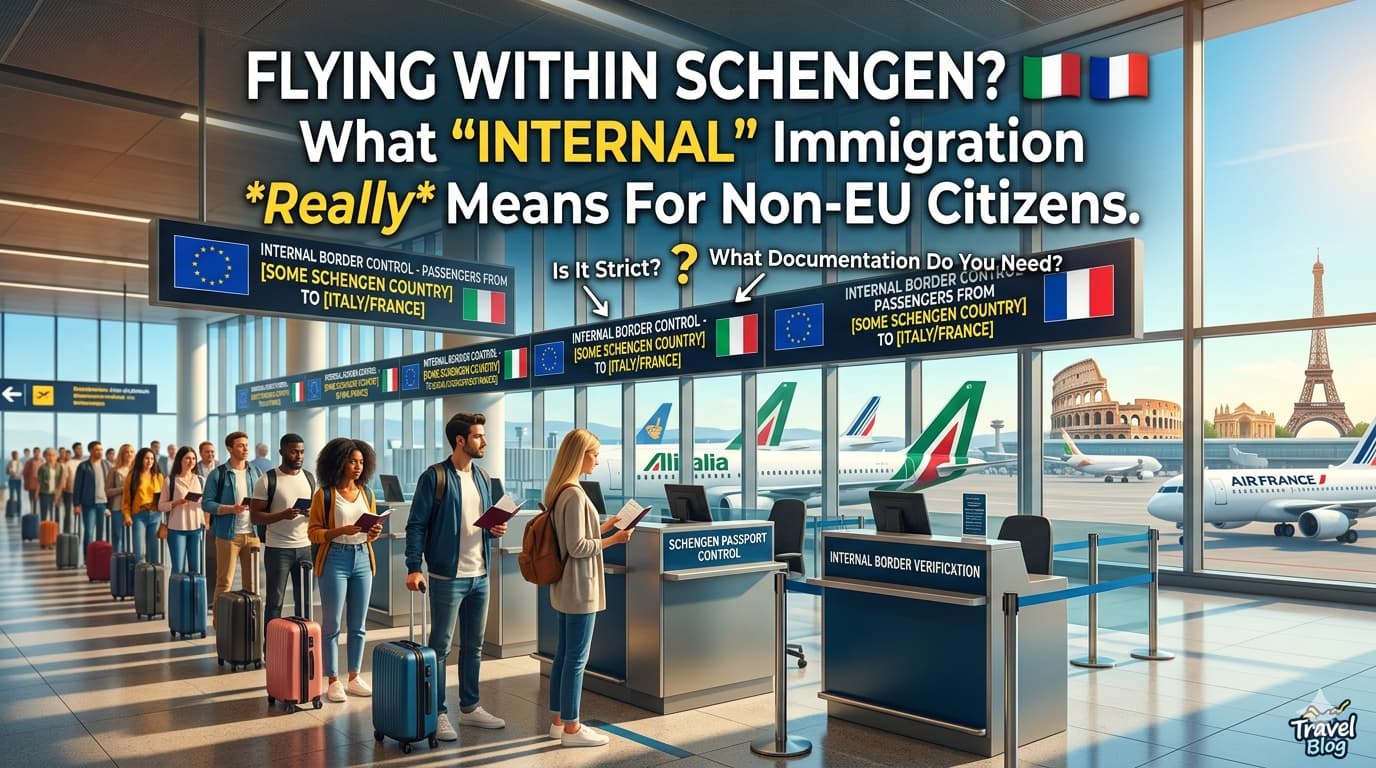
A user asked this question on Reddit and I think it’s best for me to provide answer here so my readers can also benefit from it. Not just that, I will also provide answers to more related frequently asked questions here, according to the current Schengen travel policy.
Now, when you fly between two Schengen countries as a non-EU citizen, you will not go through formal immigration passport control the way you do when you first enter the Schengen zone from outside. But that does not mean nobody is watching, and it absolutely does not mean you can travel without the right documents.
Let me explain exactly what that means in reality — because there is a significant difference between “no passport control” and “no checks at all,” and confusing the two has caused real problems for travelers I have worked with over the years.
How the Schengen Area Works for Non-EU Citizens
The Schengen Agreement abolished internal border controls between its 29 member states. That means when you fly from Paris to Amsterdam, or from Rome to Madrid, you are not crossing an international border in the traditional sense. You move through the departure hall, board your flight, land at your destination, and walk out into the arrivals area — just like a domestic flight.
No immigration officer stamps your passport. No queue at a booth. No questions about how long you are staying or what you are doing there.
But — and this is the part that trips people up — the absence of border control at the airport does not mean the country you just arrived in has no interest in who you are and whether you are legally entitled to be there. It just means that check happened when you first entered the Schengen zone from outside, not every time you move between countries within it.
So when I see someone asks how strict it is, my honest answer is: the initial entry is where the real scrutiny happens. Everything after that is lighter — but not absent.
Related article>> Italy’s EES Rollout Completes — What It Really Means for Travelers Heading to Rome, Milan, and Beyond
Do I Go Through Passport Control on Domestic Schengen Flights?
No — not in the traditional immigration sense. When you fly between two Schengen countries, the flight is treated similarly to a domestic flight. There is no dedicated passport control booth at the arrival gate staffed by immigration officers waiting to check your visa.
However, I always tell clients not to interpret “no passport control” as “nobody will check anything.” Police, customs officers, and security personnel retain the right to conduct checks anywhere within Schengen territory — at airports, train stations, bus terminals, or on the street. These are not immigration checkpoints in the formal sense, but they are real and they happen.
In my experience, the checks you are most likely to encounter on an intra-Schengen flight are at the departure gate — not on arrival. Airlines check your documents before they let you board, and we will come to that shortly.
The Difference Between Immigration Control, Identity Checks, and Airline Checks
These three things often get conflated and they should not be.
Immigration control is the formal border check conducted by government officers when you enter or exit a country from outside the Schengen zone. This is where your visa or entry authorization is verified, your biometrics may be recorded under the new Entry/Exit System, and a formal entry record is created. For intra-Schengen flights, this does not happen.
Identity checks are checks conducted by police or security forces within Schengen territory. These can happen anywhere, at any time, and are not tied to border crossings. Under Article 23 of the Schengen Borders Code, member states are explicitly permitted to conduct police checks within their territory — including at airports and train stations — as long as those checks do not have the same effect as systematic border controls. In reality, this means random or intelligence-led checks rather than checking every single person passing through.
Airline checks are the most consistent and predictable form of document verification you will face on intra-Schengen flights. Airlines are required to verify that every passenger holds valid travel documentation before boarding — not because they are acting as immigration officers, but because they face significant fines if they transport someone who turns out to be traveling without the right papers.
Can Airlines Deny Boarding Within Schengen?
Yes — and this happens more often than people expect. I have had clients turned away at departure gates for intra-Schengen flights not because of a visa problem, but because their residence permit was expired, their passport was too close to expiry, or they were carrying the wrong documentation for their specific situation.
Airlines scan passports and travel documents at check-in and at the gate. Their systems flag documents that appear invalid or insufficient. A gate agent who sees a flagged document will typically call a supervisor, and in many cases that results in denied boarding.
The specific documents airlines check before intra-Schengen flights include your passport, your visa if you hold one, your residence permit if that is the basis of your travel authorization, and in some cases your national identity card if you are an EU citizen. For non-EU citizens, the passport remains mandatory — a residence permit alone is usually not sufficient for airline check-in purposes, though we will address that specific question in more detail below.
Can I Travel Within Schengen With Just a Residence Permit?
This is one of the most common questions I get from non-EU clients living in a Schengen country, and the answer is: it depends on your situation — but generally, no, not just the permit alone.
If you are a non-EU national legally residing in a Schengen country on a valid residence permit, you can travel to other Schengen countries. But your passport needs to be valid alongside your residence permit. The residence permit does not replace your passport — it supplements it.
The combination of a valid non-EU passport plus a valid Schengen residence permit is what gives you the right to travel within the zone. If either document is missing, expired, or insufficient, you can face problems at airline check-in even for a flight that involves no formal immigration checkpoint on the other end.
One specific situation I see regularly: non-EU nationals whose passport has expired but whose residence permit is still valid. They assume the permit covers them. It does not. Airlines will typically deny boarding in this situation, and if they do not, police checks at the destination can create serious complications.
Are There Random Checks Between Schengen Countries?
Yes — and the frequency varies significantly by country, by route, and by the current political and security climate. This is something I always brief clients on because it genuinely surprises people who expected a completely seamless experience.
Some Schengen countries have been more active than others in exercising their right to temporary border controls. Germany, France, Austria, and the Netherlands have all reinstated temporary border controls at specific land crossings and sometimes at airports during periods of elevated security concern, high migration pressure, or major events. Under the Schengen Borders Code, member states can reintroduce temporary border controls for up to 30 days at a time in exceptional circumstances.
These temporary reintroductions mean that what was an unchecked crossing yesterday can be a passport control checkpoint today. Travelers who were not expecting it sometimes encounter a proper border check that they were not prepared for.
Beyond temporary reintroductions, plain-clothes and uniformed police conduct mobile operations on trains, at bus stations, and at airports on routes known to be used by irregular migrants. These operations are ongoing in several countries and you can encounter them even on a completely unremarkable trip between two major cities.
What Documents Should Non-EU Travelers Always Carry?
In my experience, the travelers who never have problems are the ones who carry everything and assume nothing. Here is what I tell every non-EU client before any intra-Schengen trip:
Your valid passport goes everywhere with you — not a photocopy, the original. If your passport expires within three months of your return date from the Schengen zone, sort it out before you travel.
Your visa sticker if you are in the Schengen zone on a Type C short-stay visa. Keep the passport open to that page accessible, not buried at the bottom of your bag.
Your residence permit if you are living in a Schengen country. This should be with you at all times regardless of whether you are traveling or not — most Schengen countries legally require non-EU residents to carry it.
Your travel history records if you are on a short-stay visa. If you are close to your 90-day limit, carry evidence of your entry and exit dates in case a police officer asks you to demonstrate you have not overstayed. A screenshot of your Schengen day count from our 90/180-Day Rule Calculator alongside your boarding passes from entry and previous exits is the kind of evidence that resolves a question in thirty seconds rather than turning it into a lengthy interrogation.
What Happens If I’m Stopped by Police Inside Schengen?
Stay calm — this is the most important thing I tell people. A police check inside Schengen territory is not automatically a crisis, and treating it as one by becoming flustered or evasive makes it worse.
Police officers conducting identity checks in Schengen countries typically ask for your travel document and may ask where you are coming from and where you are going. If your documents are in order, the exchange should be brief.
If your documents raise a question — an expired visa, a stamp pattern that suggests you may be approaching your 90-day limit, a residence permit that does not match your passport — the officer will escalate. You may be taken to a nearby office for further questioning, your documents may be cross-checked against national or Schengen databases, and in some cases you may be detained while inquiries are made.
If you are found to have overstayed your visa, the consequences range from a fine to a formal removal order depending on the country and the severity. Germany and Switzerland in particular handle overstay situations rigorously.
If you are in the right and your documents are correct but you are still being questioned, remain cooperative, produce your documents clearly, and do not volunteer information you have not been asked for. If the situation escalates, you have the right to contact your country’s consulate.
Is It Possible to Get Deported While Traveling Within Schengen?
Yes — this is possible and it does happen, though it is not the outcome of every police check. Deportation from one Schengen country typically results in an entry ban across the entire zone, not just the country that issues it. The Schengen Information System flags persons subject to entry bans across all member state border databases simultaneously.
The situations that most commonly lead to removal orders for non-EU travelers within Schengen are: overstaying the 90-day visa limit, being found without valid documentation, being flagged on a Schengen or national security database, or having entered the zone without going through proper entry channels.
What people do not always realize is that the EES — the Entry/Exit System now fully operational across Schengen since April 2026 — has made overstay detection significantly more automated. The system logs every entry and exit digitally. A police check on a train in Austria can now surface an Italian entry with no corresponding registered exit from three months ago in a matter of seconds.
Common Mistakes Non-EU Travelers Make
The mistakes I see most frequently with intra-Schengen travel are not dramatic — they are small oversights that become significant problems.
Assuming the 90-day allowance resets when you move between countries is probably the most dangerous misconception. It does not. If you spent 45 days in Spain, 20 days in Portugal, and are now in France, you have used 65 of your 90 days across the entire zone — not a fresh 90 days in France.
Leaving the passport at the hotel because “it’s just an internal flight” is another one I see regularly. Do not do this. Your passport should travel with you at all times within Schengen territory, particularly if you are a non-EU national.
Assuming that because there was no passport check on the last ten intra-Schengen flights, there will not be one on this one. Temporary border controls can appear with relatively short notice and police checks are by definition unpredictable.
My Advice to my Readers and Clients
The Schengen Area is genuinely one of the most convenient travel zones in the world for people who have the right documentation. If your papers are in order — valid passport, valid visa or residence permit, Schengen day count within the legal limit — internal travel is relaxed, easy, and in most cases completely uneventful.
The system only becomes adversarial when something is not in order. And the best way to ensure that never happens to you is to know your numbers, carry your documents, and check your Schengen day count before every trip.
Before any intra-Schengen travel, especially if you have made multiple European trips in the last six months, run your dates through our Schengen 90/180-Day Rule Calculator. It takes two minutes and tells you exactly where you stand. That two minutes has saved more than a few of my clients from a very uncomfortable conversation at a European airport.
I hope you learned something today? And if you have any doubts about your specific situation, drop them as comment in the comment section before you travel — not after something goes wrong.

