

When this question comes up — and it comes up a lot — I always take a breath before answering. Not because the answer is complicated, but because it is blunt in a way that most people are not prepared for.
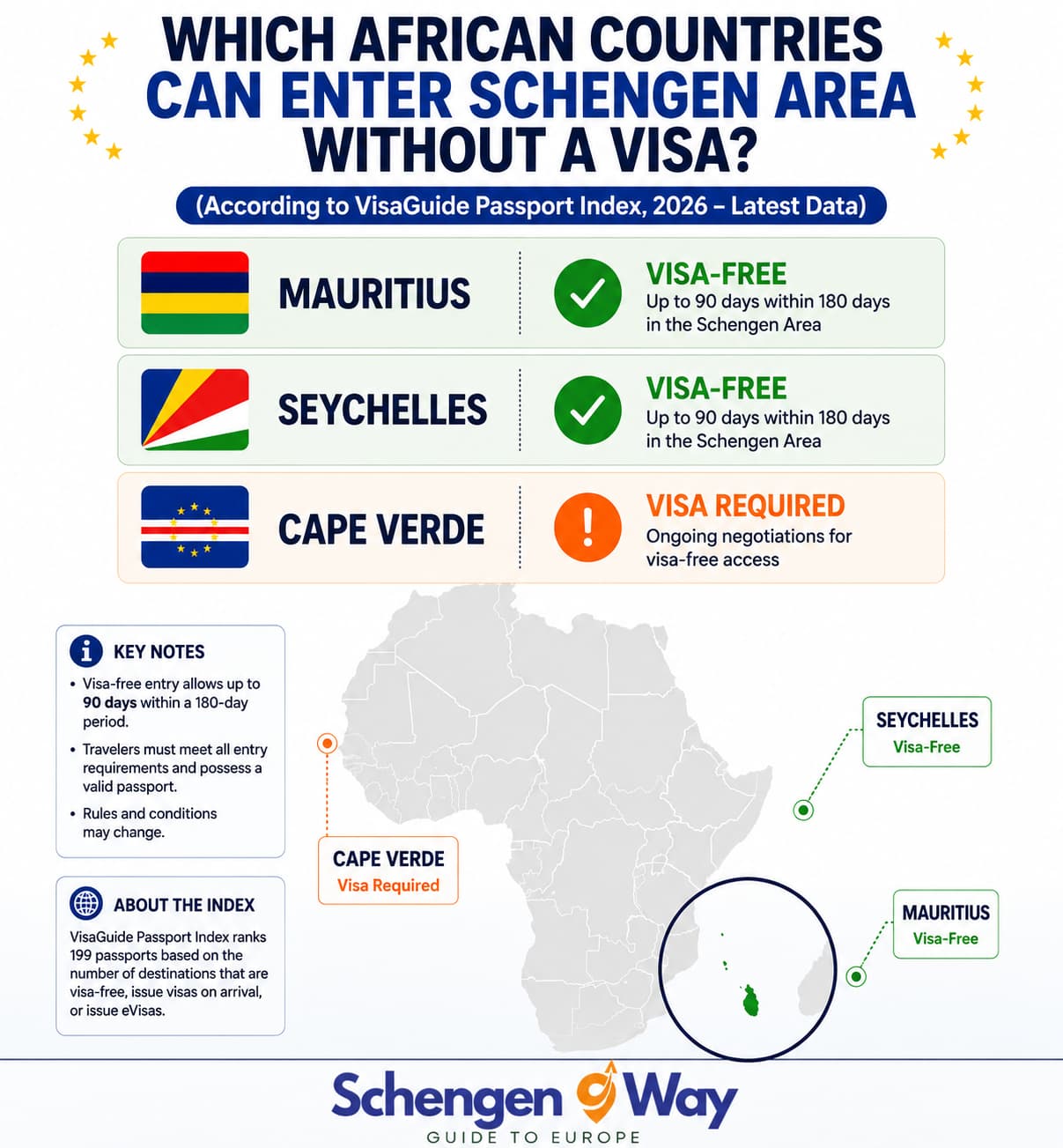
Here is my straight answer: almost no African country enjoys genuine visa-free access to the Schengen Area in 2026. Out of 54 countries on the African continent, only two — Seychelles and Mauritius — hold passports that allow their citizens to walk into France, Germany, Italy, Spain, or any other Schengen country without applying for a visa in advance.
That is the honest answer. Two out of fifty-four.
Everything else you read online about African passport holders and Schengen — the suggestions, the workarounds, the “practically visa-free” claims — needs to be read very carefully. Because there is a significant difference between visa-free access, visa-on-arrival, and the formal Schengen visa that most African travelers still need. And confusing them is one of the most expensive mistakes I see clients make.
Let me break all of it down for you properly.
What “Visa-Free Access to Schengen” Actually Means
Before going further, it is worth being precise about what we are actually talking about — because the terminology gets muddled constantly in travel forums and on social media.
Visa-free access to the Schengen Area means you board a plane to Paris, land at Charles de Gaulle, walk to the immigration desk, show your passport, and get stamped through. No prior application. No embassy appointment. No document submission. No fee. No waiting weeks for a decision. Just your passport and go.
Visa-on-arrival means you travel without obtaining a visa in advance, but you complete a visa formality at the destination airport before being allowed to enter. Most Schengen countries do not offer visa-on-arrival to African passport holders at all. The Schengen Area has no systematic visa-on-arrival system for nationalities that require visas — you need the sticker in your passport before you board the plane.
An eVisa is an electronic visa you apply for online before travel. Again — most Schengen countries do not issue eVisas for tourism purposes. The formal consulate or VFS Global application process remains the only route for most African travelers.
So when someone on a forum tells you that South Africans can “basically get in easily” or that Kenyans can “get a visa on arrival” in Europe — that is either wrong, outdated, or applies to specific non-Schengen European countries like Georgia, Serbia, or Turkey, which operate completely separate entry systems.
The Two African Passports With Genuine Schengen Visa-Free Access
1: Seychelles
Seychelles is the continent’s standout exception. The Seychellois passport ranks 22th globally in the Henley Passport Index for 2026, granting visa-free access to 156 countries including France, Germany, Italy, Spain, Sweden, Norway, and Switzerland. That covers virtually the entire Schengen zone. Seychellois citizens are the only African nationals who can enter Schengen countries the same way British, American, or Canadian travelers do — passport and nothing else.
As of 2026, Seychellois citizens have visa-free or visa-on-arrival access to 154 countries and territories, making the Seychellois passport the best-ranked African country according to the Henley Passport Index.
2: Mauritius
Mauritius is the second African passport with meaningful Schengen access. As of 2026, Mauritian citizens have visa-free or visa-on-arrival access to 147 countries and territories, ranking the Mauritian passport 25th in the world and 2nd in Africa according to the Henley Passport Index. Mauritians can enter Schengen countries visa-free for short stays — the same standard 90-day allowance within any 180-day period that applies to other visa-exempt nationalities.
Those are your two African countries that can enter the Schengen area without a visa . The rest of the continent — all 52 other African countries — requires a formal Schengen visa for entry into the zone.
Where Does the Rest of Africa Stand in 2026?
The picture across the continent ranges from “relatively strong within Africa” to “among the weakest passports in the world globally,” and the Schengen situation reflects that spread.
South Africa is the third strongest African passport but it gets no Schengen exemption. South African passport holders require a Schengen visa for most European countries. There is no visa-free access to the Schengen Area, UK, or Ireland. The SA passport ranks 48th globally on the Henley Passport Index, making it the 4th strongest in Africa after Seychelles, Mauritius, and Botswana. In fact, South Africans lost visa-free access to five additional destinations in 2026 compared to the previous year — a reflection of the global tightening trend rather than any South Africa-specific diplomatic deterioration.
Nigeria sits near the bottom of the global index. As of April 2026, the Nigerian passport holds the 188th position globally on the VisaGuide Passport Index, which ranks the passports of 199 countries and territories. Nigerian passport holders enjoy visa-free access to 28 countries and territories. But, none of those 28 are Schengen countries.
The pattern holds across East Africa, West Africa, North Africa, and Central Africa. Morocco and Tunisia enjoy some access to specific European countries through bilateral agreements — but not Schengen visa exemptions. Kenya, Ghana, Ethiopia, Senegal — all require a formal Schengen visa application before any European trip.
Can Any African Passport Enter Europe Without a Visa — Even Partially?
This is where I need to give you a nuanced answer rather than a simple yes or no, because “Europe” and “the Schengen Area” are not the same thing.
There are European countries that are not in the Schengen Area and operate their own entry rules. Some of them are considerably more accessible to African passport holders than Schengen countries are.
Georgia, which sits on the border of Europe and Asia, offers 365-day visa-free access to South African passport holders and reasonable access to several other African nationalities.
Serbia, North Macedonia, Albania, and Montenegro in the Western Balkans offer visa-free access to a wider range of African nationalities than the Schengen zone does — though these are not Schengen countries and a stay there does not count toward Schengen days.
Turkey offers an eVisa system that is accessible to many African nationalities who cannot enter Schengen countries without a full visa process.
None of these, however, are Schengen Area countries. Getting into Georgia or Serbia does not give you access to France or Germany. That access requires either Schengen visa-free status — which only Seychellois and Mauritian passport holders currently have on the continent — or a formal Schengen visa.
Related article>> How Strict Is Immigration Control for Non-EU Citizens Flying Within the Schengen Area?
Why Are Schengen Visa Rules Stricter for African Countries?
I get asked this directly by readers and I always answer honestly: the Schengen visa regime is not applied based on geography alone — it is applied based on the principle of reciprocity, historical migration patterns, diplomatic relations, and the assessed risk of visa overstays.
Most African countries do not offer EU citizens visa-free access in return. The Schengen system is built on bilateral agreements — if your country does not extend a similar courtesy to European passport holders, the EU has no diplomatic incentive to extend the exemption to your citizens.
The declines for African passports in 2026 are largely administrative rather than diplomatic in nature. Several affected countries have shifted from visa-free or visa-on-arrival entry to eVisa systems — a trend increasingly reshaping how passport power is calculated. Across Africa, countries including Malawi, Nigeria and Namibia have cited a lack of reciprocity as a reason for tightening entry, often through eVisa rollouts. The result is a more fragmented mobility landscape where passport rankings increasingly reflect geopolitics and digital border controls rather than simple freedom of movement.
The EU also maintains rigorous assessment criteria before granting visa-free status to any country. These include the strength of the country’s border management systems, the reliability of its biometric passport infrastructure, low irregular migration rates, and strong bilateral diplomatic relations. Most African countries have not yet met all of these criteria simultaneously — not because of any inherent problem with African travelers, but because the diplomatic and administrative framework for these agreements takes years to build.
Do Diplomats or Special Passport Holders Have Different Access?
Yes — and this is worth knowing if you work in government or an international organization.
Diplomatic passport holders from several African countries have different Schengen access from regular passport holders. Many Schengen countries have bilateral agreements granting diplomatic passport holders visa-free access even when the same country’s regular passport requires a visa. This applies to senior government officials, diplomats, and accredited representatives traveling on official business.
Service or official passports — the kind issued to government employees traveling on official duty — sometimes carry partial exemptions as well, though this varies significantly by country and by which Schengen state you are entering.
If you hold a diplomatic or service passport and are planning a Schengen trip, I will advise you verify your specific entitlements through your country’s Ministry of Foreign Affairs rather than assuming the same rules apply as for a regular passport.
Can I Transit Through Schengen Without a Visa?
This is one of the most practically important questions for African travelers and it is not answered well in most guides.
Like I have always maintained in all my guides, the answer to this question depends on your nationality and whether you are staying in the international transit zone or entering the Schengen area proper.
If you are transiting through a Schengen airport and remaining in the international transit zone — not going through passport control — most African nationalities do not need a visa for that transit. However, some specific nationalities are required to hold an Airport Transit Visa even for airside transit where they never enter the country. The list of nationalities requiring an Airport Transit Visa varies by Schengen country.
If you need to go through passport control during your transit — even briefly — you are formally entering the Schengen zone and you need a valid Schengen visa or visa-free status to do so.
The safest approach is always to check the specific entry requirements of the country whose airport you are connecting through, and do not assume that transit is automatically permitted. Airlines will check this at departure and will deny boarding if they have reason to believe you cannot legally transit.
Has Any African Country Recently Gained Visa-Free Schengen Access?
No — not since the last significant expansion of the Schengen visa-waiver list, which did not include any African countries.
The recent visa-free movement news coming out of Africa has been entirely intra-continental. Seychelles, Rwanda, The Gambia, Benin, Togo, and the Republic of Congo have all introduced or announced visa-free policies for all African citizens — which is a positive development for regional mobility and the African Continental Free Trade Area agenda, but it is completely separate from Schengen access.
These intra-African visa-free moves are genuinely significant for continental integration. But they have no bearing whatsoever on Schengen entry requirements. A Rwandan citizen can now arrive in Togo without a visa — but they still need a full Schengen visa to visit Italy.
The EU’s expansion of its visa-waiver list is a slow diplomatic process that has included Caribbean nations, Balkan states, and Pacific island countries over the years. No African country is currently in active negotiation toward Schengen visa exemption at the time of writing.
Which Schengen Visas Are Easiest for African Applicants?
Well, since the formal Schengen visa is the reality for the vast majority of African travelers, the practical question is which embassies offer the most accessible process and the best approval rates.
Based on the data we track at track at SchengenWay, the Schengen embassies with the lowest overall rejection rates — and therefore the most accessible application environments — include Iceland at around 2.2%, Greece at approximately 10%, Germany at 13.7%, and Latvia at around 10.9%. These contrast sharply with embassies like Malta which recorded the highest Schengen rejection rate of 38.5% in 2026.
For Nigerian applicants specifically, our detailed guide comparing France vs Germany vs Spain covers the approval rate data and strategic considerations for each embassy in depth.
The general principle is that smaller or less frequently applied-to Schengen countries sometimes offer a more accessible window for first-time applicants — Greece and Germany consistently outperform Spain, Italy, and France for Nigerian and broader African applicants in terms of approval rates relative to application quality.
Starting with a country that has historically higher approval rates, building a clean Schengen travel record, and then applying to more competitive destinations on subsequent trips is the strategic approach that works most reliably. I have seen clients who were rejected by France three times get approved for Greece on a well-prepared first application, travel cleanly, and then get approved for France without issue on the next round.
Common Mistakes African Applicants Make When Applying for Schengen Visas
In my experience, the applications that fail are not failing because the applicants did not qualify. They are failing because of avoidable preparation errors.
Submitting bank statements that were downloaded from a mobile app rather than officially stamped at the bank branch is one of the most frequent. For many Schengen embassies — particularly those processing Nigerian and other African applications — an unstamped statement is treated as an incomplete document regardless of how healthy the balance looks.
Related article>> Schengen Visa Bank Statement Requirements for Nigerians and Africans — How Much Money Is Actually Enough in 2026
Applying too close to the travel date is another one. Processing takes up to 15 working days from the date of your appointment, and appointment slots at VFS Global centers in Lagos, Abuja, Nairobi, and Accra fill weeks in advance during peak periods. Applying six to eight weeks before travel is the minimum comfortable window.
Also read>> VFS Global Lagos vs VFS Global Abuja — Which Center Processes Schengen Visa Applications Faster in 2026?
Submitting a cover letter copied from the internet — or no cover letter at all — is a third consistent problem. The cover letter is your one opportunity to explain your specific travel plan, your financial situation, and your reasons for returning home in your own words. A generic template tells the visa officer nothing useful about you as an individual applicant.
Check out>> How to Write a Cover Letter for Schengen Visa in 2026
And perhaps most importantly: applying without knowing your Schengen day count if you have traveled to Europe before. The 90/180-day rolling window applies to every entry and every day spent in the zone. Overstaying, even accidentally, creates a documented violation that follows you across every future Schengen application. Use our Schengen 90/180-Day Rule Calculator before every trip to verify exactly where you stand.
What I Tell My Readers About Traveling to Schengen From Africa
The conversation I have most often goes something like this. Some readers send me a message, they have done some research online, they have seen something about “visa-free” travel for Africans, and they are confused about whether it applies to them.
After explaining the Seychelles and Mauritius exceptions, and confirming that for the overwhelming majority of African passport holders the formal Schengen visa process is the reality, I tell them two things.
First — the process is manageable when you approach it correctly. A well-prepared, honest, consistent application from a genuine traveler with solid financial documentation and clear ties to their home country gets approved regularly. The rejection statistics are high because too many applications are poorly prepared, not because the system is designed to exclude African travelers categorically.
Secondly, choose a Schengen destination with a reasonable approval rate for your nationality, prepare your documentation thoroughly, build your travel record with one successful visa and a clean trip, and use that history as the foundation for everything that follows. Europe does not become inaccessible with an African passport. It becomes accessible in a specific sequence, through a specific process, that rewards preparation.
The mobility gap between African passports and European ones is real, documented, and genuinely frustrating. But within the constraints of the current system, well-prepared African travelers are going to Europe every single day. The question is whether your application puts you in that group.
If you are planning your first Schengen application and want to understand which embassy gives you the best odds based on your specific country and profile, start with our complete Schengen visa guides — and reach out through our contact page if you want a direct conversation about your specific situation.

