

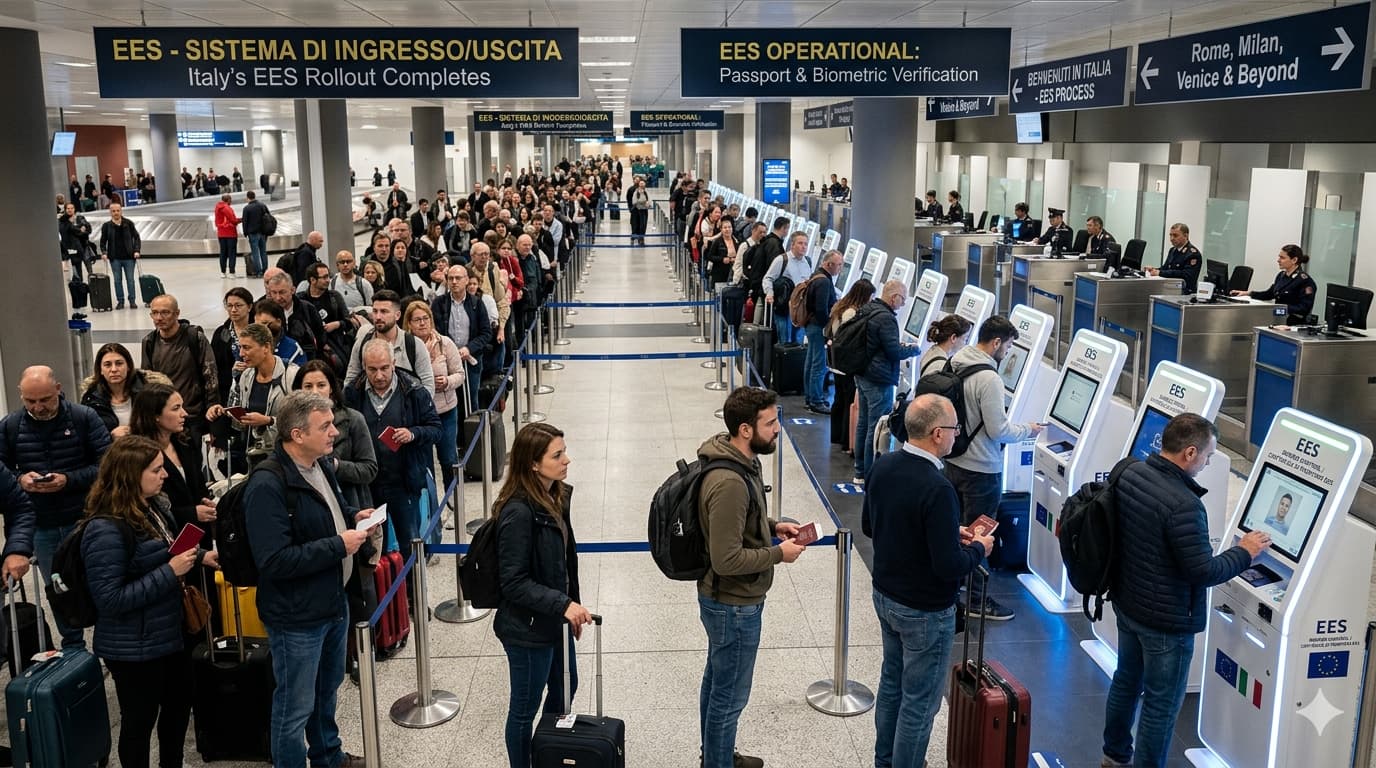
If you flew into Rome Fiumicino or Milan Malpensa last month and found yourself standing in a passport queue that barely moved for ninety minutes, you were not imagining it. You were experiencing the growing pains of the most significant overhaul to European border management in a generation — and if you are planning to travel to Italy this summer, the situation has changed again in the last few weeks in ways that matter to you directly.
Here is the full picture of what has happened, where things stand right now, and what every traveler needs to do before stepping on a plane to Italy.
How Italy Got Here — A Rollout Seven Months in the Making
The EU Entry/Exit System is not new in concept. It was years in the making before Italy began its phased activation on October 12, 2025 — starting with Rome Fiumicino and Milan Malpensa, the country’s two busiest international gateways. Palermo and Genoa followed on October 20, 2025, and the system expanded progressively from there.
The full mandate arrived on April 10, 2026 — the first time the procedure became mandatory at every external Italian crossing point, from Rome Fiumicino and Venice Marco Polo airports to the ferry ports in Bari and Trieste and the Alpine road posts on the Brenner Pass. That date marked the moment Italy joined the rest of the Schengen zone in full EES compliance — as of April 10, 2026, the EES replaced the stamping of passports, allowing the automatic detection of overstayers who have exceeded the maximum duration of their authorized stay.
The system itself — a €1.3 billion platform run by EU agency eu-LISA — does more than replace ink stamps with fingerprints. It registers the person’s name, travel document data, biometric data including fingerprints and captured facial images, and the date and place of entry and exit. It also records refusals of entry. The practical effect is a Schengen-wide digital ledger that knows exactly where you are, when you arrived, and how many days you have left — automatically.
What Happened When It Went Fully Live
The theory was orderly. The reality was not
Less than two weeks after the EES became fully operational for short-stay travellers, Italy was feeling the strain. From the early-morning wave at Rome Fiumicino to late-evening arrivals at Milan Malpensa, passport halls turned into bottlenecks as border officers juggled manual stamping and the newly mandated fingerprint-and-facial-scan kiosks.
Processing times increased by 70% in some locations due to the added steps involved in biometric data collection — a figure reported by the Airports Council International that captures just how dramatically the system changed the pace of border clearance. Border-police unions warned of teething problems, noting that first-time registration takes two to four minutes per passenger, meaning peak-hour queues could initially double.
The May Day long weekend brought the situation to a head. Lines at Rome Fiumicino and Milan Malpensa stretched well beyond two hours for some British, US, and Canadian travelers. Reports emerged of passengers missing connecting flights. Within hours of EES going fully live, airports across the Schengen area were in crisis. Passengers faced waits of up to three hours at border control, missed flights, and spent thousands finding their own way home.
A specific problem emerged that nobody had fully anticipated: foreign residents of Italy who hold a valid permesso di soggiorno card — legally exempt from EES registration — were still being funnelled into the slower “All Passports” queues because e-gates could not read their residence permits. Several travellers were mistakenly entered in the system as short-stay visitors, raising the risk that future trips could trigger over-stay alerts.
Italy’s Emergency Response — The 45-Minute Queue Threshold
Faced with a summer season approaching and queue times that were making international headlines, Italy’s Interior Ministry moved quickly. Italy’s Interior Ministry drafted an emergency decree allowing border police at Rome Fiumicino, Milan Malpensa, Venice Marco Polo, and other gateways to bypass biometric kiosks and revert to manual passport stamping whenever queues surpass 45 minutes. The hybrid regime is expected to run until September 30, 2026.
Live queue-time displays in control halls will trigger the fallback procedure. When the clock hits 45 minutes, officers switch back to stamps. When queues ease, the kiosks resume.
Now here’s the news, Italy completed its physical infrastructure upgrade — finalizing kiosk installation, e-gate calibration, and staff training across all remaining border points including land crossings and ports — which represents the technical completion of the rollout, even as the practical operation remains in this hybrid manual-biometric mode through summer.
Airlines must still transmit Advance Passenger Information, meaning overstays will continue to be tracked electronically even when no biometrics are taken. This is the important detail that travelers need to understand: the 45-minute fallback to stamping does not mean EES has been switched off. The central database remains live. Your Schengen days are still being counted. The system just collects them differently when the queues get out of hand.
What This Means for Your 90-Day Count
The EES counts each 24-hour period spent in the zone and alerts officers if a traveller risks exceeding the 90/180-day rule — a common error for frequent flyers on short-term assignments.
For UK citizens, Americans, Canadians, Australians, and other visa-exempt nationalities, this is the most significant practical change EES introduces. The old passport stamp system had gaps — stamps that were missed, faded, or not applied at busy crossings. Some travelers relied on that inconsistency, consciously or not. EES closes all of it. Italy has publicly confirmed that it does not plan to exempt any nationality from biometric registration requirements under the EU Entry/Exit System.
Business-travel managers note it complicates duty-of-care compliance — workers could accrue extra Schengen days if manual stamps are mis-read or missing. Companies are updating expense-report tools to capture exact entry and exit data and briefing staff to photograph stamps as backup evidence.
For individual travelers, the practical implication is straightforward: track your Schengen days carefully and do not rely on the impression that the system is lenient because you sometimes see manual stamping. The digital record is running regardless. Use our Schengen 90/180-Day Rule Calculator.
What to Do Before You Travel to Italy This Summer
The situation is live and evolving, but the practical advice for anyone heading to Italy between now and September 2026 is clear.
Arrive earlier than you normally would at the airport. The official guidance from airlines — instructed directly by authorities — is to add at least 90 minutes to your usual pre-departure buffer if you are connecting through an Italian hub. During peak summer months, two hours of additional buffer is more realistic for major airports.
Make sure your passport has at least two blank pages. Officials stress that the central EES database will remain live, so travelers should ensure their passports have at least two blank pages. The fallback manual stamping still requires physical space in your passport. Running out of blank pages at an Italian border control point in August is a situation nobody wants to be in.
If you are an Italian resident traveling on a non-EU passport, carry your permesso di soggiorno at all times and be prepared to explain your exemption status at the border. The e-gate reading issue means you may be directed to a manned booth regardless — knowing your rights in advance saves considerable stress.
And if you are planning a multi-country Schengen itinerary that includes Italy alongside France, Spain, Greece, or other destinations, remember that every day across the entire zone counts toward the same 90-day pool. Italy is just one country in that calculation.
The Bigger Picture — ETIAS Is Still Coming
The EES story is not finished. In addition to the Entry/Exit System, ETIAS will also soon be established. From the end of 2026, visa-exempt non-EU nationals — including travelers from the USA, Canada, Australia, and Japan — must apply for an ETIAS authorization before entering the European Schengen Area.
ETIAS is the pre-travel authorization layer that comes on top of EES — not instead of it. When it launches, visa-exempt travelers will need to complete a short online form and receive authorization before boarding a flight to Italy or any other Schengen country. We have covered ETIAS in full in our complete ETIAS 2026 guide.
The direction of travel is clear: European borders are becoming significantly more digitally managed than they have ever been. EES is the foundation. ETIAS is the next layer. The era of arriving at Fiumicino with just a passport and a vague sense of how long you have been in Europe is over.
What Nigerian and Indian Visa Holders Need to Know
For travelers who require a Schengen visa for Italy — including Nigerian, Indian, Pakistani, and other non-visa-exempt nationalities — the EES changes your border experience but not your visa requirement. You still need a valid Italian Schengen visa before travel. What changes is that your entry and exit are now recorded biometrically rather than through a stamp.
If you are planning an Italy trip and have not yet started your visa application, read our complete Italian Schengen visa requirements guide for the full document checklist, fee breakdown, and application process — especially important now that Italian border processing takes longer on the ground, making early visa approval even more critical to your overall travel timeline.
Italy is not closing its doors. It is changing the lock. Make sure you have the right key — and arrive with enough time to use it.

