How to Move to Germany Without a Blocked Account (Verpflichtungserklärung Guide)
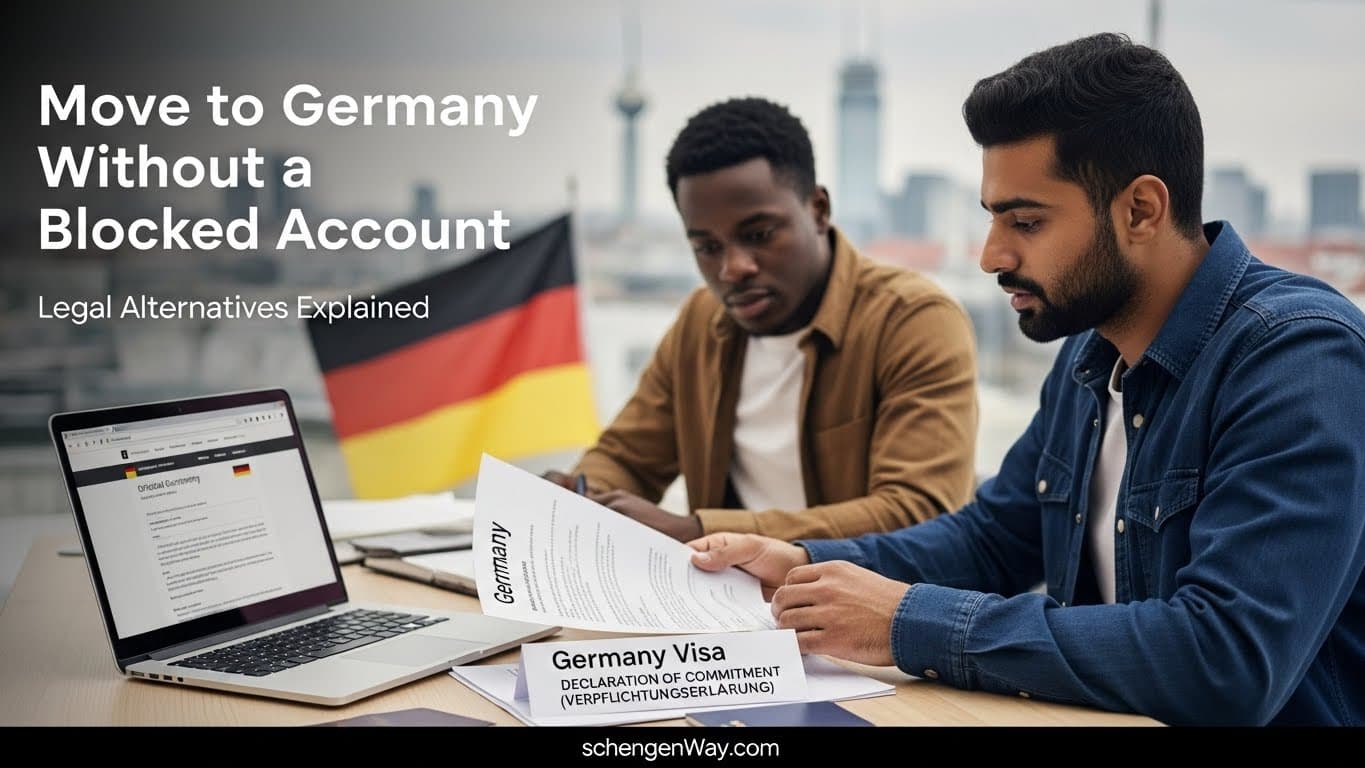
If you’re searching for how to move to Germany — especially for study or long-term stay — one of the biggest hurdles you’ll face is proving that you can support yourself financially. Most people think that a blocked account (Sperrkonto) is the only way. But that’s not true. There are several alternatives you can use instead of a blocked account, and in this article, we’ll explain each one step by step so you can decide which option fits your situation best.
What Is a Blocked Account and Why Is It Common?
A blocked account is a special German bank account where you deposit a set amount of money (currently about €992 per month or €11,904 per year) before your visa application. That amount can later be withdrawn in monthly installments after you arrive in Germany. It’s the most common proof of funds for non-EU nationals.
However, opening a blocked account can be stressful, especially if you don’t have access to €10,000+ up front. Luckily, the German embassy accepts other forms of financial proof in certain cases.
5 Ways to Move to Germany Without Blocked Account
Below are 5 verified ways you can move to Germany without the blocked account requirement.
1. Declaration of Commitment (Verpflichtungserklärung)
This is one of the strongest alternatives to a blocked account — and the one many people overlook.
What is Declaration of Commitment (Verpflichtungserklärung)
A Declaration of Commitment (in German Verpflichtungserklärung) is a legal document signed by someone already living in Germany (a friend, relative, or employer) who promises to cover your living expenses during your stay.
How It Works
- The sponsor must prove that they have enough income to support both themselves and you.
- The document is issued by the Foreigners’ Office (Ausländerbehörde) in Germany.
- The sponsor must attend in person and submit financial proof at the office.
- Once issued, you include the original in your visa application.
Why This Is Useful
For people who have family or friends in Germany, this is a great way to bypass the blocked account requirement. It doesn’t require you to deposit a large sum of money yourself — your sponsor simply guarantees it.
Don’t get me wrong, while a Verpflichtungserklärung can replace a blocked account, it doesn’t guarantee visa approval — you also must satisfy all other Germany visa requirements.
2. Scholarship — Fully or Partially Funded
Many people I know have moved to Germany via scholarships and none were required to provide blocked account. If you secure a recognized scholarship, this can replace the blocked account entirely.
How Scholarship Works as Proof
Scholarships from reputable institutions (government, university, or public foundation) that cover at least the minimum monthly support (around €992/month) are accepted by German embassies as proof of sufficient funds.
Types of Scholarships
- DAAD Scholarships — highly respected and competitive
- University-specific scholarships
- International scholarships awarded by German foundations
- Some private foundation awards (if official enough)
How to Use It
Submit the official scholarship award letter with your visa application. The letter must clearly state:
- Total amount
- Duration of funding
- Payment schedule
If the scholarship doesn’t cover all required funds, then you can combine it with another method — e.g., partial blocked account, Verpflichtungserklärung, or the other alternatives I will explaining below.
3. Parental Income
For many applicants from Africa and Asia, parents or guardians fund the move abroad. In some cases, this can be used instead of a blocked account.
What Counts
To use this option, you need to show documents that prove your parents have enough financial resources to support you — such as:
- Bank statements
- Payslips and tax returns
- Income certificates
- Savings statements (fixed account or FD)
- Affidavit of support
This method is accepted by some embassies, but it’s less consistent than the other methods, because it depends heavily on how convincing your documents are, and embassy staff may still request a blocked account or sponsor letter. So, I’ll always advise you check with your local consulate first.
4. Bank Guarantee (Bankbürgschaft)
A bank guarantee is another financial proof you can use to move to Germany— especially if you can’t afford a blocked account deposit but have other financial resources.
What is Bank Guarantee (Bankbürgschaft)?
A bank issues a legal letter (called a Bankbürgschaft) guaranteeing that it will cover your expenses if needed. That bank confirmation is submitted to the German embassy instead of a blocked account.
How It Works
- Your bank (in Germany or internationally) must be recognized and accepted by German authorities.
- You may need collateral or a minimum relationship with the bank.
- The bank must commit to paying on your behalf if needed.
This option is less common but useful for students or applicants who have solid financial backing but don’t want to lock actual cash into a blocked account.
Conclusion
Understanding how to move to Germany without relying on a blocked account can make the entire relocation process feel far more achievable, especially for applicants from Asia and Africa where access to large upfront funds can be a challenge. As this guide has shown, the blocked account is not the only route. Germany’s immigration system allows alternative forms of financial proof, provided they are credible, well-documented, and aligned with your visa type.