

Someone visited my office not long ago and asked something I hear regularly: “Norway sounds difficult. Do you think I have a real chance?”
She had done her research online, found a lot of conflicting information about what documents were needed, and was worried that Norway would be harder to get approved for than somewhere like Germany or Greece. She had a solid job, genuine travel plans, and enough money in her account to comfortably cover the trip. What she lacked was confidence in how to put it all together.
By the time she left my office with her document list, her cover letter drafted, and a clear timeline, that anxiety was gone. She got approved in 11 days.
The Norwegian Schengen visa is not dramatically harder than any other Schengen application. But it has specific expectations that, if you do not know about them, can trip up an otherwise strong application. That is what this article is about — not just what to submit, but how to submit it in a way that moves your file through the review process cleanly and quickly.
What Is the Norwegian Schengen Visa?
A Norway Schengen visa is a short-stay visa that allows its holder to enter Norway and stay there for up to 90 days within 180 days for purposes like tourism, business, visiting family or friends, and other short-term reasons. Since Norway is a member of the Schengen Area, a Schengen visa issued by Norway also allows the visa holder to travel to all 29 Schengen countries.
Norway is not in the European Union — a fact that surprises many people — but it is a full Schengen member through a separate bilateral agreement. Practically speaking, this changes nothing for the visa applicant. The process, the documents, the fee structure, and the 90-day rule all work exactly the same as for any other Schengen country.
What it does mean is that the Norwegian Directorate of Immigration — known as UDI — is the authority that ultimately governs visa policy. Some applications go through the Norwegian embassy or consulate directly. Others go through VFS Global, which Norway uses in many countries to handle the front-end submission process. UDI is the main authority that handles many immigration and residence permit decisions in Norway. For visitor visas, embassies and consulates handle many decisions, but some cases can be sent to UDI for additional checks.
Can You Use a Schengen Visa from Another Country to Enter Norway?
Yes — completely. This is one of the most commonly asked questions I get from clients planning a Nordic trip, and the answer is straightforward. If you hold a valid Schengen visa issued by France, Germany, Italy, or any other Schengen member state, you can enter Norway on that visa without any separate Norwegian application. Norway, as a Schengen member, accepts any valid Schengen visa for entry.
The only condition is the 90-day rule — which applies across the entire Schengen zone, not per country. Days spent in Germany count toward the same pool as days spent in Norway. You can always use our Schengen 90/180-Day Rule Calculator before planning any multi-country Nordic trip to confirm exactly how many days you have available.
Related Guides:
- France Visa Requirements 2026: Complete Guide to the France Schengen Visa (Step-by-Step)
- Everything You Need to Know About Germany Schengen Visa Requirements and How to Apply
- Lithuanian Schengen Visa 2026 — Requirements, Fees, and How to Apply (Complete Guide)
Who Needs to Apply Through Norway?
The main destination rule applies here the same as everywhere in Schengen. Apply through Norway if Norway is the country where you will spend the most days, or your first point of entry into Schengen if you are splitting time equally between countries.
If you are spending four days in Norway and ten days in Denmark, apply through Denmark — not Norway. When you get this right before submitting your application, it saves you both time and the complication of a rejection on procedural grounds.
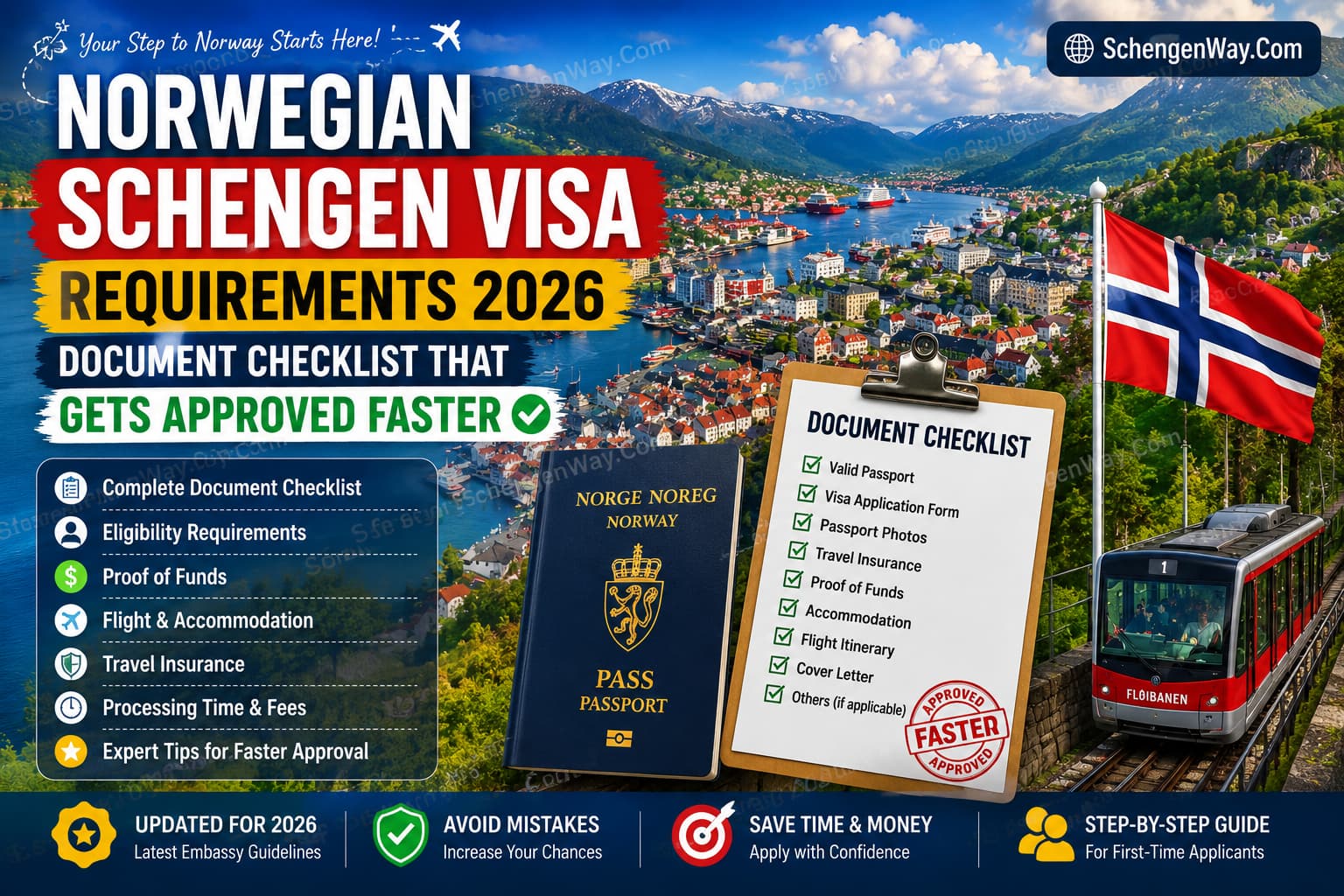
Norway Schengen Visa Document Checklists
Let me tell you, most checklists online just list documents. What I am going to do is explain why each document matters and what specifically makes a good version of each one versus a weak version that creates delays.
Valid passport
Your passport must have at least 3 months validity beyond your stay, be issued within the last 10 years, and have a minimum of 2 blank pages.
The three-month validity requirement is stricter than some applicants expect — it is not three months from today, it is three months beyond the last day of your intended stay. If your passport expires four months from now and you plan to be in Norway for two months, you are cutting it uncomfortably close. Renew before you apply if there is any doubt.
Completed and signed visa application form
Start your application through the official UDI visa portal. All you need to do is just head over to udi.no, download the form, complete it in full in capital letters, and signed by hand. Do not leave any section blank — a blank field is treated the same as a missing document and will slow your application at the initial completeness check before it even reaches a reviewer.
Passport photographs
Two recent passport photos — 35×45mm, white background. The passport photograph should be taken within the last six months. Full face visible, no glasses, neutral expression. These seem minor until an application gets sent back because the photograph does not meet specification. And you need to use a professional photo service rather than a phone app.
Travel medical insurance
Buy travel insurance that meets Schengen requirements before applying. The policy must be valid across the entire Schengen Area — not just Norway — with minimum coverage of €30,000 including medical repatriation. Print the full policy certificate, not just the booking confirmation. Embassy reviewers need to see the coverage amount, validity dates, and geographic scope clearly stated. A policy that covers “Europe” without specifying Schengen countries and without a stated minimum coverage amount will be questioned.
Confirmed return flight reservation
Your reservation must show your entry into and exit from the Schengen zone. Norway specifically — based on what I have seen with multiple applications — is comfortable with a reservation rather than a purchased ticket, but it must be a real reservation with a booking reference that can be verified, not a screenshot of a search result.
Proof of accommodation
Hotel bookings, Airbnb confirmations, or an invitation letter if you are staying with someone in Norway. Every night of your stay needs to be accounted for. The accommodation dates must align precisely with your flight dates. If there is any gap — your flight arrives on the 10th but your hotel starts on the 11th — explain it in your cover letter or it creates a question that delays processing.
If you are staying with a friend or family member in Norway, their invitation letter should include their full name and address, confirmation that you will stay with them for the stated dates, and a copy of their Norwegian residence permit or ID. A vague email saying “you can stay with me” does not meet the standard.
Cover letter
This is not a formality. In my experience, a well-written, specific cover letter is one of the most underrated documents in a Schengen application — and one of the most consistently neglected. Write specifically about your trip: where you are going in Norway, what you plan to do, your daily budget, and clearly state your reasons for returning home. A generic template that could apply to any applicant going anywhere in Europe does not help your case. But, a cover letter that describes your specific plans, references your specific documents, and explains anything that might raise a question does help your case significantly.
Proof of financial means
This is where I see the most preparation errors and the most rejections. Norway does not publish a specific fixed daily rate requirement the way some Schengen countries do — financial sufficiency is assessed case by case. But from what I have observed across multiple applications, a working benchmark of approximately €100 per day of your stay in accessible funds is a reasonable standard to aim for. For a ten-day Norway trip, that is €1,000 in trip funds demonstrated clearly in your account.
More important than hitting a specific number is the consistency of your statement history. Three to six months of bank statements showing regular income credits, a stable or growing balance, and no large unexplained deposits are worth more than a single high balance that appeared three weeks before your application date. The embassy is assessing your financial credibility, not just your current balance.
Bank statements must be officially stamped and signed by your bank — not printed at home from your mobile banking app. For Nigerian applicants, this means walking into your branch and requesting official printed statements. For Indian applicants, the same standard applies.
For the complete breakdown of how to prepare your financial documents in a way that holds up under embassy scrutiny, read our Schengen visa bank statement requirements guide.
Employment documentation
If you are employed, you need an employment letter on official company letterhead confirming your role, salary, length of service, and that you have been granted approved leave for the travel period. Include your last three months of payslips. The salary figure in your employment letter must match the credits appearing in your bank statement — a discrepancy between these two documents is one of the most consistent rejection triggers I see.
If you are self-employed, include your business registration documents, business bank statements for the last three to six months, and your most recent income tax returns.
Previous Schengen visas
If you have traveled to Schengen countries before on a visa, include copies. Prior visas with clean travel records work strongly in your favor — they demonstrate you have previously respected visa conditions and returned home as required. If you do not have prior Schengen history, this is not a disqualifier, but your other documents need to work harder to establish credibility.
What Norway’s Embassy Actually Evaluates
The Norway consulate assesses applications on the basis of genuine visitor intent, financial self-sufficiency, ties to your home country, and the completeness of your document file.
That last point — completeness — is where faster approvals come from. Submitting a well-organised, complete application significantly reduces the risk of refusal or delays.
What this means in practice is that your file should answer the reviewer’s four core questions before they have to ask them:
Why are you going to Norway? — this is answered by your cover letter and itinerary.
Can you fund the trip? — this is answered by your bank statements and employment letter.
Will you leave when your visa expires? — this is answered by your employment ties, family commitments, property, and the general credibility of your home-country life.
Is everything consistent? — this is answered by checking that every date, figure, and claim in your file matches every other document.
When all four questions are answered before the reviewer reaches for a query form, the application moves faster. When any one of them requires the reviewer to stop and investigate, the 15-day timeline extends.
How Long Does a Norwegian Visa Take?
Standard processing time is often described as up to 15 days, counted after the consulate receives a complete file. Extra checks can extend decision time, in some cases up to 45 days when UDI gets involved.
Apply no earlier than 6 months before your trip and at least 4 weeks in advance.
The 15-day clock only starts when the embassy considers your file complete. If your application is submitted with a missing document or something that requires clarification, the clock effectively pauses while the issue is resolved. This is why completeness matters not just for approval chances but for the speed of your approval.
In practical terms, I always advise clients to apply six to eight weeks before travel for a standard first application. For peak summer season — June through August when Norway draws its highest visitor numbers — applying three months in advance is safer. Appointment slots at VFS Global centers fill faster during this period and processing loads are higher.
Standard processing is usually 15 days, but some cases can take longer. If you apply through VFS Global, an additional service fee of approximately €27 is charged per application.
Related article>> How Some VFS Staff Mislead Visa Applicants (And How to Avoid Costly Mistakes)
Is Norway Visa Hard to Get?
This is the question my client asked when she first sat down. The honest answer is: Norway is not significantly harder than other comparable Schengen destinations, but it is thorough. The Norwegian consulate reviews files carefully — they are not known for rubber-stamping applications, but they are also not known for arbitrary rejections.
What makes Norway applications succeed or fail is the same as everywhere in Schengen — the quality of preparation. A complete, consistent, honest application from a genuine traveler with credible financial documentation and real ties to their home country clears the Norwegian review process well within the standard timeline.
What makes applications slow down or fail is inconsistency between documents, insufficient financial history, vague travel plans that do not hold together as a real itinerary, or documents that were assembled in a hurry without being cross-checked against each other.
Norway’s Northern Lights season — October through March — and summer season both draw heavy application volumes. Applying outside these peaks, everything else being equal, tends to move faster.
Common Mistakes That Slow Approvals or Cause Rejections
One mistake I see regularly that costs people their application is the employment letter dated more than three months ago. Some applicants use a letter they had prepared for a previous application attempt. By the time they reapply, the letter is stale. A letter dated four to six months ago may be considered outdated by stricter embassies.
The second most consistent problem is the large deposit that appears in the bank statement just before application. I have seen clients transfer money from a family member’s account into their own to boost the closing balance, without realizing that the pattern of how that money arrived tells a different story than steady salary credits. A sudden large deposit with no explanation does not tell a coherent story — it raises questions about the credibility of the financial picture.
Third is the travel insurance certificate that does not explicitly state €30,000 minimum coverage. The policy might cover it — but if the certificate handed to the embassy says “comprehensive European cover” without the figure, the reviewer cannot confirm compliance. Always ensure the coverage amount appears explicitly on the document you submit.
For a deeper understanding of how embassies assess documents and what raises red flags during review, our article on how embassies detect fake documents
What About the New EES System?
All travelers from countries outside the EU/EEA who visit Norway or the Schengen Area for a short stay are now registered in the European Entry/Exit System, which is fully operational. The system records facial images, fingerprints, and information about passports, as well as the time and place of entry and exit.
What this means practically is that your Schengen days are now tracked digitally at every Norwegian entry and exit point. The 90-day rule has always existed — but it is now enforced with digital precision rather than the looser passport stamp system. Before any multi-country trip that includes Norway, use our Schengen 90/180-Day Rule Calculator to confirm your exact remaining allowance.
What I Always Tell Clients Before They Apply for a Norway Visa
Norway is extraordinary — and I genuinely mean that in a way that has nothing to do with selling a visa. The fjords, the Arctic light, the coastal towns that look like they were designed by someone who had never seen anything ugly — it is worth the preparation.
The preparation itself is not complicated when you approach it correctly. Give yourself six to eight weeks before your travel date. Get your employment letter freshly dated. Have your bank statements officially stamped covering the last three to six months. Write a cover letter that describes your actual specific trip rather than a generic trip to Europe. Make sure every date in every document tells the same story. Check that your insurance certificate explicitly states €30,000 coverage.
And do not wait until something goes wrong to ask for help. The applications that go smoothly are the ones that were reviewed carefully before they were submitted — not the ones that get rushed out the door two weeks before departure.
If you want your application reviewed for consistency and completeness before you submit, or if you need help putting together a specific section of your file, reach out through our SchengenWay contact page. We look at a lot of Norway applications and we know what moves them through quickly.
Norway is waiting. Go prepared.

