

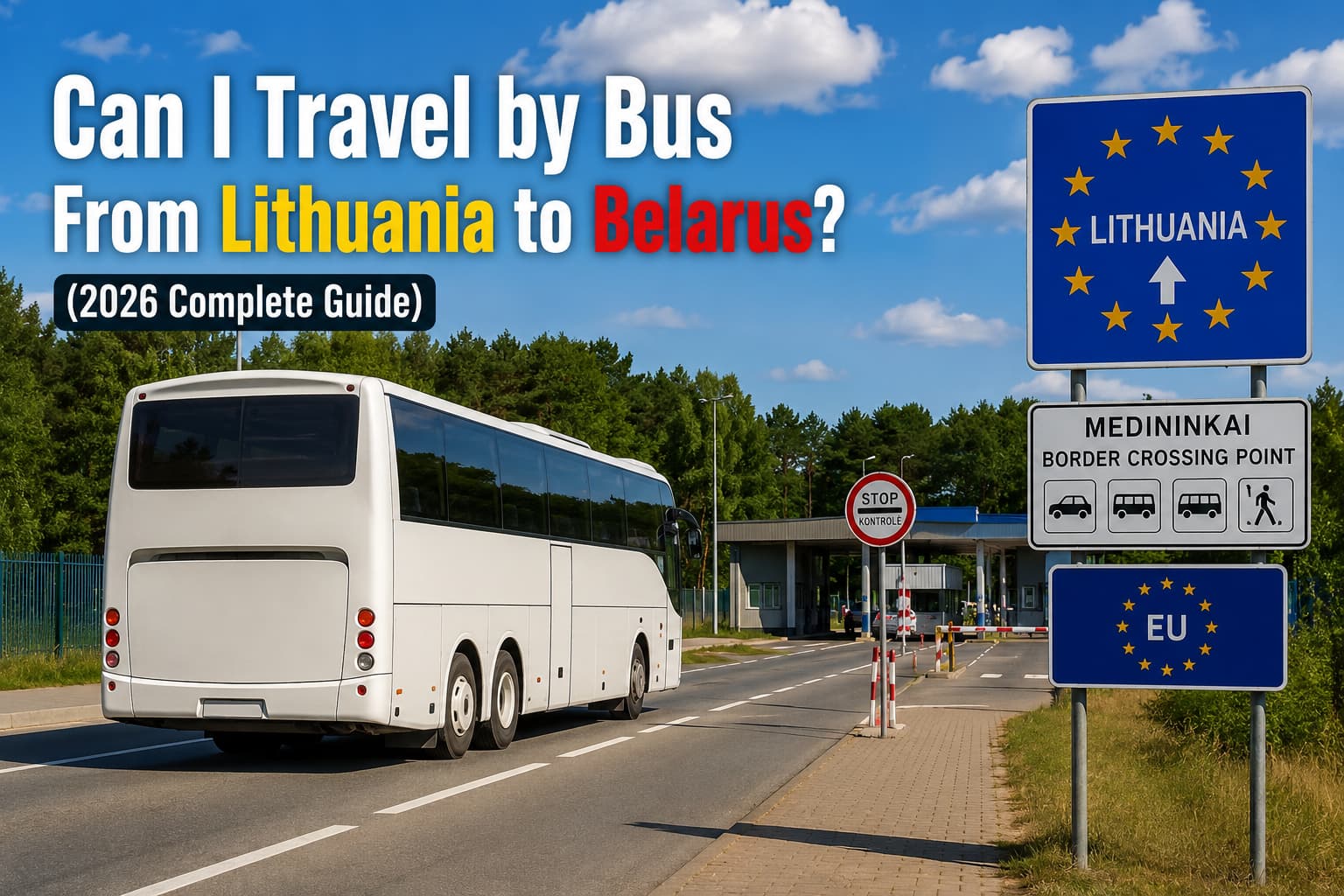
The short answer is yes — you can travel by bus from Lithuania to Belarus. Buses run the route. The crossing exists. People make this journey regularly.
I have seen this question asked multiple times on Reddit and Quora, but here is the thing I always tell clients who come in asking this question: the fact that the route exists and the fact that it is reliably open are two different things. The Lithuania-Belarus border has been closed, reopened, partially restricted, and reopened again multiple times in the last three years. And unlike a flight delay or a missed connection, arriving at a closed border crossing after a three-hour bus ride with your bags packed and your hotel booked in Minsk is a genuinely miserable situation.
So yes — let us talk about how the bus journey works. But let us also talk about what you need to know before you get on that bus.
Is the Lithuania-Belarus Border Open Right Now?
This is the first question and the most important one — and I want to be direct with you: the status changes.
As of January 7, 2026, Lithuania had closed all border checkpoints with Belarus. That closure followed a series of security incidents including disruptions at Vilnius Airport caused by balloons being used to smuggle cigarettes across the border. Lithuania later reopened its two border crossings with Belarus — Medininkai and Šalčininkai — after weeks of closure, moving the reopening decision forward by a day following diplomatic communications.
Of the six crossings that exist between Lithuania and Belarus, Lithuania has closed most of them since 2023. As I write now, only two remain open — Medininkai-Kamenny Log and Šalčininkai-Benyakoni — but Lithuania reserves the right to close them immediately if it detects security threats, as it has done on several occasions.
What this means in reality is that the route is operational as of the time of writing — but it has been shut without warning before and can be shut again. This can change literally overnight. So, I will always advise you recheck the border status 48 hours before travel, and even 24 hours before departure. The most reliable source is the official Belarusian border website, where each checkpoint is marked green for open and red for closed.
I always tell clients: do not book non-refundable accommodation in Minsk until you have confirmed the border is open within 48 hours of your departure. It sounds excessive until the crossing gets shut the day before your trip and you are looking at cancellation fees on both sides.
How Does the Bus Journey From Lithuania to Belarus Work?
Assuming the border is open, the bus from Vilnius to Minsk is the most practical way to make this crossing. Direct flights between Belarus and most of Europe have been heavily disrupted since 2021, and international trains are no longer a reliable option. The bus is what most people take.
Buses run daily, follow a direct route, and drop you right in the city centre. Although the distance from Vilnius to Minsk is only about 180 kilometres, the journey typically takes 6 to 7 hours. The longer duration is due to border formalities on both the Lithuanian and Belarusian sides. Earlier in 2025, the trip could even take up to 12 hours.
The Lithuanian-Belarusian border is tightly controlled but quite orderly on the Lithuanian side. What happens on the bus at the border is more involved than what most European travelers are used to on internal Schengen routes. Officers board the vehicle, passports are collected and checked, bags may be inspected, and everyone waits inside the bus during the process. You are not standing in a queue at a booth — you are sitting in your seat while the paperwork moves around you. It sounds civilized but it can be slow.
Border crossing at Belarus depends on the situation at checkpoints. Sometimes it can take up to several hours.
In my experience, the crossing time is the single biggest variable in this journey. Everything else — the bus ride itself, the Minsk arrival — is predictable. The border is not. Build in a generous buffer and do not connect this journey to anything time-sensitive on the other end.
Which Buses Run the Route?
There are several bus companies that make the journey between Lithuania and Belarus. Eurolines and Ecolines both operate on the route. Based on the experience of travelers who have used both, Ecolines has been more reliable and is generally cheaper as well.
From Vilnius Bus Station, there are two cities in Belarus that you can travel to — Minsk Central Bus Station and Hrodno, also known as Grodno.
Vilnius Bus Station is centrally located and straightforward to find. Buses depart from there and arrive at Minsk’s central station, which is well connected to the rest of the city by metro and taxi. You do not need to figure out onward transport in Minsk the moment you arrive — the central station is a proper hub.
Booking in advance is sensible, particularly during summer and around public holidays when seats fill. Tickets are available through operator websites and aggregators like Infobus, though I always recommend cross-checking directly with the operator to confirm the bus is actually running before you rely on third-party booking confirmations.
Do I Need a Visa for Belarus?
This depends on your passport — and the situation here has actually improved meaningfully for a wide range of travelers in the last two years.
As of July 19, 2024, Belarusian authorities expanded their visa-free entry policy for land border crossings to include 35 European Union countries, alongside Latvia, Poland, and Lithuania, which were already eligible. The 30-day visa-free entry policy was extended and is currently set to run until December 31, 2026.
This is significant. Citizens of most EU member states — including France, Germany, Italy, Spain, the Netherlands, Poland, and Lithuania itself — can enter Belarus visa-free for up to 30 days through land border crossings, including the Medininkai-Kamenny Log crossing used by buses from Vilnius.
Some nationalities require a visa to enter at land borders, while an e-visa option became available from March 2025 for eligible countries.
If you are a UK citizen, you are generally eligible for the 30-day visa-free arrangement under the extended policy. If you are a non-EU, non-UK traveler, you need to verify your specific nationality against the current Belarusian entry policy. The list of visa-free eligible nationalities is not static and has changed before with relatively short notice.
Travelers who do not qualify for visa-free entry need to obtain a Belarusian visa in advance — either through a Belarusian embassy or, where available, through the e-visa system. Attempting to cross without the correct documentation is not a situation where the border officers will help you figure it out on the spot. You will be turned around.
Can I Enter Belarus With a Schengen Visa?
No. A Schengen visa is not valid for entry into Belarus. Belarus is not a Schengen country and has no relationship with the Schengen visa framework. A valid French Schengen visa, a German Schengen visa, or any other Schengen sticker in your passport does not entitle you to enter Belarus. You either qualify for the visa-free arrangement based on your nationality, or you need a separate Belarusian visa.
I have seen this confusion come up more than once — travelers who assume that because they can travel freely within Schengen, a neighboring country would extend them similar courtesy. Belarus does not. The Schengen visa stops at the Lithuanian border. From that line eastward, different rules apply entirely.
What Documents Should You Carry?
Even if you qualify for visa-free entry into Belarus, you need to be carrying the right documents or you can still face problems at the crossing.
Your valid passport is the core requirement. It must have enough validity — most guidance recommends at least three to six months of remaining validity beyond your planned return date.
Medical insurance covering treatment and hospitalization in Belarus is technically required. Technically, you need medical insurance that covers hospitalization and treatment in Belarus, although it is not always asked for on entry. The fact that it is sometimes not checked does not make it optional. The Belarusian border is not a place where you want to be caught without something that is technically required, even if others have gotten through without it. Get the insurance — it costs very little and removes one potential complication.
Proof of accommodation — a hotel booking or host address — can be requested. Most hotel booking platforms do not work in Belarus. Hotels.com and contacting accommodations directly are how travelers have made advance bookings. Print your booking confirmation rather than relying on being able to pull it up on a phone at the border.
Return bus ticket or onward evidence showing you intend to leave before your 30-day visa-free window expires is helpful to have. It is not always requested but it reinforces your position if the border officer has questions about your stay.
Related article>> How Strict Is Immigration Control for Non-EU Citizens Flying Within the Schengen Area?
What Should You Expect at the Border?
The border process is organised and safe, but the wait can be long. Here is the realistic picture of what happens when your bus arrives at the Medininkai-Kamenny Log checkpoint.
On the Lithuanian side, you will go through EU exit formalities. Since Lithuania is a Schengen country and the EES — Entry/Exit System — is now operational across Schengen, your exit will be biometrically logged. Your passport is scanned, your fingerprints may be recorded if this is your first entry or exit through the EES system, and your Schengen day count is updated in the system. This is the same process covered in our article on how the EES works at Italian and other Schengen borders.
After clearing Lithuania, the bus crosses into Belarusian territory and stops at the Kamenny Log checkpoint on the Belarusian side. Belarusian border officers are thorough. They board the bus, collect passports, sometimes take them away for processing, and return them with entry stamps once you have been cleared. Questions about the purpose of your visit, where you are staying, and how long you plan to be in the country are standard.
The Lithuanian-Belarusian border is tightly controlled. Bag inspections happen — not for every passenger on every crossing, but often enough that you should be prepared for your luggage to be opened and checked. Carry only what you actually need and nothing that could cause unnecessary questions.
The entire border process — both sides combined — typically takes one to three hours on a normal day. During periods of elevated security checks or when there are more buses than usual, it can stretch longer. Patience is genuinely the most useful thing you can bring to this crossing.
Can I Be Denied Entry at the Border?
Yes — and it happens. Entry is never guaranteed regardless of whether you technically qualify for visa-free access. The Belarusian border officer has discretionary authority to refuse entry.
Common reasons for refusal include insufficient financial means to support your stay, inability to explain your visit convincingly, documentation that does not match what you have stated, or flagging in any security system. I have also seen cases where travelers with a history of overstaying in other countries, or who have had previous entry issues in countries that share information with Belarus, encountered problems.
If you are denied entry, you will be put back on a bus to Vilnius. You will not be detained in most circumstances, but you will not be entering Belarus that day, and the return journey is on you financially.
The most reliable way to avoid denial of entry is to have clear answers to basic questions — where are you staying, how long are you there for, why are you visiting — and the documentation to back up those answers.
Are There Alternative Routes If the Lithuania Border Is Closed?
Yes — and given the border’s history of temporary closures, knowing your alternatives before you travel is sensible.
The Poland-Belarus border has only one crossing point remaining open: Terespol-Brest. Plenty of buses run daily between Warsaw, Terespol, Brest, and Minsk, with travel time of approximately 10 hours from Warsaw to Minsk. Poland is accessible from Lithuania by bus or train, making this a viable reroute if the Lithuanian crossings are closed.
Latvia has one border crossing operational with Belarus: Pāternieki-Grigorovshchina. Since October 2025, it has been mandatory to register in advance in an Electronic Queue System via lvrobeza.lv. The reservation costs €9.30 per vehicle. This is primarily useful for travelers in private vehicles rather than bus passengers, but knowing it exists as an option is worth noting.
If both Lithuania and Latvia are closed, the Poland route via Terespol-Brest is the most established alternative for getting to Minsk from the EU side.
Is It Safe to Travel to Belarus by Land?
The border crossing itself is orderly. The process is organised and safe. The bus journey through Lithuania is entirely normal. The Belarusian side of the crossing is strict but not hostile toward tourists and visitors making a legitimate trip.
The broader question of safety in Belarus as a destination is one where I advise clients to check their government’s current travel advisory. The political situation in Belarus has been tense since 2020, and several Western governments maintain advisory notices recommending travelers exercise increased caution or avoid non-essential travel. These advisories do not necessarily mean the country is dangerous for a tourist visiting Minsk for a few days — but they reflect a real context that travelers should be aware of and decide for themselves how they weigh.
What I tell my clients is this: if you go, go prepared, go with a clear purpose, and go knowing that you are traveling to a country where the political environment affects how some things work — from which apps function to which payment cards are accepted to how you communicate while you are there.
Conclusion
The Vilnius to Minsk bus is one of the more unusual travel experiences available in Europe right now — a crossing between an EU Schengen country and its eastern neighbor through a border that carries real geopolitical weight. The journey is doable. People make it without incident regularly. And Minsk is a genuinely interesting city that rewards the traveler who makes the effort.
But it is not a trip to approach casually.
Check the border status through official sources in the 48 hours before you travel. Confirm your visa situation for your specific nationality rather than assuming the visa-free policy applies to you. Carry your documentation — passport, insurance, accommodation proof — in organized, accessible form. Build time buffers into both sides of the crossing. And book accommodation through channels that actually work in Belarus rather than discovering at the border that your booking confirmation is from a platform that operates in the wrong currency or under sanctions.
If the Lithuanian crossings are closed when you want to go, the Poland route is your reliable alternative and it is a well-traveled one.

