Schengen Visa for Switzerland 2026 — Requirements, Fees, and How to Apply From India, UAE, Thailand, Singapore and Beyond
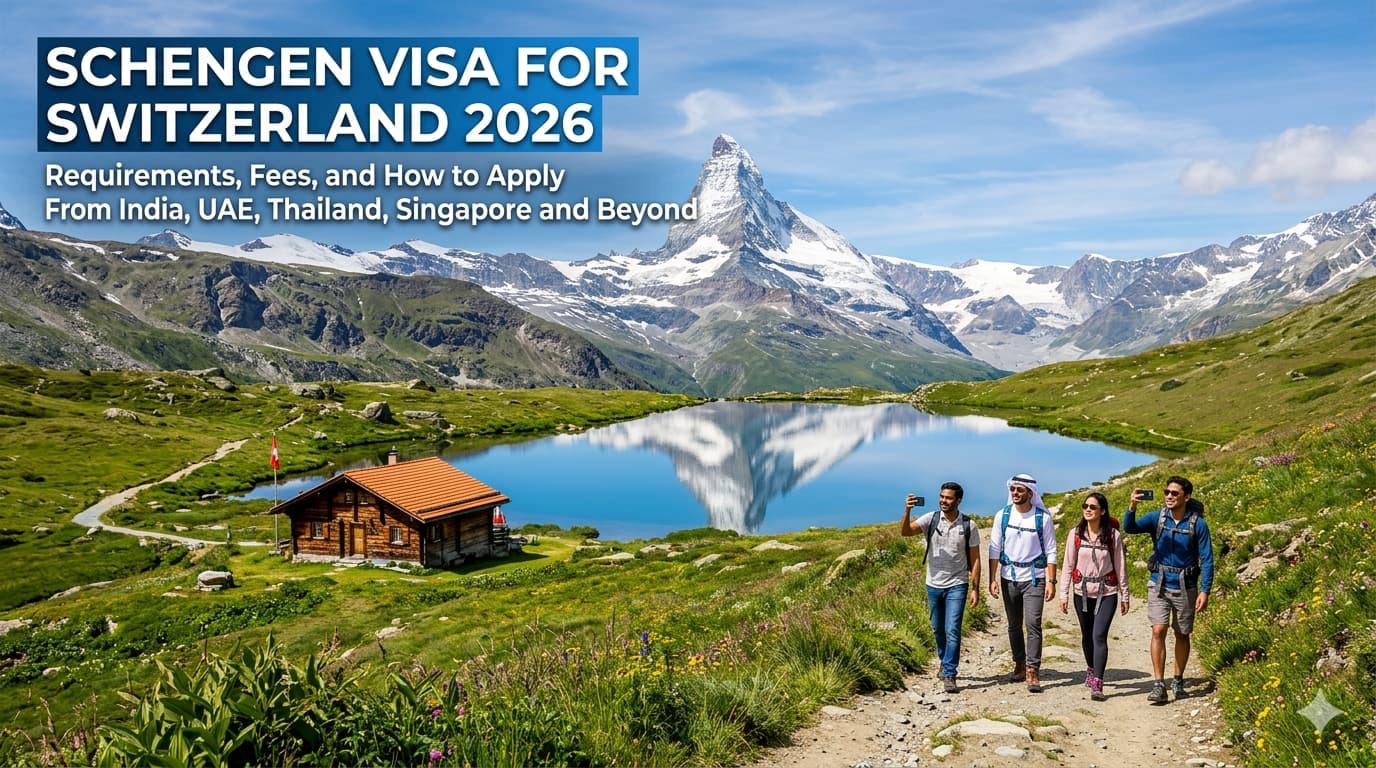
Switzerland is the kind of place that stops people mid-sentence. You are trying to describe it and the words just fall short. The Matterhorn at sunrise. Lake Geneva reflecting an impossible shade of blue. The streets of Zurich’s old town on a quiet Tuesday morning. Interlaken sitting between two lakes with the Alps rising on every side like something out of a painting nobody would believe was real.
Every year, millions of travelers from India, Thailand, Singapore, the UAE, Ireland, and dozens of other countries add Switzerland to their European bucket list — and then spend weeks trying to figure out exactly how the Schengen visa for Switzerland works. Which documents. Which embassy. Which fees. How long it takes. What happens if something goes wrong.
This guide answers every one of those questions clearly and completely. Switzerland has tightened its documentation requirements in recent years. In 2024, it rejected roughly 15% of Schengen visa applications from Indian nationals, putting it among the stricter consulates processing Indian applications. That number is not meant to discourage you — tens of thousands of applicants from these countries are approved every year. It is meant to make clear that the quality of your application genuinely matters, and walking into this process unprepared is a real risk.
By the time you finish this guide, you will know exactly what you need, how to prepare it, and how to give your Switzerland Schengen visa application the strongest possible foundation.
Is Switzerland Part of the Schengen Area?
Yes — but there is an important distinction that confuses many applicants, particularly those from India, Singapore, and the UAE who are familiar with EU membership as the default framework for European travel.
Switzerland is not an EU member but is part of the Schengen Area. This means the Schengen visa rules apply, but Swiss customs and border controls may differ from EU norms.
What this means practically is that Switzerland follows all standard Schengen visa rules — the same 90/180-day limit, the same application process, the same visa fee structure, and the same zone-wide validity that applies across all 29 Schengen members. A Schengen visa issued by Switzerland allows you to travel freely across all 29 Schengen countries including France, Germany, Italy, Spain, the Netherlands, and Austria — not just Switzerland itself.
Switzerland also has a specific and unique relationship with Liechtenstein. As we covered in our complete Liechtenstein Schengen visa guide, Switzerland handles all visa applications for Liechtenstein on Liechtenstein’s behalf — meaning a Swiss Schengen visa automatically covers Liechtenstein as well.
One practical consequence of Switzerland not being in the EU is that Swiss customs and border controls may differ from EU norms. Switzerland has its own customs territory separate from the EU’s single market. When you fly into Zurich or Geneva from outside the Schengen zone, you go through Swiss immigration — not EU immigration — and Swiss customs regulations apply on your entry. This matters for what you can bring in and how much currency you can carry without declaration.
The currency situation also catches travelers off guard. Switzerland uses the Swiss franc — CHF — not the euro. If you are combining Switzerland with France, Germany, or Italy on the same Schengen visa, you will need to account for two different currencies in your budget.
Who Needs a Schengen Visa for Switzerland?
Your requirement depends entirely on your passport nationality — not where you live, and not what other visas or residence permits you hold.
Nationalities that DO need a Schengen visa for Switzerland
All Indian passport holders need a Schengen visa to visit Switzerland for short stays of up to 90 days within a 180-day period. This applies to tourism, business meetings, visiting family or friends, attending conferences, and medical travel.
Beyond India, nationals who require a Schengen visa for Switzerland include citizens of Thailand, China, Pakistan, Bangladesh, the Philippines, Indonesia, Vietnam, most of Africa including Nigeria and Ghana, and the majority of South and Southeast Asian countries.
Nationalities that do NOT need a Schengen visa for Switzerland
Citizens of Singapore, the UAE, the United States, the United Kingdom, Canada, Australia, Japan, South Korea, and approximately 60 other countries can enter Switzerland visa-free for short stays of up to 90 days within any 180-day period. For these nationalities, no advance visa application is required — a valid passport is sufficient for entry.
However — and this is critical for Singapore and UAE nationals specifically — from late 2026, visa-free travelers will need ETIAS pre-authorization before visiting Switzerland. Starting in late 2026, a new travel authorization system called ETIAS will be implemented for visa-exempt travelers to the Schengen Area. This is not a visa — it is an online pre-screening completed before travel — but it is mandatory for all visa-exempt nationalities including Singapore and UAE citizens from the launch date. We cover ETIAS in detail in a dedicated section later in this guide.
The residence rule clarification
Many applicants from Thailand and India who are living in Singapore or the UAE wonder whether their residence status exempts them from the visa requirement. It does not. Most applicants must be legally residing in India, with some categories requiring at least six months of residence. An Indian national living in Dubai still needs a Schengen visa for Switzerland. A Thai national based in Singapore still needs one. Your passport nationality determines your requirement regardless of where you currently reside.
What Types of Schengen Visa Does Switzerland Issue?
Understanding the difference between short-term and long-term visas is very important before applying.
Type C — Short-Stay Schengen Visa
A Schengen Tourist Visa Type C is for holidays, sightseeing, and visiting friends and family, with a stay permitted of up to 90 days within a 180-day period. A Business Visa is for meetings, conferences, and short official trips. A Transit Visa is required only if you transit through certain Schengen airports and do not hold exemptions.
This is the visa the overwhelming majority of international travelers to Switzerland need. It covers tourism, family visits, business meetings, attending conferences, short medical consultations, and transit. Within Type C, Switzerland issues single-entry, double-entry, and multiple-entry visas — the type issued depends on your travel history, the purpose of your visit, and the embassy’s assessment of your application.
Type D — National Long-Stay Visa
If you plan to live, study, or work in Switzerland, you need a long-term national visa. This is a completely different process handled directly by the Swiss embassy rather than through VFS Global, and the requirements are significantly more extensive. Work visas, student visas for programs longer than 90 days, and family reunification visas all fall under the Type D category.
For the purposes of this guide — which focuses on the Schengen visa for Switzerland for tourism, business, and short visits — everything from here forward applies to the Type C short-stay visa.
What Documents Do You Need for a Schengen Visa for Switzerland?
Getting your documents right is the single most important thing you can do for your Switzerland Schengen visa application. Most delays and rejections happen not because the process is difficult, but because applicants rush or skip important steps.
Even small mismatches — name, passport number — can lead to rejection. Every document in your application must tell the same consistent story. If your cover letter says you are traveling from June 10 to June 20, your flight reservation, your hotel booking, your insurance policy, and your leave letter all need to reflect the same dates. Inconsistency is the fastest route to a refusal stamp.
Here is the complete document checklist for a Switzerland Schengen tourist or visitor visa in 2026:
Core documents every applicant needs
- Passport issued within the last 10 years with at least 3 months validity after the scheduled return date, with at least two blank pages. Handwritten passports and passports with observations regarding the front page cannot be accepted.
- Photograph with white background, not older than 6 months — size 35 to 40mm in width, not copied or scanned. The picture must be pasted on the application form — stapled or pinned pictures cannot be accepted.
- Completed and signed Schengen visa application form — available free of charge from the Swiss embassy website or through VFS Global. Must be printed, signed by hand, and submitted with all sections accurately completed
- Confirmed return flight reservation showing your entry into and exit from the Schengen zone
- Confirmed accommodation for every night of your stay — hotel bookings, Airbnb confirmations, or a formal invitation letter from a host in Switzerland
- Travel medical insurance with minimum €30,000 coverage, valid across all Schengen countries for the entire duration of your stay. Applicants who wish to apply for a six months or a one year multiple visa are not obliged to provide a 180 or 365 day coverage — it is sufficient to submit an insurance policy covering the first journey. You can check out how to get travel medical insurance here.
- Cover letter clearly stating your travel purpose, itinerary, and intention to return home. See full guide on how to write a cover letter for Schengen visa in 2026.
For employed applicants
A letter on business letterhead from the employer needs to be signed and stamped by HR or directorate, mentioning position and duration of service, a no-objection statement regarding the planned trip to Switzerland and Schengen states, and travel dates and purpose of the trip.
Additionally include
- Last three months of payslips
- Bank statements for the last three to six months showing consistent salary credits — all documents have to be originals, in A4 format, with stamp and signature of bank
- Personal ITR — only ITR-V, Indian Income Tax Return Verification Form or Acknowledgement is accepted — for Indian applicants
For self-employed applicants
Business registration certificate, GST Registration with Annex A and B, Partnership Deed or proof of proprietorship, company’s and personal ITR, and last three months personal bank statements.
For retired applicants
Personal pension bank statement for the last three months and proof of regular income generated by ownership of property or business.
For family visits — visiting someone in Switzerland
An invitation letter — original document — needs to be on business letterhead from the inviter or a signed personal letter, dated and signed, mentioning full names of all invitees, duration of stay, and including details of the inviter including full name, address, email ID, and telephone number.
For student applicants
- Copy of student college ID card and an introduction letter from the school, college, or university
- If a minor is applying: consent letter from the non-travelling parent or legal guardian, certified by public notary, and in all cases a copy of passport from both parents or legal guardian, or PAN card or driving license.
One important submission rule from the official Swiss embassy checklist:
Please submit the documents in the exact order given. Do not staple any document. This matters at VFS Global centers — the staff who do the initial document check are looking for a specific organization. Submitting documents out of order or stapled together creates confusion and may result in your file being flagged for additional review before it even reaches the embassy.
How Much Does a Schengen Visa for Switzerland Cost in 2026?
The Switzerland Schengen visa fee follows the standard Schengen fee schedule. The visa fee is €90 for adults, €45 for children ages 6 to 12, and free for children under the age of 6.
Beyond the embassy fee, applicants submitting through VFS Global pay an additional service charge. For Indian applicants specifically, the VFS service charge for Switzerland applications currently sits at approximately ₹2,000 to ₹3,500 depending on the center and service tier. The total cost for an Indian adult applicant including both fees is approximately ₹10,000 to ₹15,000 at current exchange rates.
For Thai applicants submitting through VFS Global Thailand, the total cost is approximately THB 3,500 to THB 4,500 depending on the service tier and center location.
For UAE residents submitting through VFS Global in Dubai or Abu Dhabi, the combined total in dirhams is approximately AED 380 to AED 450.
For Singaporean residents who require a Schengen visa — primarily non-exempt nationality passport holders living in Singapore — the total at VFS Global Singapore is approximately SGD 140 to SGD 165.
Remember that the visa fee is non-refundable. So, whether your application is approved, refused, or withdrawn after submission, the embassy fee stays with Switzerland. This is universal Schengen policy — not a Switzerland-specific rule.
Second, pay through the official channel only. Pay the applicable visa fee online or at the centre and keep the payment receipt safe as you will need it during submission.
How Long Does a Schengen Visa for Switzerland Take to Process?
As a general rule, a decision is taken by the Consulate within 15 days. This period may, in individual cases, be extended.
Some Schengen states require that they be consulted on visa applications submitted to other Schengen states by citizens of certain countries. The consultation process may take up to 14 calendar days.
In reality, the total timeline from appointment date to passport return varies significantly by applicant profile and time of year:
- Straightforward tourist applications with complete documentation: 7 to 15 working days
- First-time Schengen applicants or complex cases: 15 to 30 working days
- Applications requiring inter-state consultation: up to 45 days in total
- Peak summer season — June through August: typically toward the longer end of each range due to higher application volumes
I have always recommended that you submit the visa application early, at the earliest 6 months before the planned journey.
The absolute minimum submission window is 15 days before travel — but submitting that close to your departure date is genuinely risky. Slots at VFS Global centers fill up quickly, particularly in major Indian cities. Slots at VFS Global centres in India fill up fast, and the Swiss Embassy in New Delhi processes all applications centrally, which means there is little room for shortcuts.
The practical recommendation by applicant profile:
- Standard tourist application, experienced traveler: Submit four to six weeks before travel
- First-time Schengen applicant: Submit eight to ten weeks before travel
- Summer travel — June to August: Submit three to four months in advance
- Indian applicants in peak season: Start looking for appointment slots the moment your travel dates are confirmed — not when your documents are ready.
How Do You Apply for a Schengen Visa for Switzerland? Step-by-Step
Here is something that most guides get wrong — and we want to set the record straight before anything else.
You can start your Switzerland Schengen visa application online. The Swiss State Secretariat for Migration — known as SEM — provides an online portal where you can begin your application digitally. However, starting online does not mean finishing online. At some point in the process, you will still need to come in person for biometrics collection and document submission. Think of the online component as the preparation stage and the in-person appointment as the completion stage.
Like I always say, your application should be submitted no earlier than six months and no later than 15 days before your departure date for Switzerland. That 15-day minimum is a hard deadline — not a recommendation. But submitting that close to your travel date is genuinely risky because processing can take up to 15 working days or longer, and VFS Global appointment slots in busy cities like Mumbai, New Delhi, and Bangkok fill up weeks in advance.
Step 1 — Find your application point
Where you apply depends on where you currently live. You apply via the Swiss embassy, consulate, or authorized visa application center in your country of residence — not necessarily your home country, and not necessarily the country of your passport nationality.
Switzerland maintains embassies and consulates across the globe. You can find the complete list of Swiss embassies and consulates worldwide on the official website of Switzerland’s Federal Department of Foreign Affairs — known as the FDFA. Before booking any appointment or submitting any document, go directly to the official website of the nearest Swiss embassy or consulate to your location, verify the specific application procedures they follow, and confirm whether they process applications directly or through VFS Global.
Step 2 — Check whether VFS Global applies to you
Switzerland outsources its visa application process to VFS Global in many countries. If you are applying from India, China, Saudi Arabia, or several other nations, your application goes through a Swiss VFS Global center rather than directly to the Swiss embassy. For Indian applicants specifically, VFS Global Switzerland India centers are located in New Delhi, Mumbai, Bengaluru, Chennai, Kolkata, Hyderabad, Ahmedabad, Chandigarh, Pune, Jaipur, Kochi, Goa, Puducherry, and Jalandhar.
However — and this is important — not every country routes Switzerland applications through VFS Global. Some countries have direct embassy or consulate submission. Some have locally authorized visa application centers that are not VFS. The only reliable way to confirm which applies to you is to check the official website of the nearest Swiss diplomatic mission in your country through the FDFA list. Do not assume VFS Global applies to your country simply because it applies to India or China.
Step 3 — Begin your application online
Start your Swiss visa application process through the SEM online portal. This is where you complete your application form digitally, review the requirements for your specific visa category, and prepare your document checklist. The online form covers your personal details, travel purpose, itinerary, accommodation, financial means, and employment status — complete every field accurately and ensure the details match your passport exactly.
Even a single character mismatch between your online form and your passport — a transposed letter in your name, a wrong digit in your passport number — gets flagged during review and causes delays. Take your time at this stage. Accuracy here protects everything that follows. And if you are confused, check out How to Complete Schengen Visa Application Form.
Step 4 — Gather all documents before booking your appointment
Do not book your in-person appointment and then scramble to gather documents with the clock ticking. Assemble your complete document package first, verify every document for consistency, and only then lock in your appointment date.
Your bank statement dates must align with your employment letter. Your flight reservation must cover the exact dates in your cover letter. Your insurance policy must cover the full duration of your stay. Your hotel bookings must match your stated itinerary. Every piece of information across every document tells the same story — and that story must be consistent, specific, and honest.
Please submit the documents in the exact order given. Do not staple any document. Switzerland’s official document checklist specifies the exact ordering. Follow it precisely — the VFS center staff who conduct the initial document check are looking for a specific organization, and submissions that deviate from the required order create friction before your file even reaches the embassy.
Step 5 — Book and attend your in-person appointment
Book your in-person appointment through the official VFS Global website for your country or through your nearest Swiss embassy depending on which route applies to you. At your appointment, VFS staff will conduct a preliminary document check, collect your biometric data — fingerprints and photograph — and process your payment.
Personal appearance of the applicants is mandatory when applying for a Schengen visa if your finger scans have not been collected yet. Personal appearance and fingerprint scan is not necessary for children under the age of 12 years. If your finger scans were collected within the last 59 months and a visa with the mention “VIS” has been granted, then you won’t have to give new fingerprints for your next visa application, and personal appearance is not necessary.
This 59-month biometric exemption is particularly useful for frequent Schengen travelers. If you have applied for any Schengen visa in the last five years and your fingerprints were already collected, you may qualify to submit without attending in person — verify this with VFS Global or your nearest Swiss embassy before assuming you qualify.
Arrive at least 15 minutes before your scheduled time. Bring original documents and clean photocopies of each. Bring your appointment confirmation either printed or on your phone.
Related article>> How to Book Schengen Visa Appointments Faster in 2026
Step 6 — Track and collect
After submission, use the VFS Global tracking portal with your reference number to monitor progress. You will receive SMS and updates when the application moves through stages. When your passport is ready for collection, check every detail on your visa sticker before leaving the center — validity dates, number of entries, and maximum duration of stay. Report errors immediately.
Learn How to Track your Schengen Visa Application
Schengen Visa for Switzerland From India — Complete Guide
India is the single largest source of Switzerland Schengen visa applications globally. The Swiss Alps, Bollywood’s longstanding love affair with Swiss locations, and Switzerland’s status as a dream honeymoon and anniversary destination combine to make it one of the most desired European visas among Indian travelers.
All Indian passport holders need a Schengen visa to visit Switzerland for short stays of up to 90 days within a 180-day period. There is no visa-on-arrival, no e-visa, and no alternative entry route.
Where Indians apply
Applications are not submitted directly to the Embassy. Indian applicants must go through VFS Global centres, which collect and forward applications to the Swiss Embassy in New Delhi for processing. All VFS Global Switzerland India centers forward to the same New Delhi embassy — meaning your processing experience is consistent regardless of which city you submit from.
You can begin your application online through the SEM portal, then attend your nearest VFS Global Switzerland India center for the in-person biometrics and document submission stage. Check the official Swiss embassy New Delhi website to confirm current procedures before starting.
India-specific document requirements
Beyond the standard checklist, Indian applicants specifically need:
- Personal ITR — only ITR-V, Indian Income Tax Return Verification Form or Acknowledgement is accepted — for the last available year
- For self-employed applicants: business registration certificate, GST Registration with Annex A and B, Partnership Deed, or proof of proprietorship
- Form 16 if salaried — corroborates the income stated in your employment letter
- All bank statements must be originals in A4 format with stamp and signature of bank — downloaded or printed internet banking statements are not accepted
The rejection reality for Indian applicants
Switzerland rejected roughly 15% of Schengen visa applications from Indian nationals in 2024, putting it among the stricter consulates processing Indian applications. This is higher than many other Schengen embassies — but a well-prepared, honest, consistent application significantly reduces that risk.
Appointment strategy
Slots at VFS Global centres in India fill up fast. New slots typically appear Monday and Tuesday mornings. So, always have your details ready before you open the booking portal. For summer travel start looking three to four months ahead.
Schengen Visa for Switzerland From the UAE — What Residents Need to Know
The UAE situation requires the same clarification it does for every Schengen application.
UAE nationals
UAE passport holders are visa-exempt for Switzerland. They can enter for up to 90 days without any advance visa. From late 2026, ETIAS pre-authorization will apply, which is covered below.
UAE residents holding non-exempt passports
If you hold an Indian, Pakistani, Filipino, Nigerian, or other non-exempt passport and are residing in the UAE, your UAE residence does not exempt you from the Switzerland Schengen visa requirement. Your passport nationality determines your requirement.
You can begin your application online through the SEM portal before attending your in-person appointment. The Swiss consulate in Dubai or VFS Global UAE centers in Dubai and Abu Dhabi handle Switzerland applications from UAE residents. Also, check the official Swiss consulate Dubai website through the FDFA list for current procedures and whether VFS Global or direct submission applies.
Applying from the UAE rather than your home country carries a practical advantage — UAE-based bank statements, employment letters from UAE employers, and salary credits in dirhams often present a stronger financial profile than home country documents for applicants who earn and save in the UAE.
Schengen Visa for Switzerland From Thailand — Specific Guide
Thai nationals need a Schengen visa to visit Switzerland. Switzerland is one of Europe’s most popular destinations for Thai travelers — the Alpine scenery and Switzerland’s quality reputation align strongly with Thai traveler preferences.
You can start your application online through the SEM portal from Thailand. For the in-person stage, check the official website of the Swiss Embassy in Bangkok through the FDFA list to confirm current submission procedures — whether that is direct embassy submission, a local authorized center, or a VFS Global arrangement. Switzerland’s application procedures vary by country and the FDFA list is always the most reliable source.
Key documents for Thai applicants
- Valid Thai passport with at least three months validity beyond return date
- Thai bank statements for the last three to six months — officially certified
- Thai income tax documents or social security contribution records
- Employment letter from Thai employer with leave approval confirmation
- For self-employed Thai applicants: business registration and business bank statements
Processing from Thailand typically follows the standard 15 working day guideline. Allow up to 30 working days during European peak summer season.
Schengen Visa for Switzerland From Singapore — What You Need to Know
Singapore’s situation involves two distinct groups of travelers.
Singaporean citizens
Singapore passport holders are visa-exempt for Switzerland and can enter for up to 90 days without any visa. From late 2026, Singaporean citizens will need ETIAS pre-authorization — covered below.
Non-Singaporean residents in Singapore
If you hold an Indian, Chinese, Thai, or other non-exempt passport and are residing in Singapore, your Singapore Employment Pass, S Pass, or Dependent Pass does not change your visa requirement. You still need a Schengen visa for Switzerland.
You can start your application online through the SEM portal from Singapore. Check the official website of the Swiss Embassy in Singapore through the FDFA list for current in-person submission procedures — including whether VFS Global operates in Singapore for Switzerland applications or whether direct embassy submission is the route.
Applying from Singapore rather than your home country is generally permitted with at least six months of Singapore residency. Singapore-based CPF statements, Singapore employer letters, and Singapore bank statements typically present a strong financial profile for the Swiss embassy’s assessment.
Schengen Visa for Switzerland From Ireland — Do Irish Citizens Need One?
No. Irish citizens do not need a Schengen visa for Switzerland — and they never will.
Ireland is an EU member state and Irish citizens hold EU passports which give them the right of free movement across all EEA member states. Switzerland, through its bilateral EEA agreements, falls within this framework. Irish citizens can enter Switzerland, live, work, and stay indefinitely without any visa, pre-authorization, or advance application.
From late 2026, Irish citizens — like all EU citizens — will not need ETIAS either. ETIAS applies exclusively to non-EU, non-EEA nationals who currently have visa-free access. EU passport holders including Irish, French, German, and Italian citizens are completely exempt from ETIAS requirements.
For Irish citizens the entry requirements are a valid Irish passport or national ID card and nothing else. Switzerland is as open to an Irish citizen as any destination within the European Union.
How Much Money Do You Need to Show for a Switzerland Schengen Visa?
Switzerland does not publish a fixed daily rate requirement the way Spain publishes €100 per day or Italy publishes €120 per day. Financial sufficiency is assessed case-by-case by the Swiss embassy based on your overall financial profile.
As a working benchmark, CHF 100 per day — approximately ₹9,200 for Indian applicants, THB 3,900 for Thai applicants, and AED 415 for UAE-based applicants at current exchange rates — provides a reasonable foundation for your financial demonstration. For a 10-day Switzerland trip that is CHF 1,000 in accessible trip funds.
But the daily figure is only part of what the embassy evaluates. Financial credibility is one of the most important factors. Visa officers evaluate whether you can afford your trip without financial stress or illegal work. The consistency of your bank statement history matters as much as the closing balance. A moderate stable balance growing over six months tells a better story than a high balance that appeared three weeks before your application.
For the complete breakdown of how to prepare your bank statements for a Schengen visa application — how many months to submit, how to handle large deposits, what red flags to avoid, and how to present your financial profile most effectively — read our detailed guide on Schengen Visa Bank Statement Requirements. Everything covered there applies directly to your Switzerland application.
What Are the Most Common Reasons Switzerland Schengen Visas Are Rejected?
Switzerland visa rejections are more common than most applicants expect, especially for Schengen visas where documentation and intent are strictly evaluated.
The leading rejection triggers across Indian, Thai, UAE, and Singapore-based applications are incomplete documentation, inconsistent information across documents, insufficient financial proof, and weak demonstration of ties to the home country. Missing documents — bank statements, insurance, bookings — can lead to immediate refusal because Schengen authorities follow a strict checklist system.
One specific note for Indian applicants: if a Schengen visa has been refused, even for other countries like France or Germany, the applicant will consequently be refused a visa from Switzerland. This includes similar circumstances like overstaying a visa. Previous refusals across any Schengen country are visible to the Swiss embassy.
For the complete breakdown of every major rejection reason, the specific evidence that triggers each one, and the exact steps to address them before you apply — read our full guide on Why Schengen Visas Get Rejected and How to Fix Each Reason before you submit your Switzerland application.
What Is ETIAS and Does It Affect Your Switzerland Trip?
ETIAS — the European Travel Information and Authorization System — affects visa-free travelers to Switzerland specifically. Starting in late 2026, a new travel authorization system called ETIAS will be implemented for visa-exempt travelers to the Schengen Area.
If you are Singaporean, Emirati, British, American, or from any other currently visa-free nationality — ETIAS will be required before you board your flight to Switzerland from late 2026. It is not a visa. It is a short online pre-screening that costs €20, takes approximately 10 minutes, and is valid for three years across all 29 Schengen countries including Switzerland.
If you are an Indian, Thai, or other nationality that already requires a full Schengen visa — ETIAS does not apply to you. Your Schengen visa already covers the pre-screening function that ETIAS performs for visa-free travelers.
For the complete explanation of how ETIAS works, when exactly it launches, and what happens at Swiss borders after it goes live — read our full ETIAS 2026 Complete Guide for International Travelers which covers every detail relevant to Switzerland and all other Schengen countries.
Is a Schengen Visa Issued by Another Country Valid for Switzerland?
Yes — and this is one of the most practically useful facts for travelers combining Switzerland with other European destinations.
A valid Schengen visa issued by any of the 29 Schengen member states covers Switzerland for the duration of the visa’s validity. If you hold a valid French Schengen visa, a German one, an Italian one, a Dutch one — any of them — you can enter Switzerland on that visa without any additional application or authorization. Switzerland is part of the same zone and the visa is zone-wide.
This means that if Switzerland is a side trip within a broader European itinerary — say you are spending two weeks in Germany and want to take a long weekend to Zurich and Lucerne — your German Schengen visa covers the Switzerland portion entirely. You do not apply for a separate Switzerland visa. You simply cross the border with your existing valid visa in your passport.
The practical implication for application strategy is important: if Switzerland is not your primary destination — if you are spending more days in France, Germany, or Italy — you apply through that country’s embassy, not through Switzerland. Only apply through Switzerland when Switzerland is genuinely where you will spend the most days or where you will first enter the Schengen zone.
Also, if you enter the Schengen zone through France on a French Schengen visa and spend most of your trip there, then cross into Switzerland for a few days, your French visa covers Switzerland perfectly. But if you plan to enter Switzerland first — flying into Zurich, for example — and then travel elsewhere in Schengen, your application should go through Switzerland because Switzerland is your point of entry.
Can You Visit Liechtenstein on a Switzerland Schengen Visa?
Yes — automatically and without any additional paperwork.
As we covered in detail in our complete Liechtenstein Schengen visa guide, Liechtenstein is a Schengen member and does not issue its own visas. Switzerland handles all Liechtenstein visa matters. This means a Switzerland Schengen visa covers Liechtenstein by default — the two countries operate under the same visa framework.
There are no passport controls between Switzerland and Liechtenstein. You cross from Switzerland into Liechtenstein by road or bus and simply enter. Your Swiss Schengen visa is all the documentation you need.
For travelers planning a multi-country Alpine itinerary combining Switzerland, Liechtenstein, and Austria, a single Schengen visa applied for through Switzerland covers all three — Switzerland and Liechtenstein directly, and Austria as a fellow Schengen member.
What Happens if Your Switzerland Schengen Visa Application Is Refused?
Getting a refusal letter is disappointing — but it is not the end of the road, and handling it correctly from the moment you receive it matters enormously for what comes next.
The first and most important thing to do is read the refusal letter carefully. The rejection letter contains the specific reasons why you were refused. They’re usually coded but there’s always an explanation. Collect your passport and your refusal letter from VFS, keep both documents safely — you will need them for any reapplication.
There is no mandatory waiting period for Schengen visa reapplication. You can technically apply again immediately. But the much more important question is: should you apply immediately? Applying again with the same weak application gives the same result.
The most common mistake after a Switzerland Schengen visa refusal is reapplying too quickly with the same documents that caused the refusal in the first place. The visa fee is non-refundable — ₹10,000 to ₹15,000 for Indian applicants or the equivalent in your currency — and submitting the same application a second time without genuinely addressing the refusal reason wastes that money and adds a second refusal to your record.
One specific consequence for future applications worth understanding clearly: if a Schengen visa has been refused, even for other countries like France or Germany, the applicant will consequently be refused a visa from Switzerland. This includes similar circumstances like overstaying a visa. The Swiss embassy can see your complete Schengen application history. A France refusal, a Germany refusal, or any previous Schengen rejection is visible when you apply to Switzerland — and vice versa.
After a refusal, you have two options: appeal the decision or reapply with a strengthened application. Appealing is appropriate when you believe the refusal reason is factually incorrect and you have evidence to support that. Reapplying is more practical when the refusal reflects a genuine weakness in your documentation that you can now address properly.
For the complete step-by-step strategy for reapplying after a Schengen visa refusal — including how to read refusal codes, what to fix before reapplying, and how to frame your cover letter after a previous rejection — read our full guide on How to Reapply After a Schengen Visa Rejection which covers every scenario relevant to Switzerland and other Schengen embassies.
What Happens if You Overstay Your Schengen Visa in Switzerland?
Switzerland is one of the strictest Schengen countries when it comes to immigration enforcement. The countries that enforce overstay penalties very strictly include Germany, the Netherlands, and Switzerland. Walking in thinking Switzerland will be lenient about an overstay is a serious miscalculation.
If you stay longer in the Schengen Area without reason than your visa allows, it can lead to an entry ban. Depending on the Schengen country, a fine may also be imposed. If you realize that you have exceeded the 90-day limit on your Schengen visa, you are required to report to the Swiss representation responsible for your place of residence in Switzerland.
The consequences of overstaying in Switzerland in 2026 are real and lasting:
Fines range from €200 to €1,000 or more depending on the country and length of overstay. Entry bans of one to five years bar you from the entire Schengen Area — not just Switzerland. Deportation means forced removal at your expense with a permanent record. Future visa applications become significantly harder.
An overstay can result in an entry ban of one to five years across the entire Schengen Area. That means all 29 countries — not just Switzerland. A ban means you can’t visit France, Germany, Italy, or any other Schengen country for the duration. Entry bans are recorded in the Schengen Information System — a shared database accessible to border agents across all member states. There is no way to avoid the ban by entering through a different country.
The EES factor makes this more serious in 2026 than it has ever been before. With EES, every entry into Schengen is logged and every exit is logged. The moment you arrive at a Schengen border post, the system displays whether you have a past entry with no corresponding logged exit — which flags an overstay automatically across all Schengen entry points.
Don’t assume you can avoid detection by leaving overland. EES is being implemented at all border types — air, sea, and land.
If you realize you are approaching your limit mid-trip, the honest advice is to leave before your deadline — even if it disrupts your plans. Voluntary departure is treated significantly better than being detected at a border. Voluntary departure shows good faith and often results in shorter bans or just a fine. Deportation goes on your permanent record, results in longer bans, and you may be detained until removal.
For a genuine emergency — a medical situation, a documented flight cancellation, a natural disaster — contact Swiss immigration authorities immediately and document everything. The extension of your Schengen visa is only possible in exceptional cases: if you are unable to leave the Schengen Area due to force majeure, humanitarian reasons, or serious personal reasons before your Schengen visa expires.
And the impact extends beyond Europe. As a consequence of overstaying a Schengen visa, your travel record will be ruined. This will impact your future visa applications for the countries that perform background checks — including the USA, Canada, the UK, and Australia.
If you want to stay in Europe beyond your allowed 90 days, the legal alternatives are real and accessible. Spending time in non-Schengen countries like the UK, Turkey, Serbia, or Georgia does not count against your Schengen allowance. Applying for a Type D long-stay national visa before your trip gives you a completely separate legal basis for extended residence. These paths exist — use them. Overstaying is never worth the consequences it carries.
Frequently Asked Questions
These questions come directly from real searches on Google, Reddit’s r/schengen, Quora, travel forums, and Indian and Thai travel communities — reflecting what people from India, Thailand, Singapore, UAE, and Ireland are genuinely asking about the Schengen visa for Switzerland.
Do Indian passport holders need a Schengen visa for Switzerland?
Yes. All Indian passport holders need a Schengen visa to visit Switzerland for short stays of up to 90 days within a 180-day period. This applies to tourism, business meetings, visiting family or friends, attending conferences, and medical travel. Applications go through VFS Global India centers which forward all files to the Swiss Embassy in New Delhi for processing.
Is the Switzerland Schengen visa the same as a Schengen visa for other countries?
Yes. A Schengen visa issued by Switzerland is valid for travel across all 29 Schengen member states — France, Germany, Italy, Spain, Greece, the Netherlands, Austria, and all others. Conversely, a valid Schengen visa issued by any other Schengen country is valid for Switzerland. You do not need a separate Switzerland-specific visa if you already hold a valid Schengen visa from another member state.
Can I apply for a Switzerland Schengen visa online?
You can start your Switzerland Schengen visa application online through the Swiss State Secretariat for Migration portal. However, you will still need to attend an in-person appointment at your nearest Swiss embassy, consulate, or authorized VFS Global center for biometrics collection and document submission. The online component handles the form and initial preparation — the in-person step remains mandatory for first-time applicants.
How long does a Switzerland Schengen visa take to process from India?
As a general rule, a decision is taken by the Consulate within 15 days. This period may, in individual cases, be extended. For Indian applicants, allow four to eight weeks total from the time you start gathering documents to the time you receive your passport — accounting for appointment booking wait times, processing, and passport return. Apply significantly earlier than the 15-day legal minimum.
What is the Switzerland Schengen visa fee in 2026?
The visa fee is €90 for adults, €45 for children ages 6 to 12, and free for children under the age of 6. This is paid to the Swiss embassy and is non-refundable. Indian applicants also pay a VFS service charge of approximately ₹2,000 to ₹3,500 on top of the embassy fee.
Do Singaporeans need a Schengen visa for Switzerland?
No. Singapore passport holders are visa-exempt for Switzerland and can enter for up to 90 days within any 180-day period without any advance visa. From late 2026, Singaporean citizens will need ETIAS pre-authorization before travel — but this is not a visa, costs €20, and is completed entirely online.
Do Thai citizens need a Schengen visa for Switzerland?
Yes. Thai nationals require a Schengen visa for Switzerland. Applications are handled through the Swiss Embassy in Bangkok or authorized centers in Thailand. Check the official Swiss embassy Bangkok website through the FDFA list for current procedures before applying.
Can UAE residents apply for a Switzerland Schengen visa from Dubai?
Yes. UAE residents holding non-exempt passports — Indian, Pakistani, Filipino, and others — can apply for the Switzerland Schengen visa through the Swiss consulate or VFS Global in Dubai or Abu Dhabi, provided they have been legally resident in the UAE for at least six months. UAE national passport holders do not need a visa and can enter Switzerland visa-free.
What happens if I miss my Switzerland Schengen visa appointment at VFS Global?
Missing your appointment without prior rescheduling means forfeiting that slot. Depending on the VFS Global terms at the time of booking, you may also lose your service charge. You will need to rebook a new appointment from scratch — and given high demand at busy centers like Mumbai and New Delhi, getting a new slot quickly is not guaranteed. If something unavoidable prevents attendance, contact VFS Global before your scheduled appointment time to reschedule rather than simply not showing up.
Is Switzerland expensive to visit on a Schengen visa budget?
Switzerland consistently ranks among the most expensive countries in the world for travelers. Hotel costs, restaurant meals, public transport, and activities all sit at a premium compared to other Schengen destinations. A realistic daily budget for a mid-range traveler in Switzerland — accommodation, food, local transport, and one activity — sits at CHF 200 to CHF 350 per day. Budget travelers staying in hostels and cooking their own meals can bring this down to CHF 100 to CHF 150. This cost reality is relevant to your visa application because your demonstrated financial means must credibly cover your actual planned expenses — not just the theoretical daily minimum.
Can I work in Switzerland on a Schengen tourist visa?
No. Type C visas do not permit employment. You need a separate national visa — Type D — for work in Switzerland. Working on a tourist visa is illegal regardless of your nationality and is one of the primary red flags that Swiss border officers and embassy visa officers are specifically trained to look for in application files.
Switzerland Is Worth Every Step of the Application
There is a reason Switzerland Schengen visa searches come from every corner of the world — from Mumbai and Bangkok to Dubai and Singapore. The country earns its reputation. The Alps are genuinely that dramatic. Zurich is genuinely that beautiful. The trains run with a punctuality that changes your relationship with time.
The application itself is manageable when you approach it correctly — start online, gather your documents honestly and completely, book your VFS appointment early, attend in person with everything prepared, and give yourself enough runway for processing. The 15% rejection rate for Indian applicants is not a wall — it is a quality bar that a well-prepared application clears comfortably.
If you combine Switzerland with Liechtenstein, Austria, or any other Schengen destination on the same trip, your single Swiss Schengen visa covers all of it. And if you use our SchengenWay calculator to track your 90-day allowance across the whole trip, you travel with the confidence of knowing exactly where you stand.
Go to Switzerland. Just go prepared.
For any specific questions about your Switzerland application — your document profile, your financial situation, or how to structure a multi-country itinerary around a Swiss Schengen visa — reach out through the comment section and we will give you a direct, honest answer.
Related Articles on SchengenWay
- Latvia Schengen Visa: Who Needs One, What It Costs, and How to Get Approved in 2026
- Spanish Schengen Visa Requirements for Indian Citizens (2026 Guide)
- Belgium Schengen Visa Requirements: How to Apply, Documents & Processing Time
- How to Apply for a Hungary Schengen Visa: A Step-by-Step Guide
- How to Apply for a Czech Republic Schengen Visa: A Step-by-Step Guide