

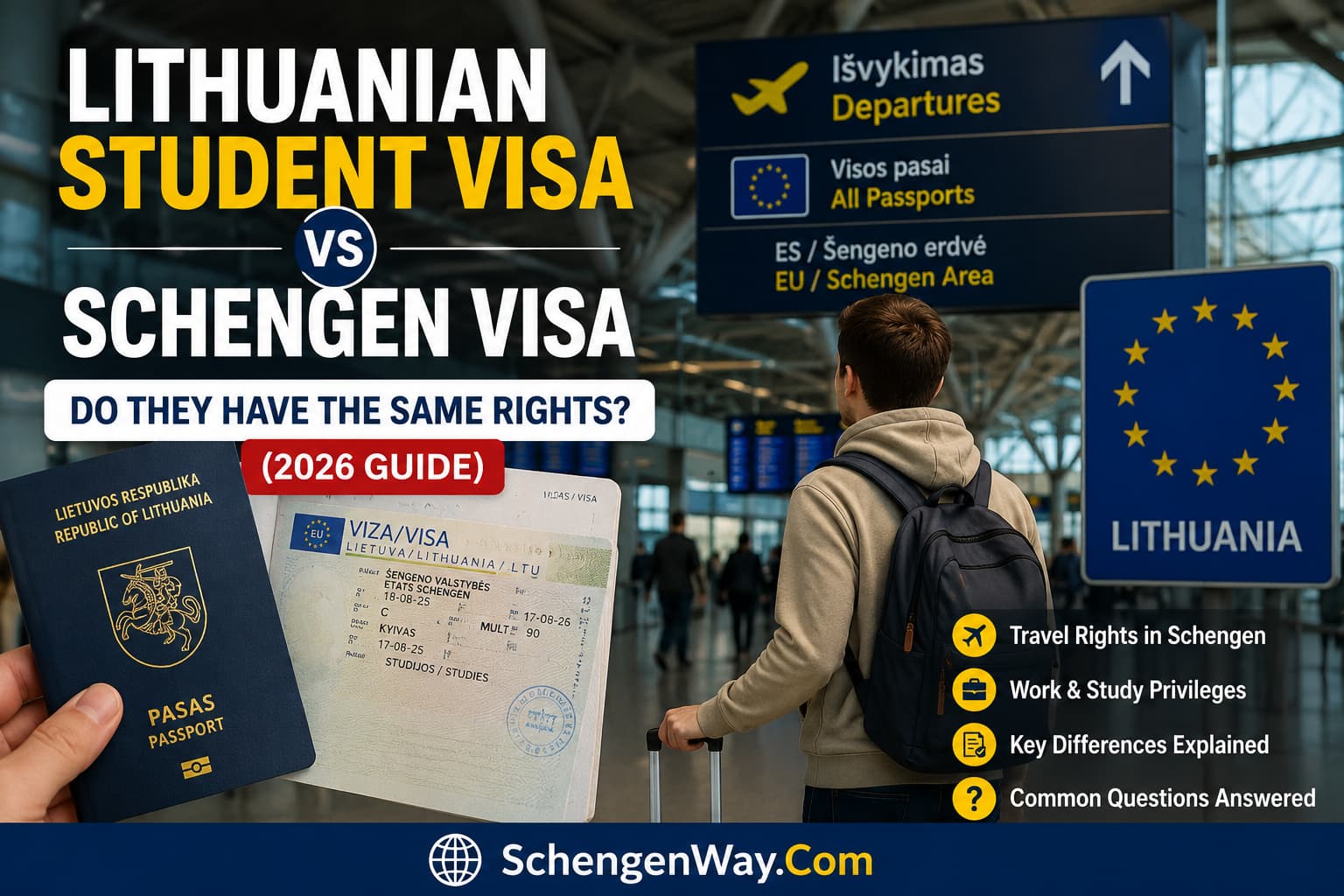
This question comes up more than you might expect — and the confusion behind it is completely understandable. You have a Lithuanian student visa. As you already know through our previous post that Lithuania is in the Schengen Area. And the Schengen countries are connected. So looking at this logically, it feels like the rights should be equivalent. Well, they are not — and the gap between what students assume and what the rules actually allow has caused real problems for people I have worked with.
Now, let’s answer the question before we go any deeper: a Lithuanian student visa and a Lithuanian Schengen short-stay visa are two fundamentally different documents with different legal foundations, different durations, different travel permissions, and different rights. They share the fact that Lithuania issued them. Beyond that, they are not interchangeable.
Let me walk you through exactly what each one means and where the differences bite.
What Is a Lithuanian Student Visa — and What Is It Not?
When a non-EU student is accepted into a Lithuanian university or college for a program lasting more than 90 days, they need something beyond a standard Schengen short-stay visa. They need a national long-term visa — specifically a Type D visa — and in most cases, this is followed by a Temporary Residence Permit once they are inside the country.
If you are enrolled in a higher educational institution, you can obtain either a national long-term visa or a temporary residence permit. A national long-term visa allows you to enter the country for the purpose of studies and stay in the country for up to one year. For the first year of studies, students usually apply for the national long-term visa and apply for a residence permit for the second and subsequent years while legally in the country.
If you are a non-EU citizen hoping to study in Lithuania for more than 90 days, you will need to apply for a student visa — Visa D — and a temporary residence permit.
So the process looks like this in practice: you get accepted to Vilnius University or Kaunas University of Technology, you apply for a Type D national visa from outside Lithuania, you arrive, and then within your first year you apply for the Temporary Residence Permit — often called a TRP — which becomes your actual legal basis for staying beyond that first year.
A Lithuanian Visa D typically costs €120, with a residence permit costing an extra €120.
The important thing to understand is what type of document this is at its core. A Type D visa is a national visa — not a Schengen visa. It is issued by Lithuania, under Lithuanian national law, to allow you to reside in Lithuania for a specific purpose. The Schengen short-stay visa — the Type C that tourists and business visitors use — is an entirely different instrument issued under EU-wide rules that govern short stays across the whole zone.
So What Does the Student Visa Actually Allow?
Let us go through the rights that come with a Lithuanian student visa and Temporary Residence Permit clearly and practically.
Duration of stay
This is where the student visa immediately distinguishes itself from the short-stay Schengen visa. Where a Schengen Type C visa limits you to 90 days within any 180-day period across the zone, your Lithuanian student authorization is tied to your studies — not a 90-day clock.
Most students are in long-term study programs that offer temporary residence permits for up to two years for bachelor’s and master’s students. The TRP is renewable as long as your studies continue. You are not watching a countdown every time you cross a border.
The right to stay in Lithuania
Your student visa and TRP give you the legal right to reside in Lithuania. That is their primary function. You are not a visitor passing through — you are a registered resident for the duration of your authorized studies.
Work rights
Students can work up to 20 hours per week during term time and full-time during holidays. There is no limit for doctoral students. No separate work permit is needed.
This is genuinely one of the more generous student work arrangements in the Schengen zone. Many countries require students to apply for a separate work authorization on top of their student status — Lithuania builds it in. If you are a doctoral candidate, you can work without any hourly restriction at all.
Post-study options
For post-study, a 12-month job search TRP is available. If you complete your studies and want to stay in Lithuania to find employment, there is a defined legal pathway for that — a one-year job-seeking residence permit that buys you time to transition from student to worker without having to immediately leave the country.
Related Articles:
- How to Apply for Schengen Student Visa in 2026
- How to Convert a Schengen Visa to a Work Permit (Real Facts)
Can I Travel to Other Schengen Countries With a Lithuanian Student Visa?
This is the question I get most often from student clients — and the answer has nuance that I always take time to explain carefully because getting it wrong leads to real problems.
The short answer is yes — but with specific conditions attached that are different from what a tourist Schengen visa allows.
A Lithuanian national long-term visa — the Type D — and a Lithuanian Temporary Residence Permit both allow travel within the Schengen Area. However, the rules governing that travel are not the same as the rules for a Type C short-stay Schengen visa. Proof of sufficient means of subsistence is required — at least budget €577 per month, plus €1,153 for the return to the state of origin.
The key limitation is this: your travel within Schengen on a national visa or residence permit is supposed to be incidental to your main purpose of being in Lithuania. You are authorized to reside in Lithuania — you can travel briefly to other Schengen countries, but you cannot use your Lithuanian student status as the basis for living or residing in another Schengen country.
What I usually explain to students is this: think of your Lithuanian TRP as a Lithuanian document first and a travel document second. It lets you leave Lithuania and visit Paris or Berlin for a weekend without needing to obtain a separate Schengen tourist visa. But it does not give you the right to relocate to Germany or France and set up your life there.
Can I Live in Another EU Country With a Lithuanian Student Visa?
No — and this is where the distinction between a national residence permit and an EU-wide status becomes critically important.
A Lithuanian TRP issued for study purposes gives you the right to reside in Lithuania. It does not give you the right to reside in Germany, France, or any other EU member state. EU residence rights under the EU Long-Term Residence Directive require a specific type of permit — typically acquired after five years of legal residence — which is separate from a student TRP and carries EU-wide mobility rights.
If you have a permit or visa for studies in an EU country and are covered by an EU or multilateral programme or an agreement between universities, you may carry out part of your studies and work in addition to your studies in Lithuania if you fulfil certain requirements.
The EU mobility program is also one significant exception you need to understand. If you are studying under EU programs, you may study or work for up to 360 days without new permits. If you are participating in an Erasmus+ exchange, a specific bilateral university agreement, or another recognized EU mobility program, you may be able to spend time studying or working in another EU country without obtaining a separate national visa for that country — for a defined period under those program terms.
This is genuinely useful for students enrolled in joint programs or exchange semesters. But it only applies under the specific framework of a recognized EU mobility program — not as a general right to relocate at will.
Let Me Paint A Real-Life Picture of How This Works
Let me paint a realistic picture of what happens in practice.
Let’s assume you are a Nigerian student at Vilnius University. You have a valid Lithuanian Temporary Residence Permit. Your friend in Berlin invites you for a long weekend. Then you book a flight, pack a bag, and fly from Vilnius to Berlin.
At Vilnius airport, you go through the EES exit procedure — your biometrics are logged, your departure from Lithuania is recorded in the Schengen database. You land in Berlin, go through the internal Schengen arrival check, and present your Nigerian passport with your Lithuanian TRP. A German border officer sees a non-EU passport with a Lithuanian residence permit. They may ask the purpose of your visit, how long you are staying, and confirm that your TRP is valid. You answer clearly that you are a student based in Lithuania visiting for a weekend – and you are waved through.
That is the normal, unremarkable version of this scenario when everything is in order.
Now the version where things go wrong. You decide to extend that Berlin weekend into three weeks. You visit a few cities, stay with various friends, and enjoy Germany in a way that starts looking less like a visitor and more like a resident. When you eventually return to Lithuania, there is a flag in the EES system showing an extended absence from your registered country of residence. Lithuania’s Migration Department notices a prolonged departure that was not notified. Your TRP renewal gets complicated.
The difference between those two scenarios is not the border crossing. It is the duration and the intent. Your Lithuanian TRP is a Lithuanian document. Treating it as a general Schengen residency pass leads to exactly the kind of problem that is both avoidable and genuinely disruptive to your studies.
What Happens If I Overstay My Student Visa?
This is a serious question and I want to answer it directly because I have seen people underestimate the consequences.
If your Lithuanian national visa expires before you receive your TRP, or if your TRP lapses and you continue residing in Lithuania, you are in irregular status. Lithuania has recently tightened its immigration policies, and stricter rules are making it harder for those who fall out of status. Overstaying your authorized period — even by a few days — can result in a formal removal order, a re-entry ban, and serious complications for any future visa or permit application anywhere in the Schengen zone.
The EES system, now fully operational since April 2026, records every entry and exit from Schengen territory digitally. The manual passport stamp era — where an overstay might slip through an inconsistent recording system — is over. If you overstay your Lithuanian student authorization and later attempt to cross any Schengen border, the discrepancy between your authorized period and your actual departure date is visible immediately.
Notify the Migration Department of any changes — address, studies — within seven days. If your circumstances change — you transfer to a different university, you take a leave of absence, your program ends earlier than expected — you are legally required to notify the Lithuanian Migration Department promptly. These notification requirements are taken seriously and ignoring them creates compliance problems that are far easier to prevent than to resolve.
Related article>> Validity of Schengen Visa Explained: How Long You Can Stay and What Happens If You Overstay
Can I Convert a Student Visa to a Work Visa?
Yes — Lithuania provides a defined pathway for this, though it requires planning and does not happen automatically.
For post-study, a 12-month job search TRP is available. When you complete your degree, you can apply for this post-study residence permit which gives you 12 months to find employment without having to leave Lithuania. Once you secure a job offer, you apply for a work-based TRP to transition your residence status from student to worker.
Switching from a study permit to a work permit is possible but tighter rules mean students and migrants may face more challenges as Lithuania implements stricter migration policies alongside ETIAS preparation.
The practical advice here is to start thinking about this transition well before your studies end — not in the final month. The 12-month job search window is genuinely useful but it requires an active application before your student TRP expires, and the migration department’s processing times mean you need to plan ahead.
For information on this, check out How to Convert a Schengen Visa to a Work Permit (Real Facts)
Do I Still Need a Schengen Visa If I Have a Residence Permit?
If you hold a valid Lithuanian Temporary Residence Permit, you do not need a separate Schengen short-stay visa to travel to other Schengen countries for short visits. Your residence permit functions as the authorization for your travel within the zone — you present your passport alongside your TRP card at any Schengen internal border and the combination covers your movement.
However — and this matters — your TRP must be valid. An expired residence permit, even by a single day, means you no longer have the legal status that justified your presence in Lithuania and your travel within Schengen. So, try to always check the expiry date on your TRP card well in advance and begin the renewal process early enough to ensure there is no gap in your authorized status.
What you always need to carry when traveling within Schengen as a Lithuanian student:
- Your valid passport — the original, not a copy
- Your valid Lithuanian TRP card
- Your student enrollment confirmation — not always asked for but useful to have if an officer wants to understand the basis of your Lithuanian residence
- Proof of financial means — ideally a bank statement showing you have funds to support your visit to the country you are entering
That combination covers you for routine intra-Schengen travel without any issues.
What Happens at Border Checks With a Student Visa?
Most of the time, crossing a Schengen internal border as a Lithuanian student is uneventful. You present your passport and TRP card, the officer checks them against the system, and you proceed. The EES logs your crossing digitally rather than stamping your passport.
Where it gets complicated is when something raises a question. An expired TRP is the most common trigger. A long pattern of absences from Lithuania recorded in the EES is another. An officer who sees a student residence permit but notices you have been outside Lithuania for six of the last eight weeks may ask questions about the nature of your stay and whether you are maintaining your study obligations.
The best way to handle any such check is calmly and clearly. Know your facts — your program, your university, your return date to Lithuania — and have your documents organized and accessible. Officers conducting these checks are doing their job, not targeting students specifically. If your status is compliant, a clear, straightforward explanation resolves the situation quickly.
What I Always Tell My Student Clients
The students who navigate Lithuanian immigration smoothly are not necessarily the ones with the most complex programs or the strongest academic profiles. They are the ones who understand their legal status clearly, stay on top of renewal deadlines, and treat their TRP as the serious legal document it is rather than an administrative formality.
The Lithuanian student visa and residence permit system is genuinely one of the more practical in the EU. Students can work up to 20 hours per week during term time, there is no separate work permit needed, and a 12-month post-study job search permit is available. These are real advantages that many other European countries do not offer as cleanly.
But the travel rights are bounded. Your TRP gives you the right to reside in Lithuania and move within Schengen for short visits. It does not give you the right to relocate to another EU country, work in Germany on your Lithuanian student status, or ignore the notification requirements when your circumstances change.
Before any intra-Schengen trip from Lithuania, check your TRP expiry date. Carry your passport and TRP card together. Know how many days you have spent outside Lithuania in the current period. And if you are combining travel with studies across multiple EU countries under any kind of program agreement, read the specific terms of that program carefully rather than assuming general rights apply.
For the broader picture of how to apply for a Lithuanian Schengen visa in the first place, and what to expect from the Lithuanian consulate process, our complete Lithuanian Schengen visa guide covers everything from document requirements to processing times in detail.
If you are traveling within Schengen and want to track your day count accurately — especially important if you are making multiple trips outside Lithuania during your studies — use our Schengen 90/180-Day Rule Calculator before each trip. It takes two minutes and keeps you on the right side of the rules.
And if anything about your specific student visa situation is unclear — your TRP renewal, your travel rights, or your transition options after graduation — drop your question in the comment section, and we will point you in the right direction.

